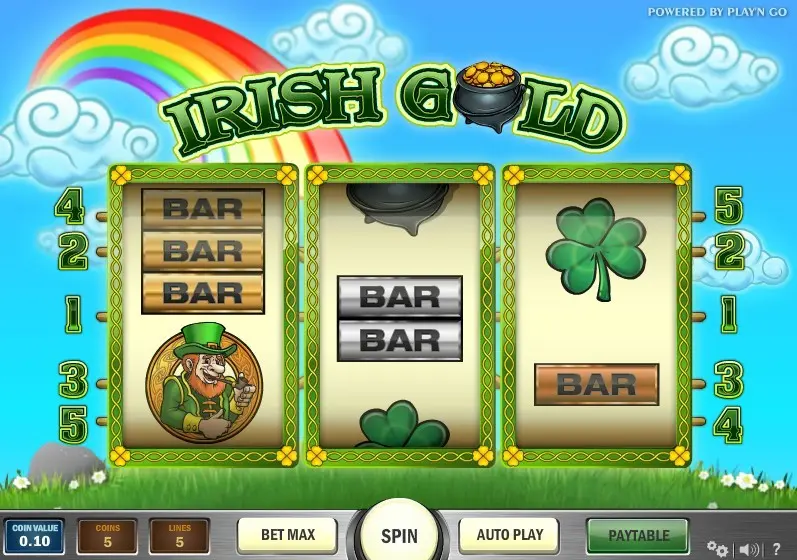
Irish Gold is a three-reel slot from Play’n GO with a published RTP of 95%. That figure is lower than the studio’s own average and lower than the average slot we track, which is the single most useful fact for deciding whether to spend time here.
The counterweight is availability: a free demo exists, so you can see the reels turn without staking anything. If you want a stripped-back three-reel format and you are playing for entertainment rather than chasing a return figure, the numbers below tell you what you are giving up.
Irish Gold slot versus the average slot
Across the games in our database, the average return to player is 95.71%. This one publishes 95.0%, which puts it 0.71 percentage points below that average. Small-sounding gaps like this are worth translating into money.
Over £1,000 of total wagering, a 95.71% game returns roughly £957 across a very large sample, while a 95% game returns roughly £950. The £7 difference looks trivial on a single session, and on a single session it is: short-run results are dominated by variance, not by the RTP figure. Wager £100,000 across a year of casual play and the same gap becomes about £710. That is the honest way to read a decimal point.
None of this tells you what will happen on your next spin. RTP is a long-run average calculated over millions of simulated rounds, not a schedule. Every spin is independent of the one before it, so a below-average game can hand you a good session and an above-average game can drain a balance quickly.
| Provider | Play’n GO |
|---|---|
| RTP | 95.0% |
| Reels | 3 |
| Theme | Irish |
| Free demo | Yes |
RTP breakdown: 95.0% in context
A 95.0% RTP means the game is modelled to return £95 for every £100 wagered across a sample far larger than any individual will ever play. The remaining £5 is the house edge. That edge is fixed by the game’s maths and nothing you do at the controls changes it.
Some practical framing. At £0.50 per spin, 500 spins puts £250 through the game. The modelled return on that is £237.50, an expected cost of about £12.50 for the session. Real sessions rarely land on the expectation. You might finish well up or lose the whole £250, because a three-reel game’s outcome distribution is wide relative to the number of spins most people play.
Play’n GO has not published a hit frequency, a maximum win figure or a bonus structure for this title in the data available here, so treat any such numbers you see quoted elsewhere with scepticism until the studio confirms them. Many slots list a max win as a multiple of stake; without that number, the 95% RTP and the three-reel format are what you have to work with.
Volatility profile
No volatility rating is published for this game, so the honest answer is that its risk profile is unrated rather than low or high. That absence matters, because volatility affects your session more directly than RTP does.
Low volatility generally means frequent small returns, a bankroll that drains slowly, and long sessions with modest swings. High volatility means long dry stretches punctuated by larger returns, and it demands a bigger bankroll to survive the gaps. Two games with identical RTP can feel completely different depending on where they sit on that scale.
Three-reel formats vary. Some are built around frequent small combinations; others concentrate their return into rare top-line hits. Without a published rating you cannot know which pattern applies here, and the free demo is the practical way to find out. Play a few hundred demo spins and watch how often the balance moves and by how much. Note that a demo run is a small sample and tells you about tendency, not certainty. It also cannot forecast what a real-money session will do, because the results are independent either way.
Play’n GO as a studio
Play’n GO has 434 games in our database with an average RTP of 95.8%. Irish Gold sits 0.8 points under its own studio’s average, so this is not a representative sample of what the developer typically ships.
The spread within their catalogue is wide, which is the useful point. Legacy of Dead publishes 96.58%, more than a point and a half above this game, and it is the obvious stop if the return figure is what is driving your choice. Divine Divas sits at 96.25%, also comfortably ahead. At the other end, Book of Dead publishes 94.25%, lower than Irish Gold despite being one of the studio’s best-known titles, which shows that name recognition and return figures are unrelated.
With 434 titles from one developer, you have room to be selective. If you like how a studio builds games, you can usually find the same style at a better published rate elsewhere in their range.
Three Irish alternatives worth comparing
There are 391 games sharing this theme in our database, and several publish materially better return figures. Leprechaun Wish leads at 97.2%, which is 2.2 points ahead. Over £1,000 wagered that difference is about £22 in modelled return, and it grows in proportion to how much you play.
Gold Party publishes 96.5% and Pop O Gold publishes 96.0%. Both clear the 95.71% database average that Irish Gold falls short of.
What none of these comparisons tell you is how the games feel to play. Reel count, pace and volatility all shape a session, and a three-reel machine is a different experience from a modern grid-based game regardless of the percentages involved. Use RTP to narrow a shortlist, then use free demos to pick from it.
Getting the most out of the free demo
The demo runs on virtual credits with the same maths as the real-money version, so it is the cheapest way to learn a game’s rhythm. Play a meaningful number of spins rather than a dozen. Watch how quickly the balance moves, how long the flat stretches run, and whether the pace suits you.
What a demo cannot do is predict real-money outcomes. Every spin is independent, so a good demo run carries no information about what follows when real stakes are involved.
Slots are 18+ and are paid entertainment, not income. Decide what a session is worth to you before you start, treat that amount as the cost of the entertainment, and stop when it is gone. No stake pattern, spin timing or betting progression changes the house edge, because the maths is identical on every round.
Should you play Irish Gold?
If you specifically want a three-reel Irish-themed game from Play’n GO and you accept 95% as the cost of that, this does the job and the free demo lets you try it at no cost. That is a narrow but real case.
If the return figure matters to you, the case is weaker. It trails the 95.71% database average, trails Play’n GO’s own 95.8% average, and trails every game listed in the theme comparison above. Leprechaun Wish at 97.2% delivers the same theme at a better rate.
The wider caveat is missing information. No volatility rating, no max win and no published hit frequency mean you cannot assess the risk profile from the data sheet alone. The demo fills part of that gap; it does not fill all of it.
More from Play'n GO
- Moon Princess Origins — 96.2% RTP
- Book of Dead — 94.25% RTP
- Rise of Olympus — 96.0% RTP
- Reactoonz — 96.51% RTP
- Moon Princess — 96.0% RTP
- Legacy of Dead — 96.58% RTP
- Divine Divas — 96.25% RTP
- Rich Wilde and the Tome of Madness — 96.59% RTP
Frequently Asked Questions
Can I play Irish Gold for free?
A free demo of this game is available, running on virtual credits with the same underlying maths as the real-money version. That makes it the cheapest way to judge the three-reel pace and see how often the balance moves before deciding whether the 95% RTP is a trade you want to make.
What is the RTP of Irish Gold and is it good?
The published RTP is 95.0%, meaning a modelled return of £95 per £100 wagered across a very large sample. It is below average: our database averages 95.71% and Play'n GO's own catalogue averages 95.8%. On a single session variance dominates, but over sustained play that gap costs you.
How volatile is Irish Gold?
No volatility rating has been published for this title, so its risk profile is unrated rather than confirmed low or high. That absence matters because volatility shapes session length and swing size more directly than RTP does. Several hundred demo spins will show you how often returns land and how large they are.
Who makes Irish Gold and what else do they produce?
Play'n GO developed it, and we track 434 of their games with an average RTP of 95.8%. Their range spans Book of Dead at 94.25% up to Legacy of Dead at 96.58%, so published return figures vary widely across the catalogue even within one studio.
How does Irish Gold compare to Leprechaun Wish?
Leprechaun Wish publishes 97.2% against 95.0% here, a 2.2 point advantage that works out to roughly £22 more in modelled return per £1,000 wagered. Both sit in a theme covering 391 games in our database. RTP favours Leprechaun Wish clearly; the reel format and pace are separate questions to test in the demos.