Fu Dao Le returns 96.0% of wagered money across a very large sample, which puts it slightly ahead of the 95.71% average across the games catalogued here and just above the 95.88% average across Bally’s Corporation’s eleven titles. That is the one hard number worth building a decision on. Almost everything else about this machine — volatility rating, max win multiplier, hit frequency, bonus mechanics — is not published, so anyone quoting those figures elsewhere is guessing.
Is Fu Dao Le worth playing?
If you want a five-reel Asian-themed game with an RTP marginally better than average and you are happy to learn the mechanics by playing rather than by reading a spec sheet, then yes — start with the free demo. If you need to know the volatility band, the maximum win or the bonus structure before you commit a bankroll, this fu dao le slot will frustrate you, because none of that data exists in the record.
The popularity signal is stronger than the documentation. Ranked 1,665, it sits in the 91.7th percentile of games covered here, meaning roughly nine in ten titles draw less attention. Popularity is not a quality measure and it says nothing about your results, but it does tell you the game gets played rather than ignored.
Bally’s Corporation is a small presence in this catalogue with eleven titles logged. Their average RTP of 95.88% is close to the wider corpus figure, so there is no house-wide pattern of unusually generous or unusually stingy returns to read into. Fu Dao Le is a fraction above their own average, by 0.12 percentage points, which is a difference too small to matter over any session you will actually play.
| Provider | Bally’s Corporation |
|---|---|
| RTP | 96.0% |
| Reels | 5 |
| Theme | Asian |
| Free demo | Yes |
What 96.0% RTP means over 1,000 spins
RTP is a long-run statistical average, not a promise about your next hour. At 96.0%, the game returns £96 for every £100 staked across a sample large enough for the mathematics to settle — think millions of spins, not thousands. The remaining 4% is the house edge.
Run 1,000 spins at £0.50 and you have staked £500. The mathematical expectation is £480 returned, a £20 average loss. That is the centre of a very wide distribution. Real 1,000-spin sessions land all over the place: some finish well up, plenty finish down more than £20, and the spread depends entirely on how the game distributes its payouts — which is the volatility question, and it is unanswered here.
Two things follow. First, every spin is independent. The reels have no memory of the last result, so a long dry run does not build up anything owed to you, and a good run does not have to be paid back. Second, 1,000 spins is nowhere near enough for 96.0% to assert itself. Treat the figure as a way of comparing games on the shelf, not as a forecast of your afternoon.
For context, 96.0% is 0.29 percentage points above the corpus average. Over £500 staked, that edge is worth about £1.45 in expectation. It is a real advantage and it is also almost invisible inside normal session variance.
How volatile is Fu Dao Le?
Bally’s Corporation has not published a volatility rating for this game, so anyone telling you it is high, medium or low is inventing it. That absence matters more than most missing fields, because volatility shapes what a session actually feels like far more than RTP does.
Here is why. Two games can both return 96.0% and behave nothing alike. A low-volatility design pays small amounts often, so your balance drifts down gently with frequent small recoveries, and a modest bankroll lasts a long time. A high-volatility design pays rarely and larger, so the same 96.0% arrives in occasional bursts separated by long stretches of nothing, and a bankroll that would comfortably survive the low-volatility game can empty in twenty minutes.
Without the rating, the demo is your measuring instrument. Play a few hundred demo spins and watch two things: how often any win lands at all, and how big the biggest win is relative to your stake. Frequent small returns point towards the low-to-medium end. Long gaps punctuated by the occasional larger hit point towards the high end. This tells you about the game’s shape, not about your future results — demo outcomes carry no predictive weight for real-money play, and the sample is far too small for the RTP to show through either way.
What the Asian theme brings to the game
The theme is logged as Asian, across five reels, in a catalogue where 1,455 other games share that label. It is one of the most crowded themes in slots, which cuts both ways for you as a player.
The upside is choice. If the presentation does not land for you, there are well over a thousand alternatives with similar visual territory and a range of published RTPs, several of them better documented than this one. You are never stuck.
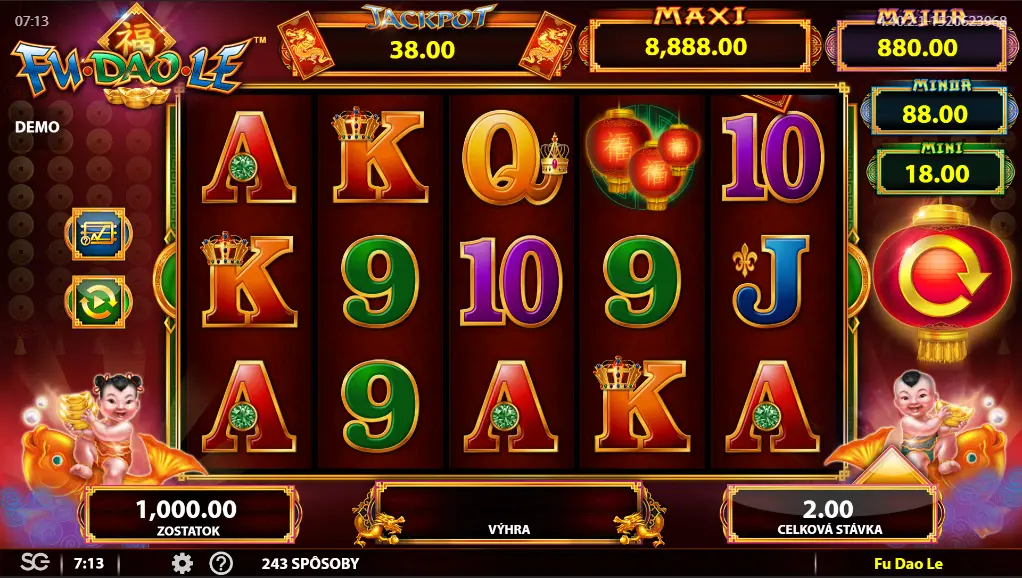
The downside is that the theme label tells you almost nothing useful. Beyond the general association with Chinese-influenced iconography and prosperity motifs that the category implies, the specific symbols, animations and soundtrack are not documented here, and inventing them would not help you decide anything. What is documented is the five-reel format, which is the standard modern layout. The number of paylines or ways is not listed, so the demo is where you find out how wins are actually formed.
Themes are a browsing filter, not a value signal. A prosperity theme has no bearing on the maths; the 4% house edge is identical whether the reels show gold ingots or fruit.
Stakes, session length and bankroll
The stake range is not published for this title, so you will see the minimum and maximum bet only when you open the game. That is a small inconvenience, and the demo resolves it in seconds at no cost.
The planning maths works the same whatever the range turns out to be. Decide your session budget first, then divide it by the number of spins you want. A £40 budget spread over 400 spins means £0.10 per spin. Halve the stake and you roughly double the spins; double the stake and you roughly halve them. At 96.0% RTP the expected cost of 400 spins at £0.10 is about £1.60, but variance means the actual figure will rarely land near it.
Set the budget before you start and treat it as spent. Stake sizing changes how long your money lasts and how large the swings feel; it does not change the house edge. There is no stake pattern, timing or progression that improves expected value, because each spin is independent of every spin before it.
Alternatives if Fu Dao Le is not for you
If the missing volatility and max win data bother you, the same Asian theme offers better-documented options with higher published returns. Wong Choy lists 96.74% RTP, three-quarters of a percentage point better than Fu Dao Le, and Mystic Fortune Deluxe is close behind at 96.71%. Over £500 staked, that gap is worth roughly £3.70 in expectation — small, but it is free to take.
Staying with Bally’s Corporation, Michael Jackson sits at 96.01%, statistically indistinguishable from this game, so pick between them on presentation rather than percentages. Dragon Spin is marginally lower at 95.94% and keeps the same broad thematic territory if that is what you came for.
None of these comparisons account for volatility, because that field is missing across most of the set. Two games separated by 0.05 percentage points of RTP can produce completely different session experiences. Try the demos side by side before committing money to any of them.
Final take
Fu Dao Le is a reasonable, under-documented five-reel game with a marginally above-average 96.0% RTP and a free demo, which is exactly the right way to try something whose volatility and maximum win are unknown. It will not disappoint anyone who goes in expecting a straightforward Asian-themed machine. It will frustrate anyone who wants the full spec sheet first.
The honest summary: the one number you can rely on is 96.0%, and it is 0.29 points better than the catalogue average. Everything else you learn by playing.
Slots are paid entertainment, not income. This is an 18+ activity — decide what the session is worth to you before you open the game, stake only that, and stop when it is gone. If tracking a budget stops feeling straightforward, that is the point to step away and look at the support options your operator lists.
Frequently Asked Questions
Can you play Fu Dao Le for free?
A free demo of Fu Dao Le is available, so you can spin it without staking money. That is particularly useful here because Bally's Corporation has not published the volatility rating, paylines or stake range, and the demo is the only way to see those for yourself. Demo results carry no predictive value for real-money play.
What is the RTP of Fu Dao Le?
The published RTP is 96.0%, meaning the game returns £96 per £100 wagered across a very large sample. That sits 0.29 percentage points above the 95.71% average across this catalogue and just above the 95.88% average for Bally's Corporation's eleven titles. Over 1,000 spins the figure has almost no predictive power.
Is Fu Dao Le high or low volatility?
No volatility rating has been published for Fu Dao Le, so treat any high, medium or low claim you see elsewhere as unverified. Volatility affects session length and swing size more than RTP does, so it is worth measuring yourself in the demo: watch how often wins land and how large the biggest one gets.
Who makes Fu Dao Le?
Bally's Corporation developed it. They are a smaller presence in this catalogue with eleven games logged, averaging 95.88% RTP, which is close to the wider 95.71% average. Their other titles here include Michael Jackson at 96.01%, Dragon Spin at 95.94%, and Rocket Returns, for which no RTP figure has been published.
How does Fu Dao Le compare to Wong Choy?
Wong Choy publishes a higher RTP at 96.74% against 96.0% for Fu Dao Le, a gap worth roughly £3.70 in expectation across £500 staked. Both share the Asian theme. Neither has a published volatility rating, though, so the two could feel very different in practice despite the small RTP difference.