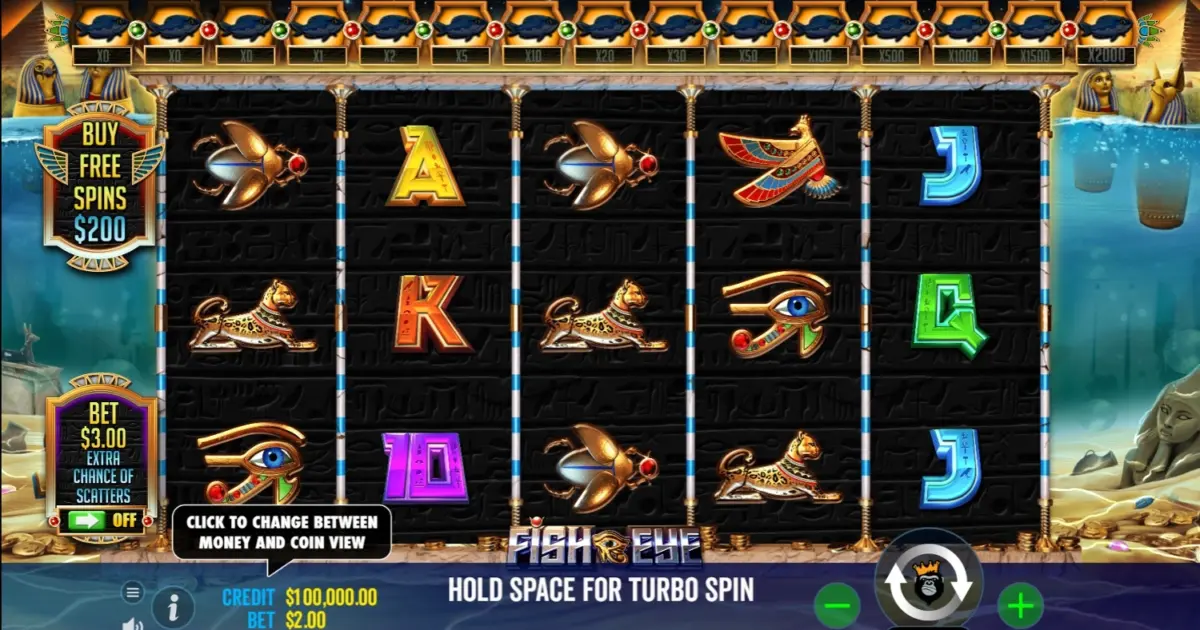
The single number that should shape your decision on the Fish Eye slot is 95.07%. That is the published return to player, and it sits below the average of the slots catalogue by 0.64 percentage points. A free demo is available, so you can look at the reels without staking anything. If you care about squeezing the best long-run return out of your budget, Pragmatic Play has titles with materially better published figures, and they are linked further down.
| Detail | Value |
|---|---|
| Provider | Pragmatic Play |
| RTP | 95.07% |
| Reels | 5 |
| Primary theme | Egypt |
| Type | Slot Machine |
| Popularity rank | 2,420 (87.9th percentile) |
| Free demo | Available |
Fish Eye slot versus the average slot
Across the games catalogued here, the average published RTP is 95.71%. This title returns 95.07%, so it gives back 0.64 percentage points less than the typical release. In cash terms over a large sample, that gap is 64p for every £100 wagered. Stake £2 a spin for 500 spins and you have wagered £1,000; the difference between 95.07% and the corpus average is about £6.40 of expected return on that volume.
That is not a dramatic gap, and it will be invisible over a short session. Variance dominates anything you experience in an hour of play. The gap matters if you play the same game regularly over months, because the edge compounds with wagered volume rather than with time.
Ranked 2,420 by popularity, it sits in the 87.9th percentile, so it gets played more than most of the catalogue. Popularity tells you about visibility and familiarity, not about return. Plenty of well-known games carry below-average RTP figures, and this is one of them.
RTP breakdown: 95.07% in context
RTP is a long-run statistical average calculated over millions of simulated spins, not a promise about your session. At 95.07%, the theoretical return is £95.07 for every £100 wagered, with the remaining £4.93 being the house margin. Your actual result on any given day can land far above or far below that line.
The sample size needed for observed return to converge on theoretical return is much larger than most people play. A few thousand spins is still statistically small. Over 1,000 spins at £0.50, you would wager £500, and the expected shortfall is roughly £24.65 — but the realistic range of outcomes around that figure is wide in both directions.
Two things follow. First, every spin is independent: previous results carry no information about the next one, and no stake pattern or timing changes the expected value of a single spin. Second, RTP is only useful as a comparison tool. Used that way, 95.07% is the honest answer to “is this a generous game?” — it is slightly below market average.
Volatility profile
Pragmatic Play has not published a volatility rating for this title in the data available here, so there is no verified figure to report. Treat any volatility label you see quoted elsewhere as unsourced unless the studio states it.
What the concept means is worth knowing anyway. Low-volatility slots pay small amounts often, which keeps balances moving and sessions long but caps the size of swings. High-volatility slots pay rarely and larger, which means long stretches with nothing back followed by occasional sharp upswings. Medium sits between the two. Volatility does not change RTP; it changes how the same return is distributed across spins.
Practically, this affects bankroll planning more than anything else. A higher-volatility game needs a larger buffer relative to your stake to survive dry spells without your balance emptying early. Since the rating here is unknown, the safe approach is to assume swings could be substantial and size stakes conservatively until the demo shows you how the balance actually behaves.
Pragmatic Play as a studio
Pragmatic Play is one of the largest slot suppliers in the market, with 739 titles catalogued here. The studio’s average published RTP across those games is 96.32%, which makes this release 1.25 percentage points below its own house standard — a bigger gap than its shortfall against the wider market.
That matters because it shows the studio is capable of better, and routinely does better. If you like the developer’s build quality and want a higher published return, Gates of Olympus is listed at 96.5%, and Sweet Bonanza at 96.51%. Both are from the same studio, so the interface conventions and stake controls will feel familiar.
The 1.44-point difference between 95.07% and 96.51% is worth about £14.40 per £1,000 wagered in expected return. Over a single session that is noise; over a year of regular play on the same title it is real money. If you are choosing purely on maths, the comparison is straightforward.
Three Egypt alternatives worth comparing
Egypt is one of the most crowded themes in the market, with 908 games catalogued under it. That gives you genuine choice if the setting appeals but the return figure does not.
Book of the Sun is published at 96.23%, more than a full percentage point above this title and above the corpus average too. On a £1,000 wagered volume, that difference is roughly £11.60 in expected return.
At the other end, Book of Dead is listed at 94.25% — lower again, and a reminder that a famous name does not guarantee a better figure. It is the best-known Egypt title in the catalogue, but on published RTP alone it is the weaker option of the three.
Comparing published RTP is the only like-for-like measure available across these games. Beyond that, the differences come down to mechanics and presentation, which is exactly what a free demo lets you judge for yourself without staking anything.
Getting the most out of the free demo
The Fish Eye free demo runs on play-money credits, so you can work through a few hundred spins and see how the game paces itself. Use it for the things numbers cannot tell you: how fast the reels resolve, whether the stake controls suit you, how the balance moves over a stretch of spins.
One caution on interpretation. A demo run is a small sample, and a good or bad stretch in play money tells you nothing about what real-money play would do next. Demo results do not predict real results. The RTP figure is the reliable guide; your demo session is not.
If you do move to real stakes: this is 18+ entertainment. Decide the amount you are willing to spend before you start, treat it as the cost of the entertainment rather than an investment, and stop when that amount is gone. A 95.07% RTP means the expected direction over time is downward, which is true of every slot.
Should you play Fish Eye?
Play it if you want to look at a Pragmatic Play Egypt release and the 95.07% figure does not bother you. Skip it if return is your main filter, because both the studio average of 96.32% and the market average of 95.71% are higher, and better-returning alternatives are a click away in the same theme and from the same developer.
The honest summary: nothing in the published data makes this stand out, and the one hard number available places it below average. Its 87.9th-percentile popularity means plenty of people play it regardless, which is fine — familiarity and feel are legitimate reasons to pick a game. Just make the choice knowing the maths, and use the demo first.
More from Pragmatic Play
- Fire Strike — 96.5% RTP
- Bigger Bass Blizzard: Christmas Catch — 96.01% RTP
- Hot to Burn — 96.71% RTP
- Joker’s Jewels Dice — 96.5% RTP
- Cosmic Cash — 96.55% RTP
- Big Bass Hold and Spinner Megaways — 96.7% RTP
- Lucky Ox — 96.55% RTP
- Gates of Olympus 1000 — 96.5% RTP
Frequently Asked Questions
Can you play Fish Eye for free?
A free demo is available for this title, running on play-money credits rather than real stakes. That lets you see the five-reel layout, the stake controls and the general pace of play before committing anything. Bear in mind that demo sessions are small samples and cannot indicate what real-money play would return.
What is the RTP of Fish Eye?
The published return to player is 95.07%, meaning a theoretical return of £95.07 per £100 wagered across a very large sample. That sits 0.64 percentage points below the catalogue average of 95.71% and 1.25 points below Pragmatic Play's own average of 96.32%. Short sessions will deviate widely from that figure.
How volatile is Fish Eye?
No volatility rating has been published for this title in the available data, so there is no verified figure to quote. Volatility affects how the 95.07% return is distributed — frequent small returns versus rare larger ones — without changing the return itself. Until it is confirmed, plan your bankroll assuming swings could be significant.
Who makes Fish Eye and what else do they produce?
Pragmatic Play, one of the larger suppliers in the market with 739 titles catalogued here at an average published RTP of 96.32%. Their better-known releases include Gates of Olympus and Sweet Bonanza, both listed at around 96.5%, which is well above this game's 95.07% figure.
Is Fish Eye better than Book of Dead?
On published RTP, yes — 95.07% against 94.25% for Book of Dead, a gap of 0.82 percentage points, or about £8.20 per £1,000 wagered in expected return. Both sit below the 95.71% catalogue average, though. Within the same Egypt theme, Book of the Sun is published higher at 96.23%.