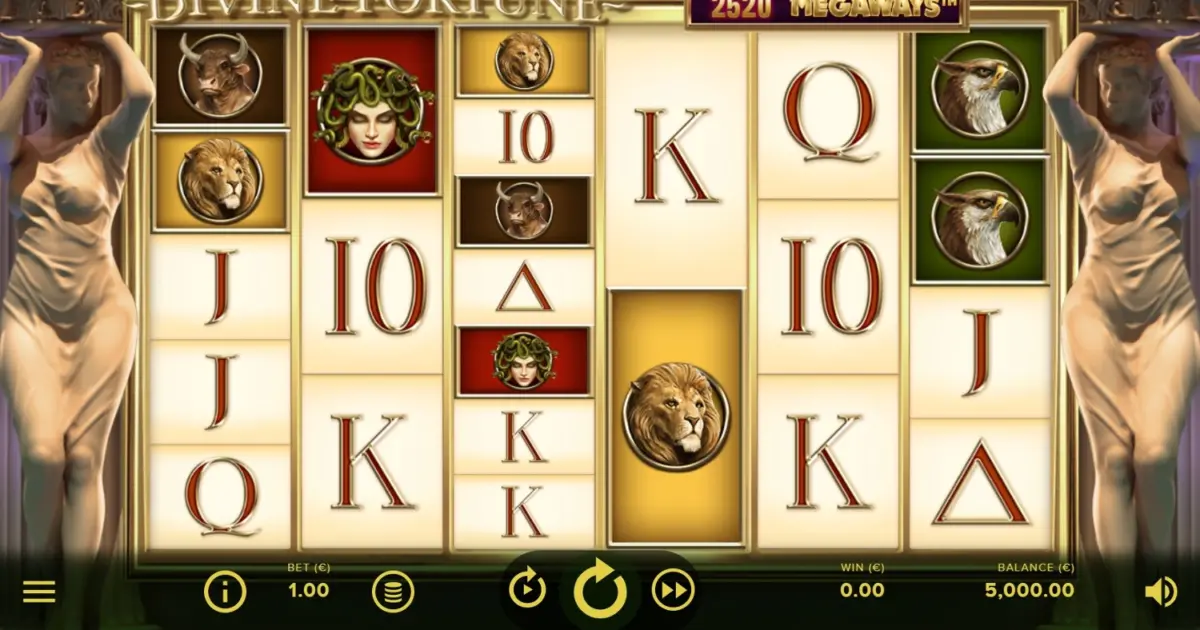
The number that matters most here is 96.09%. That is the theoretical return on Divine Fortune Megaways, and it sits 0.38 percentage points above the 95.71% average across the slots catalogued on this site. It is a six-reel NetEnt release using the Megaways mechanic, it ranks 1,544th by popularity — inside the top 8% of titles here — and a free demo is available, so you can check the pacing yourself without spending anything.
Divine Fortune Megaways versus the average slot
A 0.38 percentage point edge over the corpus average sounds trivial. Over a small sample it is. Across a long one it is real money. Wager £100 in £1 spins at 96.09% and the long-run expectation is £96.09 returned; at the 95.71% corpus average the same £100 returns £95.71. The gap is 38p per £100 staked.
Scale that up and the shape becomes clearer. Two thousand spins at £1 is £2,000 wagered. The theoretical difference between this game’s RTP and the average slot on this site is roughly £7.60 over that stretch. Meaningful if you play a lot of volume, invisible if you play a hundred spins on a Sunday afternoon.
What the figure does not do is tell you how any single session goes. RTP is an average computed over millions of spins, not a rate at which money comes back. A session can return 300% or nothing at all, and both outcomes are entirely consistent with a 96.09% game. Every spin is independent of the last, so nothing you observe in the first hundred spins tells you anything about the next hundred.
Treat the RTP as a ranking tool. It puts this title marginally ahead of the typical slot and lets you compare it against specific alternatives on a consistent basis. That is the whole of its usefulness at the point of choosing a game.
| Provider | NetEnt |
|---|---|
| RTP | 96.09% |
| Reels | 6 |
| Theme | Megaways |
| Free demo | Yes |
RTP breakdown: 96.09% in context
Break the figure down to the level of a real session. At £0.20 a spin, 500 spins is £100 wagered, with a theoretical return of £96.09 and a house edge of £3.91. At £2 a spin, the same 500 spins is £1,000 wagered and the expected cost rises to £39.10. The percentage never changes; the cash amount tracks your stake exactly.
That relationship is the single most useful thing to internalise. The house edge on this game is 3.91% of everything you wager, not 3.91% of your deposit. If you cycle a £50 balance through the game ten times over an evening, you have wagered £500, and the maths applies to £500.
Against NetEnt’s own catalogue, 96.09% is almost exactly typical. The studio’s 191 games here average 96.1%, so this title lands within a hundredth of a percentage point of the house standard. There is no premium or penalty attached to picking this one over the average NetEnt release.
One caveat worth carrying: some slots ship in multiple RTP configurations and the version a given operator deploys may not match the headline figure. FACTS lists a single figure of 96.09% for this game, so that is what is stated here. If you see a different number in a game’s own info panel, trust the panel — it reflects the build you are actually playing.
Volatility profile
No volatility rating is published in the data available for this game. That absence is worth stating plainly rather than papering over, because volatility affects your session far more directly than a fractional RTP difference does.
Here is the general mechanics, framed as mechanics rather than as claims about this title. Low volatility means frequent small returns, a balance that drifts down slowly, and long sessions from a modest bankroll. High volatility means long stretches with nothing, punctuated by occasional larger returns, and a bankroll requirement several times larger for the same number of spins. Two games can share an identical 96.09% RTP and deliver completely different experiences.
Megaways engines, as a class of mechanic, vary reel symbol counts from spin to spin, which produces a wide range of possible ways to win on any given spin. That structural variability tends to widen outcome distributions relative to a fixed-payline game. That is a statement about how variable-ways engines work in general, not a measured figure for this slot.
Since the rating is unpublished, the practical answer is to measure it yourself in the demo. Set a notional 200-spin budget, play it out at a fixed stake, and note how often you get a return at all and how deep the longest dry run goes. Do it twice. Two runs will not give you a statistically robust number, but they will tell you whether the rhythm suits your patience and your budget.
NetEnt as a studio
NetEnt has 191 titles catalogued here, averaging 96.1% RTP. That is a large, consistent library, and the consistency is the useful part: pick a NetEnt game more or less at random and you land close to 96%, which is a slightly better starting position than the 95.71% average across all providers on this site.
For comparison inside the same studio, Pirates Party is marginally higher at 96.17%, so if you are ranking purely on return it edges ahead. Starburst matches the studio average at 96.1% and is one of the most recognised slots NetEnt has released. Gonzo’s Quest sits at 96.0%, nine hundredths behind the game reviewed here.
The spread across those four titles is 0.17 percentage points — 17p per £100 wagered. At normal stakes and normal session lengths that difference is not what should decide your pick. Mechanic, pacing and whether you actually enjoy the game matter more, and those are things the demo answers and a spreadsheet does not.
Three Megaways alternatives worth comparing
There are 401 Megaways-themed titles catalogued here, and three are worth putting side by side with this one. Buffalo King Megaways leads on return at 96.52%, which is 0.43 points clear of Divine Fortune Megaways — the largest gap in this comparison set and worth about £4.30 per £1,000 wagered.
Great Rhino Megaways is close behind at 96.47%, and Apex Strike Megaways is nearly level with this game at 96.13%, a four-hundredths difference that is statistical noise at any realistic stake.
So on pure RTP, two of the three alternatives are ahead. That is useful context rather than a reason to skip this title. Volatility ratings are not published for these games either, and the underlying reel structures differ, which means the session experience can diverge sharply even at near-identical returns.
The sensible approach is to demo all four at the same stake for the same number of spins, then keep the one whose pacing you prefer. RTP separates them by fractions of a percent. How the game feels to play separates them by much more.
Getting the most out of the free demo
The demo exists to answer questions the numbers cannot. Play 200 spins at a fixed stake and pay attention to three things: how often a spin returns anything, how long the worst dry run stretches, and whether the pace holds your interest past the first ten minutes.
Compare against a benchmark. Run the same 200-spin test on Great Rhino Megaways and the difference in rhythm will be more informative than either RTP figure. Keep the stake identical across both runs or the comparison means nothing.
One limitation to respect: demo results do not predict real-money results. Short samples swing wildly in both directions, and a good or bad demo run carries no information about what happens next.
Slots are paid entertainment, not income. This game is 18+. Decide what an evening of it is worth to you before you start, treat that figure as the cost of the entertainment, and stop when it is gone. No stake pattern, spin timing or bet progression changes the 3.91% edge — the maths is identical on every spin regardless of what came before.
Should you play Divine Fortune Megaways?
It is a reasonable pick with an unremarkable profile. The 96.09% RTP is slightly above the 95.71% site average and effectively level with NetEnt’s own 96.1% house standard, so you are neither getting a bargain nor paying a premium.
Two of the three Megaways alternatives above return more — Buffalo King Megaways at 96.52% is the pick if RTP is your only criterion. The gap is £4.30 per £1,000 wagered, which matters at volume and not much otherwise.
The real unknown is volatility, which is unpublished. That is the variable most likely to determine whether you enjoy a session, and the only way to assess it is to play the demo. Start there, at a fixed stake, before any money is involved.
More from NetEnt
- Twin Spin Megaways — 96.04% RTP
- Starburst — 96.1% RTP
- Dead or Alive — 96.82% RTP
- Berryburst — 96.56% RTP
Frequently Asked Questions
Can I play Divine Fortune Megaways for free?
A free demo is available for this title, so you can spin it without a deposit or an account balance at risk. The demo runs on the same engine as the paid version, which makes it a fair way to judge pacing. It cannot pay out real money, and short demo runs tell you nothing about future real-money results.
What is the RTP of Divine Fortune Megaways?
The RTP is 96.09%, meaning a theoretical return of £96.09 for every £100 wagered across a very large sample. The house edge is 3.91% of total wagering, not of your deposit. That figure sits 0.38 points above the 95.71% average across slots catalogued here and within a hundredth of NetEnt's 96.1% studio average.
Is Divine Fortune Megaways high or low volatility?
No volatility rating is published in the data available, so any figure quoted elsewhere should be treated with caution. Volatility determines how often returns land and how deep the dry runs go, and it affects your session more than a fractional RTP difference. Test it yourself with a fixed 200-spin run in the demo.
Who is NetEnt and what else do they make?
NetEnt is the studio behind this title, with 191 games catalogued here averaging 96.1% RTP — a consistent library that sits above the 95.71% all-provider average. Other NetEnt slots include Pirates Party at 96.17%, Starburst at 96.1% and Gonzo's Quest at 96.0%, all within a fifth of a percentage point of each other.
How does it compare to Buffalo King Megaways?
Buffalo King Megaways returns 96.52% against 96.09% here, a 0.43 point advantage worth roughly £4.30 per £1,000 wagered. That makes it the stronger choice on return alone. Volatility is unpublished for both, and their reel structures differ, so session feel may vary considerably despite the small RTP gap. Demo both at the same stake.