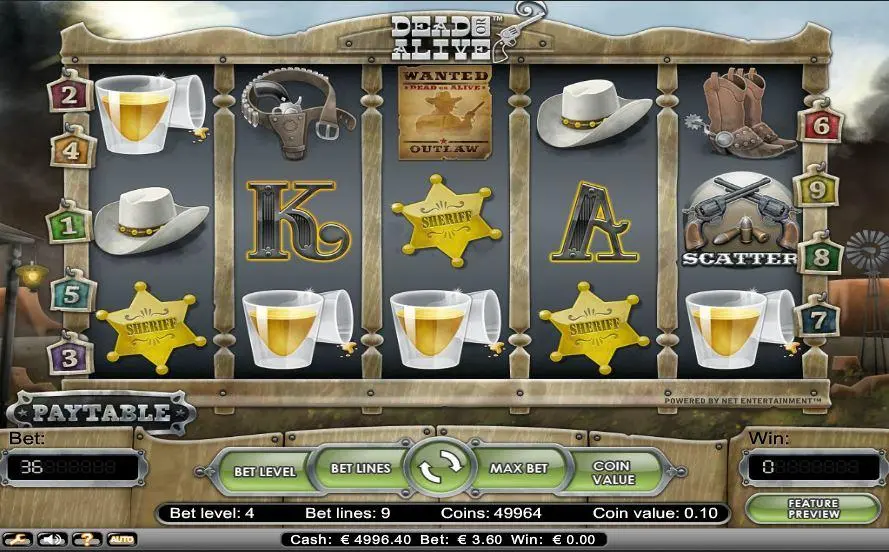
Dead or Alive slot sits in the top 11% of all tracked slots by play volume, reaching rank 1813 from a corpus of thousands. The 96.82% RTP figure is the first number worth your attention: it tells you this game returns £96.82 per £100 wagered when measured across millions of spins. That is 1.11 points above the 95.71% corpus average and 0.72 points above NetEnt’s own portfolio mean of 96.1%, making it one of the stronger statistical propositions in the provider’s 191-game catalogue.
NetEnt built this title around a Western outlaw theme, complete with Crime and American frontier aesthetics. The 5-reel layout is standard, but the RTP advantage and enduring popularity justify a closer look at what the maths actually deliver.
| Attribute | Value |
|---|---|
| RTP | 96.82% |
| Reels | 5 |
| Provider | NetEnt |
| Theme | Western |
| Popularity rank | 1813 (90.9th percentile) |
| Free demo | Yes |
First look at Dead or Alive
Dead or Alive operates on a 5-reel grid. NetEnt has not published payline data or “ways to win” figures for this title, so you cannot calculate hit frequency from the spec sheet alone. What you can verify is that the game sits comfortably above both the provider average and the broader market average for RTP, which implies the maths favour the player more than most alternatives.
The Western theme is built around Crime and American frontier iconography—saloons, outlaws, dusty towns. Whether that appeals is subjective; what matters for session planning is that the game’s statistical profile has kept it in the top decile of play volume years after release. Players return to titles that deliver on their maths, and Dead or Alive has held that position.
NetEnt’s back catalogue includes Starburst at 96.1% RTP and Gonzo’s Quest at 96.0%, both strong performers. Dead or Alive edges past them by 0.72 and 0.82 percentage points respectively, a gap that compounds noticeably over a long session.
How a round plays out
Every spin is an independent event. You select a stake, the reels spin, and symbols land. Winning combinations pay according to the paytable. The 96.82% RTP is a long-run statistical average derived from billions of simulated spins; over 100 or 1,000 spins your actual return will scatter widely around that figure.
The 5-reel structure is common to thousands of slots. Without published payline or “ways” data, you cannot calculate the probability of any given symbol combination landing. What you can say is that the game uses standard slot mechanics: wilds substitute for other symbols in many slots, scatters often trigger features, and free-spin rounds are a widespread design element across the industry. Whether Dead or Alive includes any of these features is not stated in the available spec, so assume nothing beyond the core reel-spin mechanism.
Each spin’s outcome is determined by a random number generator. The order in which you play, the size of your previous bet, and the time of day have zero effect on the next result. Slots do not run hot or cold, and no game is ever “due” a win.
Reading the 96.82% return figure
RTP is a ratio: total amount returned divided by total amount wagered, expressed as a percentage. A 96.82% RTP means that for every £100 staked across a very large sample—think tens of millions of spins—the game returns £96.82 on average. The house edge is the complement: 100% − 96.82% = 3.18%.
That 3.18% edge is smaller than the 4.29% edge on a corpus-average slot (100% − 95.71%). Over £10,000 wagered, the corpus-average slot keeps £429; Dead or Alive keeps £318. That £111 difference is the mathematical benefit of choosing a higher-RTP game, though short-term variance will dominate any single session.
In a 100-spin session at £1 per spin, the expected loss is £3.18. Some sessions will lose more, some will win; the 96.82% figure only becomes reliable once you have played thousands of spins. Treat RTP as a long-run tiebreaker when choosing between games, not as a session-by-session predictor.
Dead or Alive’s 96.82% sits 0.72 points above NetEnt’s 96.1% provider average. Across the 191 games NetEnt has released, this title ranks among the better statistical propositions, though the provider has not disclosed where exactly it falls in the internal distribution.
Why volatility changes your bankroll maths
Volatility describes how win sizes and win frequency interact. Low-volatility slots pay smaller amounts more often; high-volatility slots pay larger amounts less often. NetEnt has not published a volatility rating for Dead or Alive, which means you cannot plan session length or bankroll requirements with precision.
Without that figure, assume the following as a general rule: a 50× starting bankroll gives you a reasonable buffer against a losing streak on a medium-volatility slot. If you are playing £1 per spin, budget £50. If the game runs hotter than medium, that buffer shrinks; if it runs cooler, it stretches further. The RTP tells you the long-run cost; volatility tells you how violently the short-run swings.
High-volatility slots can drain a bankroll in thirty spins or double it in ten. Low-volatility slots grind slowly in both directions. Missing volatility data forces you to play conservatively: start with smaller stakes, track your balance, and extend your session by dropping your bet size if you are down 40% of your starting bankroll. No staking pattern changes the house edge, but smaller bets stretch the number of spins you can afford, which in turn increases the chance of hitting a feature or a large win.
Bet sizing upwards
NetEnt has not published minimum or maximum stake figures for Dead or Alive, which means you cannot calculate the exact bankroll required for a 50-spin or 100-spin session at the lowest stake. What holds universally is that your stake per spin should never exceed 2% of your total session budget. At £50, that means a maximum of £1 per spin. At £20, cap your bet at 40p.
Stake size does not alter RTP. A £10 spin and a 10p spin both return 96.82% in the long run; the £10 spin simply moves you through your bankroll one hundred times faster. Raising your stake to “chase losses” accelerates losses when variance runs against you. If you want a longer session, bet smaller.
Slots with wide stake ranges let high-rollers play the same game low-stakes players enjoy, but the maths stay identical. A £100 bettor and a £1 bettor both face the same 3.18% house edge. The difference is that the high-stakes player can lose or win amounts that matter to their budget in a handful of spins, while the low-stakes player spreads the same statistical expectation across a longer session.
If Dead or Alive does support a minimum stake below £1, treat that as your default until you have played enough spins to understand how the game’s variance behaves. Better to stretch 100 spins into 200 than to blow your budget in fifteen minutes chasing a feature.
Where Dead or Alive sits among Western slots
The Western theme catalogue includes 319 games. Dead or Alive’s 96.82% RTP is a strong figure in that group, though three comparable titles offer useful points of comparison. A Fistful of Coins returns 96.0%, a full 0.82 points lower. Wanted Dead or a Wild returns 96.38%, sitting 0.44 points below Dead or Alive but still well above the corpus average. Beef Up the Bonus Power Combo returns 96.03%, again trailing by 0.79 points.
That pattern holds across the Western category: many titles cluster around 96.0%, making Dead or Alive’s 96.82% a notable outlier. The 0.82-point gap between Dead or Alive and A Fistful of Coins translates to an £82 difference in expected return per £10,000 wagered—a meaningful edge if you are planning a long session or comparing two games you find equally entertaining.
Popularity metrics support the RTP advantage. Dead or Alive ranks 1813 overall, placing it in the 90.9th percentile by play volume. Western slots make up a sizable genre, and the titles that hold top-decile positions over time tend to be the ones whose maths favour the player. Theme alone does not sustain rank; RTP and variance do.
The honest verdict
Dead or Alive delivers a 96.82% RTP across a 5-reel Western-themed layout, ranking it in the top 11% of slots by play volume. The RTP is 1.11 points above the corpus average and 0.72 points above NetEnt’s provider mean, making it one of the stronger statistical bets in the provider’s catalogue. Missing volatility and stake-range data limits precision session planning, but the RTP edge is large enough to matter over a few hundred spins.
The game holds its rank because the maths work. Players do not sustain top-decile titles for years if the return is weak. Dead or Alive’s position suggests it delivers on the 96.82% promise, though short-term variance will dominate any individual session. If you are choosing between Western slots and RTP is your tiebreaker, this is the statistically stronger pick.
Set a budget before you play, treat it as the cost of entertainment, and stop when it is gone. Slots are a negative-expectation game over any time horizon; the house edge guarantees a long-run loss. Play for the session, not the profit. You must be 18 or over.
Sources. Volatility, max win: Bigwinboard, checked 27 Nov 2026.
More from NetEnt
- Twin Spin Megaways — 96.04% RTP
- Starburst — 96.1% RTP
- Gonzo’s Quest — 96.0% RTP
Frequently Asked Questions
Can I play Dead or Alive slot free without downloading software?
Yes, a free demo is available. No download or registration is required to spin the reels in demo mode. Demo play uses virtual credits and cannot pay real money, but it mirrors the RTP and mechanics of the real-money version, letting you test the game's variance and feature frequency before wagering your own funds.
What does the 96.82% RTP mean for my session?
RTP stands for return to player, a long-run statistical average. Dead or Alive returns £96.82 per £100 wagered across millions of spins, giving it a 3.18% house edge. Over a short session your results will vary widely; some sessions lose more, some win. The 96.82% figure becomes reliable only after thousands of spins, so treat it as a tiebreaker when comparing games, not a session guarantee.
Who makes Dead or Alive and what else have they released?
NetEnt developed Dead or Alive. The provider has released 191 games with an average RTP of 96.1%. Other popular NetEnt titles include Starburst at 96.1% RTP, Gonzo's Quest at 96.0%, and Pirates Party at 96.17%. Dead or Alive's 96.82% return places it above the provider's portfolio average, making it one of the stronger statistical offerings in NetEnt's catalogue.
How does Dead or Alive compare to other Western slots?
Dead or Alive returns 96.82% RTP, which is 0.82 points higher than A Fistful of Coins (96.0%) and 0.44 points higher than Wanted Dead or a Wild (96.38%). That gap translates to an £82 difference in expected return per £10,000 wagered when compared to A Fistful of Coins. Among 319 Western-themed slots, Dead or Alive's RTP ranks it as one of the statistically stronger choices.
Can demo play predict what will happen when I play for real money?
No. Demo play and real-money play use the same RTP and random number generator, but each spin is an independent event. Winning or losing in demo mode has no bearing on future real-money results. Demo play is useful for understanding a game's mechanics, feature frequency, and volatility, but it cannot forecast your next session's outcome. Variance dominates short-term results regardless of mode.