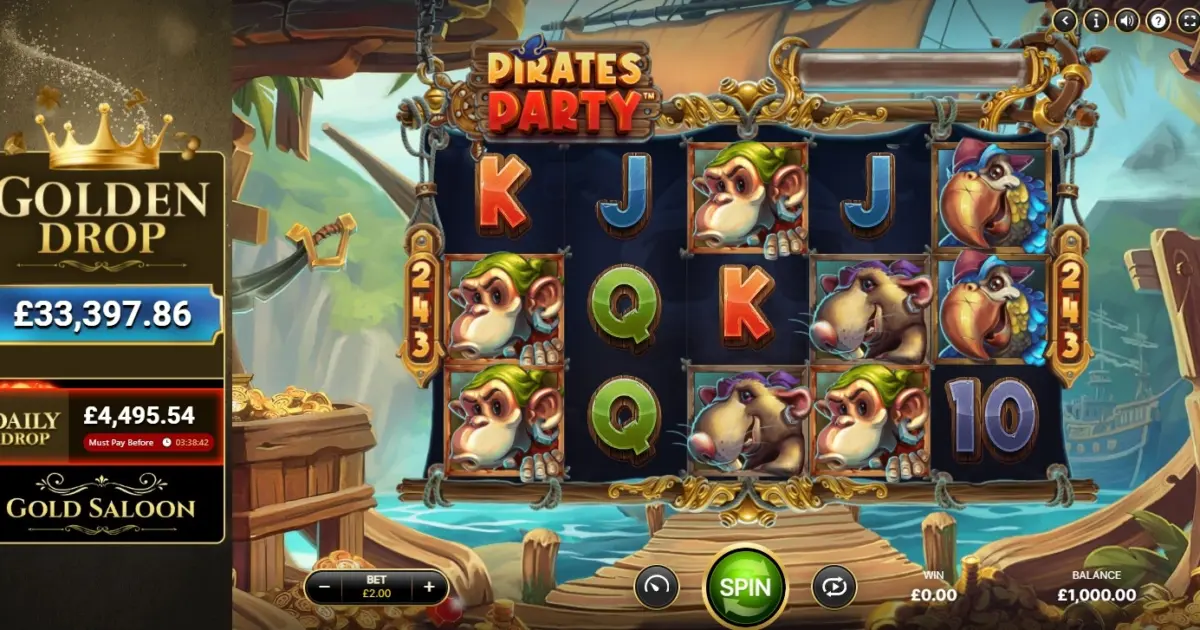
The pirates party slot sits at rank 256 on this site with a popularity percentile of 98.7, which tells you that plenty of players are at least opening the demo. What those players are walking away with depends on numbers NetEnt has not fully disclosed. This review covers what the published data allows you to assess and flags where the gaps leave you guessing.
The 5-reel grid explained
Pirates Party uses a 5-reel layout. That is the standard arrangement for most modern video slots and the format that allows the widest range of payline configurations — anything from 10 lines to thousands of ways depending on the mechanics behind the reels.
A 5-reel grid typically displays 3 or 4 rows of symbols per reel, though NetEnt has not specified the row count for this particular game. What the 5-reel format guarantees in general is enough horizontal space for three-of-a-kind wins at minimum, with longer symbol runs offering progressively higher payouts. Against a backdrop of 293 pirate-themed games and 191 titles in NetEnt’s catalogue, a 5-reel layout alone does not differentiate this game from the crowd.
The theme labels list Pirates, Animals, and 5-Reels. The first two tell you the visual content draws on nautical imagery and animal symbols. Beyond that, the labels do not describe specific characters, animations, or sound design — you would need to open the demo yourself to evaluate the presentation.
| Provider | NetEnt |
|---|---|
| RTP | 96.17% |
| Reels | 5 |
| Theme | Pirates |
| Free demo | Yes |
Paylines, ways and how Pirates Party pays
NetEnt has not published a payline or ways count for this title. Without that number, you cannot calculate the cost per spin beyond the minimum stake shown in the game’s bet controls, and you cannot model how often symbol clusters might land across the reels.
In general, a fixed-payline slot requires matching symbols along specific horizontal or diagonal lines. A ways-based game awards a win when matching symbols appear anywhere on adjacent reels from left to right, regardless of row position. Slots with 20 or fewer paylines tend to feel tighter — you land on a win line less frequently but the individual payouts are easier to trace. Ways games with hundreds or thousands of combinations produce more frequent small wins but dilute the per-spin cost.
Because the mechanics here are unspecified, the safest assumption is to open the demo, check the paytable, and note whether you are playing a line-based or ways-based game before committing any money.
96.17% RTP put in context
The published RTP of 96.17% means that over an extremely long series of spins, the game is programmed to return 96.17% of all wagered money to players. For every 100 units you stake across thousands of rounds, the theoretical return is 96.17 units. The house edge is 3.83%.
Against NetEnt’s provider average of 96.10%, Pirates Party sits fractionally above — a difference of 0.07 percentage points that has no practical effect on any individual session. Against the corpus-wide average of 95.71%, the gap widens to 0.46 percentage points, which is the more meaningful comparison because it places this game ahead of the typical slot you might pick up at a regulated casino.
For reference, Starburst runs at 96.10% — effectively the same return — while Starburst XXXtreme offers a slightly higher 96.26%. None of these differences alter long-run expectation in any way you would notice within a normal session.
Volatility and hit patterns
NetEnt has not assigned a volatility rating to Pirates Party. This is the single most important missing figure in the entire dataset, because volatility determines session shape far more than RTP does.
A low-volatility game produces frequent small wins and rarely drains a bankroll quickly, but it also rarely delivers large single-round payouts. A high-volatility game goes through long dry spells punctuated by occasional bigger returns. Your bankroll needs to be proportionally larger for the latter to survive the lean stretches.
Without this rating, you cannot set a session budget with any confidence. The popularity percentile tells you people are trying it, but trying it with a small bankroll on a potentially high-volatility title could end your session in under fifty spins. Approach it first in demo mode and observe the win frequency and payout distribution across several hundred free spins before deciding how much real money to risk.
Choosing a stake between the minimum and maximum bet
No bet range has been published in the available data for this title. NetEnt typically sets minimum stakes between 0.10 and 0.20 currency units for its 5-reel games, but treating that as a guarantee for Pirates Party would be speculation.
Where the numbers do exist, stake selection interacts directly with bankroll. If your total budget for a session is 50 units and the minimum bet is 0.20, you have 250 spins of theoretical play at that rate before the RTP curve dominates your result. At a minimum bet of 1.00, you have 50 spins — a sample too small to draw any conclusion from. The practical rule is to set a maximum number of spins you are willing to buy with your session budget, then divide to find your per-spin stake. Without a published minimum, open the game and check the bet selector before sitting down.
Demo play versus real money
Pirates Party is available as a free demo on this site. The demo uses the same math engine and RTP as the real-money version, so it reflects how the game behaves across long sequences. What it does not reflect is the emotional weight of real losses or the discipline needed to stop at a planned budget.
Playing the demo will not tell you when to switch to real money — there is no such trigger. Every spin is independent; a sequence of losses in the demo neither predicts nor prevents a big return in a paid session. Use the demo to understand the game’s rhythm and check the paytable, not to build confidence about future results.
Treat any real-money play as paid entertainment. Set a budget you are comfortable losing entirely before you deposit, stick to it, and stop when it is gone. If gambling stops being entertainment, the BetStop and self-exclusion tools offered by licensed operators are worth using. 18+ only.
Verdict on Pirates Party slot
The RTP is solid — 96.17% places it ahead of the corpus average by a noticeable margin and level with NetEnt’s portfolio norm. The popularity data suggests the theme resonates with players. Everything else that matters for a real session decision — volatility, payline structure, bet range, max win potential — remains unpublished.
Against other pirate-themed titles on this site, the comparison is unflattering in one direction: Cursed Pirates carries a lower RTP of 94.0%, meaning Pirates Party returns 2.17 percentage points more over the long run. But the absence of a volatility figure makes it impossible to say whether the better RTP comes with a friendlier or harsher session experience.
If the 98.7 popularity percentile reflects genuine enjoyment rather than casual clicks, this game earns a look. If it reflects nothing more than a catchy theme with unproven mechanics underneath, you are gambling blind. The demo costs nothing — use it before deciding.
Frequently Asked Questions
Is Pirates Party available to play for free?
Yes, NetEnt's Pirates Party is available as a free demo on this site. The demo uses the same 96.17% RTP and 5-reel layout as the real-money version, so it accurately reflects the game's long-run mathematics without requiring a deposit or registration.
What does 96.17% RTP mean for my bankroll?
Across a very large number of spins, the game returns 96.17 units for every 100 wagered, giving the house a 3.83% edge. On a session of 200 spins at 0.50 per spin, you wager 100 units total — your expected loss is roughly 3.83 units, though any single session can deviate widely from that figure.
Is Pirates Party a high or low volatility slot?
NetEnt has not published a volatility rating for Pirates Party. Without this information, you cannot determine whether the game produces frequent small wins or longer dry spells with occasional larger payouts. Playing several hundred demo spins and observing the win pattern is the only reliable way to estimate the session shape.
How does Pirates Party compare to other NetEnt slots?
At 96.17% RTP, Pirates Party sits marginally above the provider average of 96.10%. Starburst matches that average exactly, while Starburst XXXtreme exceeds it at 96.26%. The differences are small enough that volatility and feature design matter far more to your experience than the RTP spread between these titles.
Can I win real money playing the Pirates Party demo?
No. Demo play uses simulated credits and cannot produce real-money payouts. The demo exists to let you evaluate the game's mechanics, visual presentation, and win frequency before deciding whether to wager actual funds at a licensed operator.




