The number that matters here is 97.0%. That is the published return-to-player figure for this WMS three-reel machine, and it sits 1.29 percentage points above the 95.71% average across the slots catalogued on this site. Free demo play is available, so you can watch the reels behave before any money is involved.
What FACTS does not tell you is equally worth knowing. WMS has not published a volatility rating, a paytable, a max win figure or a stake range for this title. That absence shapes most of what follows: the maths is solid, the game-specific detail is thin, and the demo is where you fill the gap.
Aftershock at a glance
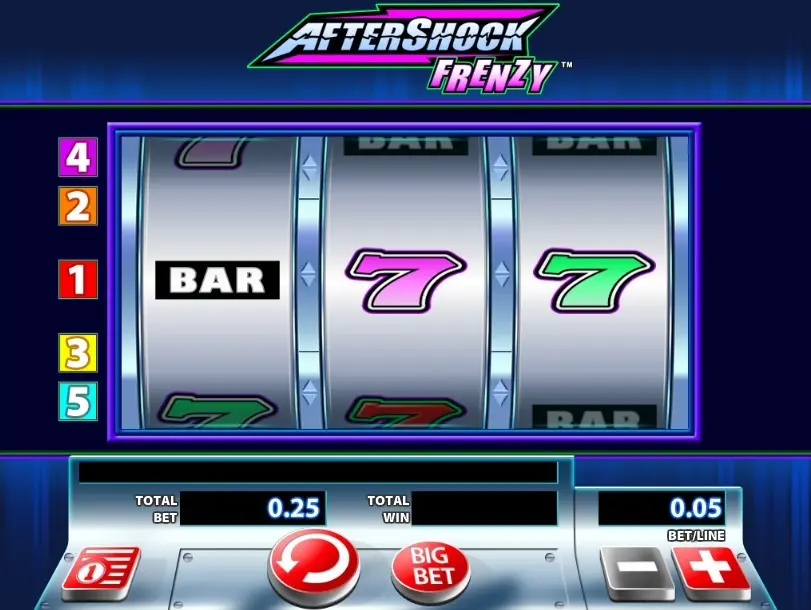
The aftershock slot is a three-reel arcade-themed machine from WMS, catalogued here under Arcade, Classics and retro, and 3-Reels. Its subcategory is listed as Slot Machine. It ranks 1722 by popularity, which places it in the 91.4th percentile — it draws steady traffic rather than headline traffic.
| Figure | Value |
|---|---|
| Provider | WMS |
| RTP | 97.0% |
| Reels | 3 |
| Primary theme | Arcade |
| Subcategory | Slot Machine |
| Popularity rank | 1722 (91.4th percentile) |
| Provider average RTP | 96.01% across 55 games |
| Corpus average RTP | 95.71% |
| Free demo | Available |
Who does it suit? Players who prioritise the published return figure over feature depth, and who like a stripped-back three-reel format. Anyone who wants to know the free-spin count, the bonus structure or the theoretical maximum win before playing will not find those numbers published for this title, and should treat any such figures quoted elsewhere with caution.
What a 97.0% RTP actually returns
RTP is a long-run statistical average, not a session promise. A 97.0% figure means the game is modelled to return £97 for every £100 wagered across a very large sample of spins — typically millions, not thousands. Your own hour at the machine can land far above or far below that line, and usually will.
Work it through. Stake £1 per spin for 1,000 spins and you have wagered £1,000. The modelled return on that £1,000 is £970, an expected cost of £30. At the corpus average of 95.71%, the same £1,000 wagered carries an expected cost of £42.90. The difference is roughly £13 across a thousand spins — real, but modest, and easily swamped by variance in either direction.
Against WMS’s own catalogue the gap is smaller. The provider averages 96.01% across 55 games, so this title runs about one percentage point ahead of its stablemates. For comparison, Invaders from the Planet Moolah sits at 96.00% and Zeus at 95.97% — both a full point below. Every spin is independent, and the RTP figure does not become more likely to appear the longer you play.
Volatility and what your session will feel like
WMS has not published a volatility rating for this game, so nobody can honestly tell you whether the swings are shallow or severe. What can be said is what volatility does in general, and how to read it yourself.
Low-volatility slots pay small amounts often. Your balance drifts down slowly, sessions last a long time on a given bankroll, and the biggest single result is rarely more than a few dozen times your stake. High-volatility slots invert that: long stretches with nothing back, then occasional results that recover a chunk of the deficit in one go. Two games can share an identical 97.0% RTP and feel nothing alike, because RTP describes the total returned and volatility describes how lumpily it arrives.
Three-reel machines historically sit toward the lower-to-medium end, since there are fewer symbol combinations to build rare high-paying outcomes from — but that is a tendency across the format, not a fact about this specific title. The practical answer is to run the demo for a couple of hundred spins and watch the shape of the balance line. Frequent small returns with a slow decline suggests lower variance. Long flat stretches punctuated by spikes suggests the opposite.
The 3-reel layout and how wins are counted
Three reels is the original slot architecture, and it constrains the maths in a way five-reel games do not. With three reel positions, the total number of possible symbol combinations is the product of three reel strips rather than five, which caps how much of the return can be pushed into rare outcomes.
WMS has not published the payline count, the ways-to-win structure or the paytable for this game, so how wins are counted here is something the demo will show you and this review will not guess at. In general terms, three-reel machines resolve either on a single centre line, on a small handful of fixed lines, or on an all-ways basis where matching symbols in any position on each reel counts. The distinction matters for how often you see a return, not for the overall RTP, which is set independently of the line structure.
The same applies to features. Many slots use wilds, scatters and free-spin rounds, and some sell a buy-feature entry. Whether this one does any of that is not in the published data. If you want a WMS game with documented feature depth, Spartacus Call to Arms at 96.05% is the better-known title to compare against.
Stake range and sizing a bankroll
No minimum or maximum stake has been published for this title, so the operator you play at will determine the range. Check it on screen before your first spin rather than assuming.
Bankroll sizing works the same regardless. Decide the total you are willing to spend, then divide by the number of spins you want the session to last. Two hundred spins on a £20 budget means 10p a spin. Four hundred spins on the same £20 means 5p. Raising the stake does not improve the return percentage; it only compresses the session and widens the swing on each spin.
Two figures to hold together: the 97.0% RTP gives an expected cost of £3 per £100 wagered, and total wagered is stake multiplied by spin count, not the size of your deposit. Play 500 spins at 20p and you have wagered £100 even if you only ever deposited £30, because returns get recycled into fresh spins. Budget against total wagering, not against the deposit figure.
Playing the Aftershock demo before you commit
Free demo play is available for this game, and given how little of its paytable is published, the demo is the most useful research tool you have. Run 200 to 300 spins, note how often you get something back, and see whether the format holds your interest. That answers the questions the data sheet leaves open.
One caveat: demo results predict nothing about real-money sessions. Demo play runs on the same independent-spin mathematics, but a short sample tells you about that sample only. A demo run that goes well is not a signal, and neither is one that goes badly.
Slots are 18+ and are paid entertainment, not a way to make money. Set a figure you are comfortable losing before you start, treat it the way you would the price of a cinema ticket, and stop when it is gone rather than topping up. If tracking that gets difficult, use the deposit and session limits your operator provides.
Verdict: who should play Aftershock
The case for this game is the 97.0% return figure. It beats the 95.71% corpus average by 1.29 points and the WMS average of 96.01% by roughly one, which makes it one of the stronger published numbers in that catalogue of 55 titles. If the return percentage is your primary filter, it earns a look.
The case against is information, not maths. With no published volatility rating, stake range, paytable or maximum win, you are buying the RTP figure and finding out the rest yourself. That is a reasonable trade on a three-reel machine, where the structure is usually simple, and it is why the free demo matters more here than it would on a documented five-reel release.
Prefer a higher-variance arcade feel with a documented RTP? DJ Rabbit at 96.54% is the closest well-covered alternative in the same theme group, though it still returns half a point less over the long run.
Frequently Asked Questions
Can I play Aftershock for free?
Free demo play is available for this WMS title, which means you can spin it with virtual credits and no deposit. That is particularly useful here, because WMS has not published the paytable, volatility rating or stake range. A few hundred demo spins will show you how often the game returns something and whether the three-reel format suits you.
What is the RTP of Aftershock and is that good?
The published RTP is 97.0%, which is high. It sits 1.29 percentage points above the 95.71% average across the slots catalogued here and about one point above the 96.01% WMS average. In practical terms, £1,000 wagered carries a modelled cost of £30 rather than the £42.90 you would expect at the corpus average.
Is Aftershock high or low volatility?
WMS has not published a volatility rating for this game, so any figure quoted elsewhere should be treated sceptically. Three-reel machines tend toward lower or medium variance because fewer symbol combinations are available, but that is a pattern across the format rather than a fact about this title. The demo will show you the actual shape of the swings.
Who is WMS and what other slots do they make?
WMS is a long-established slot developer with 55 games catalogued here, averaging 96.01% RTP. Their best-known titles include Zeus at 95.97%, Spartacus Call to Arms at 96.05% and Invaders from the Planet Moolah at 96.00%. This game's 97.0% figure is roughly a percentage point ahead of the studio's own average.
How does Aftershock compare to DJ Rabbit?
On published return, this game leads: 97.0% against 96.54% for DJ Rabbit, a gap of just under half a point. Both sit in the Arcade theme group, which covers 79 games here. DJ Rabbit is the better-documented release, so if you want published feature detail before playing, it is the easier one to research.