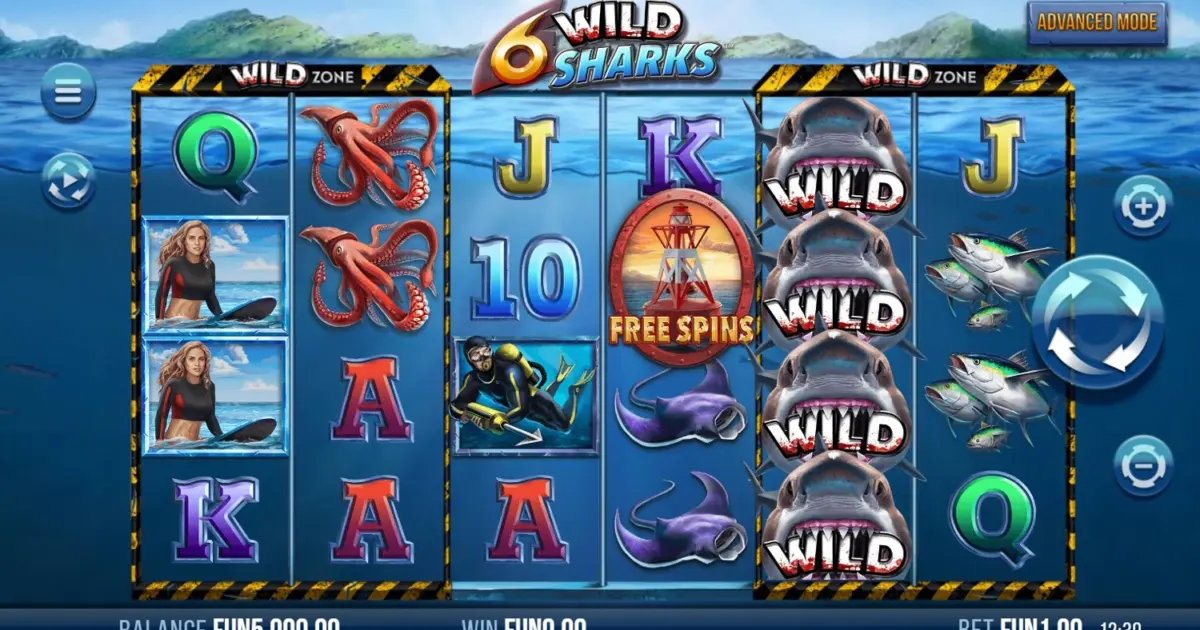
6 Wild Sharks is worth a look if you filter by return first and theme second — its 96.55% RTP puts it 0.84 percentage points above the average slot in our corpus and well above its studio average. That edge does not change how any single session feels, but over a very large sample it matters, and you can explore it at no cost in the 6 wild sharks slot free demo before deciding whether the 6-reel, Ocean and sea setup suits your bankroll.
6 Wild Sharks versus the average slot
The single most decision-relevant number here is how 6 Wild Sharks compares to the wider market. In our current corpus the average RTP is 95.71%. 6 Wild Sharks publishes 96.55%, which is 0.84 percentage points above the corpus average and 1.27 points above the 95.28% average across the 49 games from 4ThePlayer. In practical terms, that gap is small on any single spin — every spin is independent and short-term results can swing far from the average in either direction — but it compounds over volume.
Put it in cash terms: at 96.55% the theoretical return is £96.55 per £100 wagered across a very large number of spins, versus £95.71 at the corpus average. Over 1,000 spins at £1 a stake, the expected difference is about £8.40 in theoretical return (£965.50 versus £957.10). Over 10,000 spins it scales to £84. That is not a promise of profit, only the maths of the long run, and your actual session will be dominated by variance, but when you are comparing two games with similar themes or features, the higher RTP is the rational tie-breaker.
Popularity is a separate signal. 6 Wild Sharks ranks 2,840th in our lobby data, which places it in the 85.8th percentile for popularity — in other words, more played than about 85.8% of tracked titles despite a mid-table rank number. High RTP and decent traffic do not guarantee you will enjoy the game, but they do suggest many players have given it meaningful sampling time.
| Provider | 4ThePlayer |
|---|---|
| RTP | 96.55% |
| Reels | 6 |
| Theme | Ocean and sea |
| Free demo | Yes |
| Site-wide average RTP | 95.71% |
RTP breakdown: 96.55% in context
RTP, or Return to Player, is a long-run statistical average calculated over millions of simulated spins. A 96.55% RTP does not mean you will get 96.55% back in a single session, or even across 100 or 1,000 spins. It means that, if the game performed exactly to its theoretical profile over an extremely large sample, total payouts would average £96.55 for every £100 staked.
What does 96.55% imply for session planning? It is comfortably above the two benchmarks that matter most for comparison. Against the corpus average of 95.71% it is +0.84 points. Against its own provider average of 95.28% it is +1.27 points. For context, many players treat 96.00% as a rough dividing line between average and above-average; 6 Wild Sharks sits above that line. If you are choosing between games with otherwise similar appeal, this one starts with a mathematical head start.
We can illustrate the scale without implying any outcome. Over 500 spins at £0.50, total wagered is £250. Theoretical return at 96.55% is £241.38, versus £239.28 at the corpus average — a £2.10 difference in expected value. Double the stake to £1 and double the spins to 1,000, and the gap becomes £8.40 as noted above. These are averages, not guarantees, and variance will dwarf them in any short sample. The responsible way to use RTP is as a filter: all else equal, prefer the higher figure, understand it only emerges over volume, and set a budget for the session you can afford regardless of where results fall.
Volatility profile
4ThePlayer has not published a volatility rating for 6 Wild Sharks in the data supplied for this review, and no hit frequency, max win, or win-distribution figures are included in FACTS. That absence matters, because volatility shapes your experience more than RTP does in a single sitting.
In general terms, volatility describes how a slot tends to distribute payouts over time. Low-volatility slots typically produce more frequent, smaller wins that can extend session length on a fixed bankroll, but with smaller peak swings. High-volatility slots typically produce fewer winning spins, with larger gaps between hits and larger potential swings in either direction, which usually requires a larger bankroll or lower stake to sustain the same number of spins. Medium volatility sits between the two.
Without a published rating for this specific game, you cannot reliably infer which pattern applies. Treat any volatility label you see quoted elsewhere with caution unless it comes directly from the provider. The most practical approach in the free demo is to track for yourself how often wins occur and how large the gaps feel over a few hundred spins, remembering that demo play shows mechanics but does not predict real-money results. If you prefer longer, steadier sessions, you would normally pair an unknown-volatility game with a more conservative stake until you have observed its behaviour; if you prefer larger swings, you would budget for them. Because the data is missing, stake and session length remain your main controls.
4ThePlayer as a studio
4ThePlayer is the studio behind 6 Wild Sharks, with 49 games in our tracked set. The studio’s average RTP across those titles is 95.28%, which is slightly below the corpus average of 95.71%. Against that backdrop, 6 Wild Sharks at 96.55% is one of the more generous returns in the provider’s own catalogue — 1.27 points above the studio mean.
That comparison is useful when you are browsing within the same provider. For example, 2 Sweet 4 U is listed at 94.00% RTP, more than two and a half points below 6 Wild Sharks, so on return alone the latter has the clearer long-run profile. The same applies to 7×7 Thor, also at 94.00% in the related set. By contrast, 9K Yeti Santa from the same studio is higher still at 97.00%, which illustrates that 4ThePlayer slots span a wide RTP range and should be compared title by title rather than by brand alone.
Provider averages also help calibrate expectations: a studio average below the corpus does not make any single game good or bad; it simply tells you the catalogue is mixed. Here, 6 Wild Sharks outperforms its studio siblings on the one hard number we have, while themes, reel structures and features — where published — vary by title. Since volatility and max win are not supplied for this game, the RTP versus the studio mean is the most concrete studio-level comparison you can make, and it favours 6 Wild Sharks within the 4ThePlayer range.
Three Ocean and sea alternatives worth comparing
The primary theme for 6 Wild Sharks is Ocean and sea, a category that includes 527 games in our data set, with additional tags for 6-Reels and Fishing. If you like sea-based games, direct RTP comparisons are worthwhile because the theme alone does not determine return.
Big Bass Bonanza is one of the most recognisable Fishing titles in the theme and publishes 96.71% RTP, a touch above the 96.55% of 6 Wild Sharks. The difference is 0.16 points — small, but in favour of Big Bass Bonanza over a large sample, and worth noting if you are choosing purely on return. Bigger Bass Bonanza mirrors that figure at 96.71%, so the two Bass games cluster together just above 6 Wild Sharks.
Pearls of Aphrodite also sits within the Ocean and sea set at 96.81% RTP, again marginally higher by 0.26 points. None of these gaps will dominate a single session — variance will — but across thousands of spins the maths favours the higher number. Theme execution differs between titles even when the label is the same; the label tells you the game draws on ocean and sea motifs, not which symbols, animations or soundtracks it uses. If you are narrowing a shortlist, compare RTP first, then use the free demos to see which reel structure and presentation you prefer, noting that many Ocean and sea slots use different payline or ways mechanics and stake ranges that are not specified here for 6 Wild Sharks.
Getting the most out of the free demo
Free demo play is available for 6 Wild Sharks, and it is the safest way to answer whether the game suits you. Use it to check the 6-reel layout, see how paylines or ways are presented, and get a feel for pacing and interface, without staking real money. Demo spins use the same theoretical RTP as the real-money version, but they cannot predict real-money outcomes — each spin remains independent and random, and short-term results in demo tell you nothing about what will happen next.
Because key figures such as stake range, max win and hit frequency are not supplied for this title, the demo is also where you can note what is and is not shown in the paytable. If a field is missing from the provider data, treat any third-party claim about it sceptically. For session planning in general, stake size determines how many spins a fixed bankroll can support: £50 at £0.20 gives 250 spins of runway before any wins, at £0.50 it gives 100, at £1 it gives 50, before accounting for returns. Choose a stake that gives you the number of spins you want for entertainment, not one that chases losses or assumes wins will arrive.
Keep play as paid entertainment. You must be 18+ to gamble in the UK. Set a budget and a time limit before you start, use deposit and session limits if you play with real money, and step away if it stops being fun. If you need support, contact GambleAware or GamCare. Demo play is useful for learning, but it is not a rehearsal that changes the odds.
Should you play 6 Wild Sharks?
If your filter is return, 6 Wild Sharks makes a rational case. At 96.55% it sits above both the corpus average (95.71%) and the 4ThePlayer average (95.28%), and it holds up well against well-known Ocean and sea alternatives that cluster around 96.71–96.81%. The 6-reel, Ocean and sea and Fishing tags give you the broad shape, and the game is widely sampled at the 85.8th popularity percentile.
The caveat is what is not published. Without a volatility rating, hit frequency, stake range or max win figure in the supplied FACTS, you cannot fully model risk or bankroll requirements from the numbers alone, so the free demo matters more here than with a fully documented title. Try the demo, compare it side-by-side with the alternatives above on RTP and on how each game feels over a few hundred spins, and let the combination of maths and personal preference decide. On the facts available, the return profile is a clear plus; the rest is a matter of testing whether the session experience matches what you want.
Frequently Asked Questions
Can I play 6 Wild Sharks for free without wagering real money?
Yes, free demo play is available for 6 Wild Sharks, so you can try the 6-reel Ocean and sea game without staking real money. Demo spins use the same 96.55% theoretical RTP as the real-money version, but every spin is independent and demo outcomes do not predict future real-money results or guarantee similar returns.
What is the RTP of 6 Wild Sharks and what does it mean for my session?
6 Wild Sharks has a 96.55% RTP, which is 0.84 points above the corpus average of 95.71% and 1.27 points above the 4ThePlayer average of 95.28%. It means a theoretical return of £96.55 per £100 wagered over millions of spins, not in any single session, where results can vary widely.
What volatility is 6 Wild Sharks and how risky is it?
No volatility rating is provided in the FACTS for 6 Wild Sharks, so its risk profile cannot be stated from official data. In general, low volatility tends to give smaller, more frequent wins and longer sessions, while high volatility gives larger swings and rarer hits. Use the demo to observe pacing, but treat outside claims cautiously.
Who makes 6 Wild Sharks and what else do they offer?
6 Wild Sharks is made by 4ThePlayer, a studio with 49 tracked games averaging 95.28% RTP. Within the same catalogue, 2 Sweet 4 U and 7x7 Thor are both at 94.00% RTP, while 9K Yeti Santa is higher at 97.00%, showing the provider's range. 6 Wild Sharks at 96.55% sits above the studio average.
How does 6 Wild Sharks compare to Big Bass Bonanza?
Both are Ocean and sea Fishing slots, but Big Bass Bonanza publishes 96.71% RTP compared with 96.55% for 6 Wild Sharks, a 0.16-point advantage over a very large sample. 6 Wild Sharks uses 6 reels and ranks in the 85.8th popularity percentile, while Big Bass Bonanza is more widely known. Demo both to compare feel beyond the numbers.