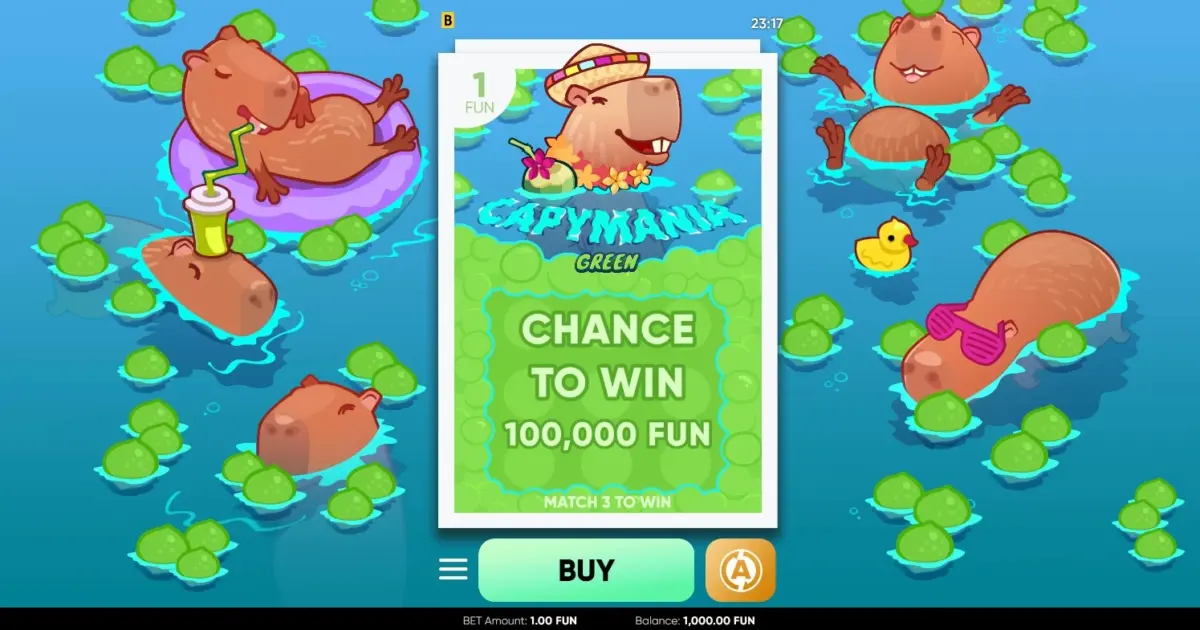
Capymania Green is a digital scratch card from BGaming with a published 97.0% RTP, a figure that sits well above both the provider’s own scratch card average and the wider category norm. The ticket’s outcome is generated the moment you buy in—scratching the panels on screen reveals a result that already exists, exactly like a physical printed lottery ticket. The question is whether the high return percentage and the free demo make this card worth your session budget.
Capymania Green in one minute
BGaming released Capymania Green as part of a three-card series sharing the same mathematical model and RTP, differing only in visual presentation. The card follows the standard digital scratch format: you purchase one ticket, the prize outcome is determined instantly by the server, and you reveal panels on screen to see what you won. There is no spin, no hold decision, no cash-out choice—one buy-in, one reveal, one result. The theme centers on capybaras, a common motif in BGaming’s scratch card lineup. The provider has not published specific prize-tier breakdowns or a top-prize figure, which is typical for scratch products where the full payout structure is baked into the batch design rather than displayed as a paytable the way a slot would show it.
| Attribute | Value |
|---|---|
| Provider | BGaming |
| RTP | 97.0% |
| Category | Scratch cards |
| Free demo | Yes |
Return to player: 97.0%
The 97.0% RTP means that for every hundred currency units wagered across the entire batch of virtual tickets, the game is designed to return ninety-seven units in prizes over the long run. This is a fixed distribution built into the prize structure at design time, not a per-ticket promise—your individual ticket can return zero or a multiple of your stake, but the batch as a whole converges on that percentage across millions of plays. Capymania Green’s 97.0% RTP is notably high: it exceeds the category average by more than nine percentage points and outpaces BGaming’s own scratch card average of 94.2%. For context, many retail lottery scratch tickets and digital equivalents sit between 70% and 85%, so a figure nearing 97% is rare in this format.
The higher the RTP, the smaller the house edge and the more of your total spend the game returns to players as prizes. That does not mean every session will break even or that a losing streak is offset by the next ticket—it means the prize pool carved out of all ticket sales is larger relative to the total wagered. If you are comparing scratch cards and prize return matters to your decision, Capymania Green’s number is a point in its favor. You can also try Capymania Yellow, which shares the same 97.0% figure in a different visual theme.
How prize tiers are built into the batch
Digital scratch cards operate on lottery-style prize distribution: the game studio pre-defines a set of prize tiers—small wins, medium wins, larger wins, and a top prize—and assigns a fixed number of tickets to each tier within a very large batch. When you buy a ticket, the server draws one from that batch, and the outcome is final before you touch the screen. The RTP percentage reflects how the studio allocated those tiers: a 97% game has a bigger share of the batch paying out prizes than a 75% game, but the exact split across tiers—how many tickets pay double your stake versus ten times versus the top prize—is internal to the design and rarely published in detail.
This is fundamentally different from a slot, where each spin is an independent RNG event with its own hit frequency and the house edge is applied per spin. A scratch card’s “hit frequency” is really just the proportion of tickets in the batch that pay any prize at all, and because the tiers are fixed in advance, there is no way to influence which ticket you draw. Timing your purchase, waiting after a losing streak, or buying multiple tickets in a row does not change the composition of the batch or your odds. The ticket you are about to buy was already generated, its outcome locked in, and your reveal is just the animation. For a closer comparison within the same provider lineup, Capymania Orange uses the same prize model and RTP as Capymania Green.
Digital versus physical scratch cards
A physical scratch ticket is printed with the prize result embedded under an opaque coating—scratch the coating off, and you see the outcome that was printed weeks ago. A digital scratch card works the same way at the logical level: the server generates your result the instant you click buy, and the on-screen scratching is a reveal animation applied to a decision that already happened. The difference is speed and convenience—you can play a digital card in seconds without leaving your screen, while a physical ticket requires a trip to a retailer and manual scratching. The prize structure and RTP math are identical in concept: both are lottery-style distributions across a batch of tickets.
One advantage of digital scratch cards is the ability to try a free demo, which physical tickets cannot offer since each ticket costs the lottery operator money to print and distribute. Many players use the demo to see the reveal animation, understand the panel layout, and get a feel for the purchase-and-reveal loop before committing real money. The demo does not predict real-money outcomes—demo tickets and real tickets are separate batches with separate RNG seeds—but it does let you experience the format risk-free. Capymania Green offers a free demo, so you can run through several tickets without spending to decide whether the game’s presentation suits you.
Common misconceptions about hot tickets
A recurring misconception is that a scratch card can be “due” after a losing streak, or that a recent string of wins makes the next ticket less likely to pay. This belief comes from a misunderstanding of how scratch card outcomes are generated. Every ticket in the batch is pre-assigned a result when the game studio designs the prize structure—there is no memory, no shoe to deplete, no reel position to track. If you buy ten losing tickets in a row, the eleventh ticket’s outcome was already determined before you bought the first one, and its prize status has nothing to do with the previous ten. Each purchase is an independent draw from the batch, and the batch composition does not change based on your session history.
Similarly, some players believe that buying tickets at a certain time of day, or immediately after another player wins, improves their odds. The server does not adjust the batch based on the clock or other players’ results. The proportion of winning tickets to losing tickets is fixed at design time and reflected in the RTP figure. Timing strategies, hot-and-cold theories, and pattern-reading do not apply to a format where the outcome exists before you click. The only variable under your control is whether to buy a ticket at all, and if so, how much of your budget to allocate. The game’s RTP tells you how much of the total wagered amount is returned as prizes across the whole batch—nothing more, nothing less.
Trying the demo first
Capymania Green includes a free demo mode, which lets you buy and reveal virtual tickets without spending real money. The demo runs on a separate RNG seed from real-money play, so the outcomes you see in demo mode are not predictive of what will happen when you deposit. What the demo does show you is the game’s presentation: how the panels are laid out, how quickly the reveal animation runs, and what the purchase-and-reveal loop feels like. For a format as simple as a scratch card—one decision, one result, no in-round choices—the demo’s value is primarily in confirming that the interface and pacing work for you, not in testing strategy or observing patterns.
Because scratch cards have a fast purchase-and-reveal cycle, it is easy to lose track of how many tickets you have bought in a session. Setting a budget in advance—a fixed amount you are willing to spend on tickets, treating it as the cost of entertainment rather than an investment—is more important here than with slower formats like slots or table games. Only play with money you can afford to lose, set a limit before you start, and stick to it. Scratch cards are a lottery product, and the house edge, even at a favorable 3% for this card, means the average player will spend more than they win over time. If you find yourself chasing losses or buying more tickets than planned, stop and take a break. This is entertainment you pay for, not income. 18+ only.
After trying the demo, if you decide to play for real money, the same advice applies: treat each ticket as a separate entertainment purchase, not a step in a progression toward a win. You can also explore Scratch Alpaca Gold, another animal-themed scratch card from BGaming, though it carries a lower 90.0% RTP.
Who should try Capymania Green
Capymania Green suits players looking for the simplest possible casino format with a higher-than-average return percentage. If you want a game with zero decisions after the buy-in, where the outcome is instant and the session moves at your own pace, this card delivers that. The 97.0% RTP is a genuine strength—it is uncommon to find a scratch card above 95%, and Capymania Green clears that mark. Players who value return percentage as a decision factor will find this card more favorable than the category norm.
The format’s simplicity is both its appeal and its limit. There is no bonus round, no hold feature, no mid-round decision that changes your odds. You buy a ticket, you reveal the result, and you move to the next one. If you prefer games with layered features, progressive elements, or in-round choices, scratch cards in general—and this one specifically—will not meet that need. The game is exactly what it says: a digital lottery ticket with a fixed prize structure and a reveal animation. For players who understand that and want a high-RTP example of the format, Capymania Green is a solid pick. For everyone else, trying the free demo costs nothing and settles the question in a few minutes.
Frequently Asked Questions
Can I play Capymania Green scratch card free before spending real money?
Yes, Capymania Green offers a free demo mode that lets you buy and reveal virtual tickets without depositing. The demo runs on a separate RNG seed from real-money play, so the outcomes you see are not predictive of paid results, but it does show you the game's interface, reveal animation speed, and purchase loop. Use the demo to decide whether the format and pacing suit you before committing any budget.
What does the 97.0% RTP mean for my chances on each ticket?
The 97.0% RTP means the game is designed to return ninety-seven currency units as prizes for every hundred wagered across the entire batch of tickets over the long run. It is a fixed prize distribution built into the batch at design time, not a per-ticket guarantee. Your individual ticket can pay zero or a multiple of your stake—the RTP describes the batch as a whole, not your next purchase. A 97% figure is notably high for scratch cards and means a larger share of total wagers is allocated to prizes compared to lower-RTP games.
Does buying multiple tickets in a row or waiting after losses improve my odds?
No. Every ticket's outcome is pre-generated when you buy it, drawn independently from the batch. Timing your purchases, buying several tickets in sequence, or waiting after a losing streak does not change the batch composition or influence which ticket you draw. There is no memory, no pattern, and no way to predict or affect the outcome of the next ticket based on prior results. Each purchase is a separate, independent draw from a fixed prize structure.
How does Capymania Green compare to other BGaming scratch cards?
Capymania Green is part of a three-card series from BGaming—Capymania Yellow and Capymania Orange share the same 97.0% RTP and prize model, differing only in visual theme. This RTP exceeds BGaming's scratch card average of 94.2% and is significantly higher than the category-wide average of 87.84%. If you are comparing options within the provider's lineup, the Capymania cards offer the best published return percentage, while other titles like Scratch Alpaca Gold sit at 90.0%.
What happens after I reveal a losing ticket on Capymania Green?
After revealing a losing ticket, the game returns you to the purchase screen where you can buy another ticket or exit. There is no bonus feature, no second-chance draw, and no carryover to the next ticket—the result you revealed is final, and the next ticket is an independent draw from the batch with its own pre-determined outcome. Because the purchase-and-reveal loop is fast, it is easy to buy more tickets than planned, so setting a budget before you start and stopping when you reach it is the responsible approach.