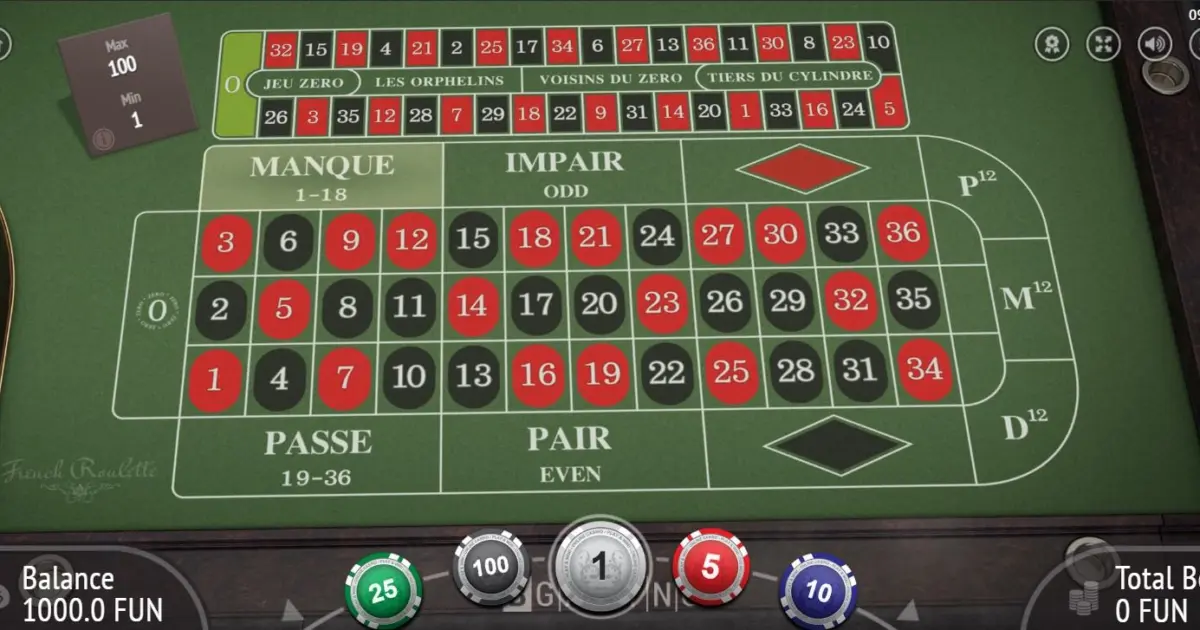
French Roulette (BGaming) is worth your time if you want the lowest house edge available in standard roulette. The 97.3% RTP reflects La Partage insurance on even-money bets, cutting that edge to 1.35% instead of the 2.70% you face on inside numbers. No betting system will change those figures, but starting from 1.35% instead of 5.26% gives your bankroll measurably more breathing room.
French Roulette (BGaming) and the BGaming roulette range
BGaming publishes three roulette tables, all reporting 97.3% RTP: this French edition, European Roulette (BGaming), and American Roulette (BGaming). The French and European releases share a single-zero wheel, but only the French version applies La Partage to even-money bets—red, black, odd, even, high and low—returning half the stake when the ball lands in the zero pocket. That insurance mechanism is the defining feature of French rules and the reason the RTP figure rises above the European baseline. The American edition uses a double-zero wheel, so the identical 97.3% RTP claim is unexpected; confirm the paytable and rules screen before committing real money, because a standard 38-pocket wheel cannot match a 37-pocket wheel with La Partage unless the payouts or bet menu differ.
The wheel, the pockets and the edge
The variant hints indicate a single-zero wheel, which means 37 pockets numbered 0 through 36. On a conventional European wheel every standard bet carries a 2.70% house edge, calculated from the gap between the 35:1 payout on a straight-up number and the true 36:1 odds. French Roulette (BGaming) applies La Partage: when zero lands, half your stake is returned on red, black, odd, even, 1–18 and 19–36. That cuts the house edge on those six bets to approximately 1.35%, because you lose only half as often when the single losing pocket appears. Inside bets—straight, split, street, corner, line—do not benefit from La Partage and remain subject to the full 2.70% edge. The 97.3% RTP represents a weighted average across all bet types; if you play even-money bets exclusively, your effective return climbs closer to 98.65%. Confirm the presence of La Partage or its cousin En Prison in the game’s own rules panel before betting, because the name alone is a strong hint, not a guarantee.
97.3% in practice
An RTP of 97.3% means the game returns $97.30 for every $100 wagered over the infinite long run. In a single session of two hundred spins, your result will be shaped far more by variance than by the 2.7% gap between cost and payout. The house edge is not a prediction of your next hour; it is the price per bet, paid in fractional units every spin. Playing even-money bets with La Partage in force lowers that price to 1.35%, the best figure available in non-novelty roulette. BGaming’s provider average RTP sits at 97.3%, matching this table exactly, while the site-wide roulette corpus averages 96.97%. That 0.33 percentage-point advantage is modest but cumulative: across five thousand even-money spins at $10, the difference between 1.35% and 2.70% edge is roughly $675 in expected cost. RTP does not tell you when you will win or lose; it tells you what you pay for the entertainment, measured in the mathematical certainty that governs every spin.
Building a bet you understand
The table below compares bet type, payout, coverage and true odds for a 37-pocket single-zero wheel. The gap between the payout column and the true-odds column is where the house edge lives. On even-money bets, La Partage returns half your stake when zero appears, effectively treating zero as half a loss instead of a full one, which is why the house edge on those bets drops to 1.35%.
| Bet type | Payout | Coverage | True odds | House edge |
|---|---|---|---|---|
| Straight (single number) | 35:1 | 1 pocket | 36:1 | 2.70% |
| Split (two numbers) | 17:1 | 2 pockets | 17.5:1 | 2.70% |
| Street (three numbers) | 11:1 | 3 pockets | 11.33:1 | 2.70% |
| Corner (four numbers) | 8:1 | 4 pockets | 8.25:1 | 2.70% |
| Line (six numbers) | 5:1 | 6 pockets | 5.17:1 | 2.70% |
| Dozen / Column | 2:1 | 12 pockets | 2.08:1 | 2.70% |
| Even-money (with La Partage) | 1:1 | 18 pockets | 1.06:1 | 1.35% |
Inside bets deliver higher volatility: a straight-up number hits once every 37 spins on average, so your bankroll must survive long cold streaks. Even-money bets win close to half the time and cost half as much per spin when La Partage is active. Neither approach changes your expected value in the long run, but the even-money route gives you more spins for the same risk capital.
Systems, streaks and independent spins
No betting system—Martingale, Fibonacci, D’Alembert, or any other progression—can overcome the house edge. Each spin is an independent event; the wheel has no memory, and the ball does not know what happened three spins ago or thirty. Doubling your bet after a loss (Martingale) does not make the next win more likely; it only ensures that when you do win, the profit covers prior losses. The catch is that a long losing streak will either drain your bankroll or collide with the table’s maximum bet limit before you recover. Waiting for five reds in a row and then betting black does not improve your chance of winning the next spin—it remains 18/37 minus the zero penalty, exactly as it was before the streak began. Progressions redistribute variance, moving expected loss into fewer, larger hits, but they do not reduce the cost per spin. On a wheel with La Partage, the even-money house edge is 1.35%, and no staking pattern will change that. The maths is completely known and completely unforgiving.
Free demo and staying in control
French Roulette (BGaming) offers free demo play, so you can test the interface, confirm that La Partage applies to even-money bets, and watch the edge work over a few hundred spins without risking cash. Demo mode uses the same RNG and the same rules as real-money play; the difference is that demo results carry no financial consequence, which can make variance feel abstract. When you move to real money, set a budget in advance, treat it as the cost of entertainment rather than a route to income, and stop when that budget is gone. Roulette is a negative-expectation game: over time the house edge will erode your bankroll, and La Partage only slows that erosion—it does not reverse it. Never chase losses, never bet money you need for other purposes, and remember that every spin is independent. This is a game of chance with known, unfavorable odds. Play only if you are 18 or older and only with money you can afford to lose.
Who should play French Roulette (BGaming)
Play French Roulette (BGaming) if you want the fairest conventional roulette bet available: even-money wagers at 1.35% house edge, backed by La Partage insurance. The 97.3% RTP is 0.33 points above the site-wide roulette average, and that gap is funded entirely by the zero-insurance rule on red, black, odd, even, high and low. If you prefer inside bets or the higher volatility of straight-up numbers, the edge rises to 2.70%, identical to any single-zero table without French rules—so compare European Roulette (Red Tiger) or the standard European release from the same provider to see whether layout or interface preferences matter more than the La Partage feature you will not be using. If you chase multipliers or bonus features, this is the wrong table; it delivers textbook roulette with the lowest standard house edge and nothing else. Confirm the rules screen shows La Partage in force before betting real money, because the 97.3% figure depends entirely on that mechanism. This table rewards players who understand the maths, accept the edge, and want to pay the smallest possible price per spin on the safest bets in the game.
Frequently Asked Questions
Is there a free demo version of French Roulette (BGaming)?
Yes, French Roulette (BGaming) offers free demo play. You can test the interface, confirm that La Partage applies to even-money bets, and observe the house edge over several hundred spins without risking real money. Demo mode uses the same RNG and rules as real-money play, so it accurately reflects the game's mechanics and RTP.
What is the RTP of French Roulette (BGaming)?
French Roulette (BGaming) reports a 97.3% RTP. This figure reflects the single-zero wheel combined with La Partage on even-money bets, which cuts the house edge on red, black, odd, even, high and low to approximately 1.35%. Inside bets remain subject to the standard 2.70% edge, so your effective return depends on which bets you place.
Does French Roulette (BGaming) have a lower house edge than American roulette?
Yes. French Roulette (BGaming) uses a single-zero wheel with La Partage, giving even-money bets a 1.35% house edge—far lower than the 5.26% edge on a standard double-zero American wheel. Inside bets on the French table carry a 2.70% edge, still less than half the cost of American roulette. The difference is the number of zero pockets and the insurance rule.
Can a betting system beat French Roulette (BGaming)?
No. Every spin is independent, and no progression—Martingale, Fibonacci, D'Alembert—can change the house edge. La Partage gives you a 1.35% edge on even-money bets, and that cost per spin is fixed by the maths. Systems redistribute variance and accelerate the risk of hitting table limits during a losing streak, but they do not reduce expected loss or make wins more likely.
How does French Roulette (BGaming) compare to European Roulette (BGaming)?
Both use a single-zero wheel and report 97.3% RTP, but French Roulette (BGaming) applies La Partage to even-money bets, cutting the house edge on those six bets to 1.35% instead of 2.70%. If you play inside bets exclusively, the two tables are mathematically identical. If you focus on red, black, odd, even, high or low, the French edition is the better choice.




