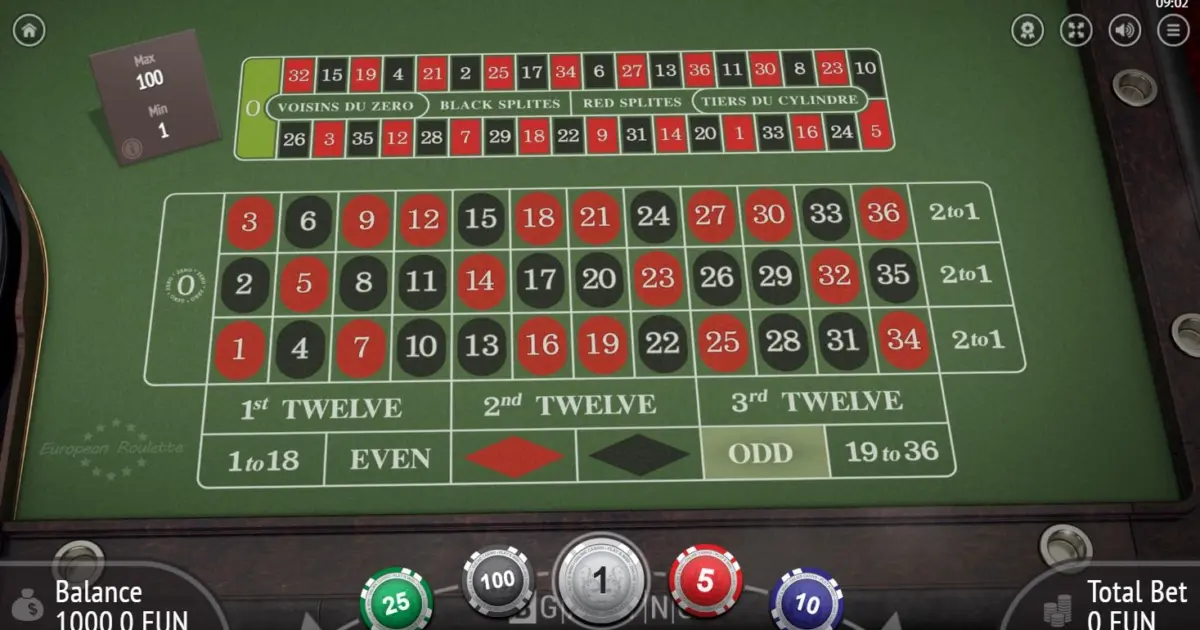
BGaming’s European Roulette delivers exactly what the name promises: a single-zero wheel with no gimmicks, no multipliers, and no rule variations that change the maths. The 97.3% RTP sits at the theoretical ceiling for a standard European wheel, which means every bet on this table carries the same 2.70% house edge that defines the format. If you want classic roulette with transparent odds and no surprise mechanics, this is a straightforward option.
European Roulette (BGaming) at a glance
This is BGaming’s entry in the single-zero category, one of three roulette tables in their portfolio alongside American Roulette (BGaming) and French Roulette (BGaming). All three share the same 97.3% RTP, which tells you immediately that BGaming uses theoretical figures rather than reporting measured payout percentages. The game sits at the 95th percentile for popularity in the roulette category, which reflects decent reach but not dominance—plenty of players find it, but it’s not a marquee title.
A free demo is available, so you can verify the interface, speed, and bet limits without committing funds. The RTP of 97.3% is 0.33 percentage points above the corpus average of 96.97% across all roulette games tracked, though that advantage is entirely explained by wheel type: European wheels always beat American wheels on RTP, and this table uses the expected European figure with no deviations.
Which wheel is this, and what it costs you
The title indicates a European wheel, which in roulette nomenclature means 37 pockets numbered 0 through 36, with one green zero. Every standard bet on a true European wheel faces a house edge of 2.70%, derived from the single-pocket gap between true odds and payout. A straight-up number pays 35:1 against true odds of 36:1 on a 37-pocket wheel; that one-unit shortfall, multiplied across every bet type, produces the universal 2.70% edge.
Compare that to an American wheel, which adds a second green pocket (00) for 38 total pockets and a 5.26% house edge on nearly every bet—almost double the cost per spin. French roulette uses the same 37-pocket layout as European but applies La Partage or En Prison rules, which return half your stake on even-money bets when zero lands. That cuts the house edge on red/black, odd/even, and high/low to about 1.35%, the best standard bet in roulette.
The name and the RTP figure both point strongly to a standard European wheel, but I have not seen the in-game rules screen for this specific table. Confirm the pocket count and the absence of La Partage before you bet real money—those two facts set the house edge, and the difference between 2.70% and 1.35% compounds quickly over a session.
What a 97.3% RTP means per spin
RTP is the long-run theoretical return to all players combined, expressed as a percentage of total wagers. A 97.3% RTP means the house keeps 2.7% of every euro, dollar, or pound wagered over millions of spins. On a single spin, you either win or lose the full bet—RTP does not describe the outcome of one round.
If you place 100 consecutive €1 bets on red, the expected loss is €2.70 in aggregate. Some sessions you’ll finish ahead, others behind, but the average converges on that figure. The house edge is the same whether you bet inside or outside, single numbers or full dozens. A €10 straight-up bet and a €10 red bet both face 2.70% expected loss per spin; the straight-up bet simply redistributes that edge across far fewer wins with much higher variance.
RTP is a statistical expectation, not a guarantee or a target the software tries to hit during your session. Each spin is independent. The wheel has no memory, no quota, and no cycle. If you see five reds in a row, the probability of red on spin six is still 18/37, exactly the same as it was on spin one.
Inside versus outside bets
The table below shows the payout, true odds, and house edge for every standard bet on a 37-pocket European wheel. The house edge is identical across all bet types because the payout shortfall is proportional: you always receive one unit less than true odds would pay.
| Bet type | Pockets covered | Payout | True odds | House edge |
|---|---|---|---|---|
| Straight up | 1 | 35:1 | 36:1 | 2.70% |
| Split | 2 | 17:1 | 17.5:1 | 2.70% |
| Street | 3 | 11:1 | 11.33:1 | 2.70% |
| Corner | 4 | 8:1 | 8.25:1 | 2.70% |
| Line | 6 | 5:1 | 5.17:1 | 2.70% |
| Dozen / Column | 12 | 2:1 | 2.08:1 | 2.70% |
| Even-money (red, odd, high) | 18 | 1:1 | 1.06:1 | 2.70% |
Inside bets cover fewer numbers and pay more per hit, so your bankroll swings harder. Outside bets hit more often but pay less, smoothing the volatility. Neither changes your expected loss per euro wagered. The zero is what costs you, and it costs you the same amount no matter how you spread your chips.
Why no betting system changes the maths
Martingale, Fibonacci, D’Alembert, Labouchère, waiting for five reds before betting black—none of these systems alter the house edge. Every spin is independent. The wheel does not know what happened three spins ago, and it does not owe you a win after a string of losses. Doubling your bet after a loss does not make the next spin more likely to win; it only increases the amount at risk when you lose again.
Betting systems are not scams in the sense that the arithmetic works as advertised: if you double after every loss, one win does recover your accumulated losses plus one unit profit. The problem is the exponential growth in stake size. A six-loss streak on a €5 base bet requires a €320 bet on round seven, and an eight-loss streak pushes you past €1,280. Most tables impose maximum bet limits specifically to break Martingale before you recover.
Progression systems redistribute variance—they trade frequent small wins for infrequent catastrophic losses—but they do not reduce expected loss. Your average outcome over thousands of spins converges on the same 2.70% edge whether you flat-bet €10 every spin or chase losses with a progression. The math is harsh but unambiguous: no staking pattern, no patience ritual, and no pattern-recognition heuristic gives you an edge on a fair wheel. If someone tells you otherwise, they are either confused or selling something.
Playing the European Roulette (BGaming) demo
The free demo lets you test the interface, spin speed, and bet-placement flow without connecting a payment method. Demo chips have no cash value and cannot be withdrawn, but the RNG, payouts, and hit frequency should mirror the real-money version. Use the demo to confirm that the rules screen lists 37 pockets, verify that straight-up wins pay 35:1, and check whether any special rules like La Partage appear in the help menu.
Demo play is useful for learning the layout and testing your own comfort with inside versus outside bet variance, but it does not predict your real-money results. The RNG produces the same probabilities in demo and real modes, yet psychological factors—loss aversion, stake size, session limits—shift behavior in ways demo play cannot replicate. Treat demo results as interface practice, not as evidence that a given bet or pattern is “working.”
If you move to real-money play, set a budget before you start and treat that amount as the cost of entertainment, not as income or a bankroll to be grown. Roulette has no skill component and no positive-expectation bet. You will lose 2.70% of your total wagers over time; what varies is the route your session takes to that average. Only gamble with money you can afford to lose, and never chase losses by increasing stakes or extending your session beyond the limit you set. This game is 18+ in all jurisdictions, and problem gambling support is available through national helplines if you need it.
Verdict
European Roulette (BGaming) is a textbook single-zero wheel with no rule tweaks, no multiplier mechanics, and no deviation from the 2.70% house edge that defines the European format. The 97.3% RTP is exactly what the maths dictates for a 37-pocket wheel with standard payouts, so there are no surprises here—good or bad. If you want classic roulette without gimmicks, this table delivers that plainly.
The absence of La Partage or En Prison means this wheel costs you more per spin than French Roulette (BGaming), which offers the same 97.3% RTP but applies the half-back rule on even-money bets when zero lands, cutting the edge to 1.35% on those bets. For players who favor red/black or odd/even, French rules are the better deal. For inside-bet players, the difference is immaterial—straight-ups, splits, and corners all face 2.70% on both tables.
BGaming’s European Roulette sits comfortably in the middle of the single-zero field: better than any double-zero American wheel, on par with other European wheels from providers like European Roulette (Red Tiger), and slightly costlier than French variants. It does one thing, does it correctly, and makes no promises beyond the maths. That’s enough.
Frequently Asked Questions
Is there a free demo for European Roulette (BGaming)?
Yes, a free demo is available. You can test the interface, spin speed, and bet placement without depositing money. Demo chips have no cash value, but the RNG and payouts should match the real-money version, so it's a useful way to confirm the rules and practice the layout before committing funds.
What is the RTP of European Roulette (BGaming)?
The RTP is 97.3%, which is the theoretical maximum for a standard European wheel with 37 pockets and one zero. That figure translates to a 2.70% house edge on every bet type, from straight-up numbers to even-money outside bets. The RTP does not vary by bet or session; it is the long-run statistical return.
Does European Roulette (BGaming) use a single-zero or double-zero wheel?
The title and RTP strongly indicate a single-zero European wheel with 37 pockets and a 2.70% house edge. A double-zero American wheel would have 38 pockets and a 5.26% edge, which does not match the stated 97.3% RTP. Confirm the pocket count on the game's rules screen before betting real money.
Can a betting system like Martingale beat this roulette table?
No. Martingale, Fibonacci, and all other progression systems redistribute variance but do not reduce the house edge. Each spin is independent; the wheel has no memory. Doubling after a loss increases the stake at risk without changing the probability of winning, and table limits prevent unlimited recovery. Expected loss per euro wagered remains 2.70% regardless of staking pattern.
How does European Roulette (BGaming) compare to French Roulette (BGaming)?
Both tables share a 97.3% RTP and use a 37-pocket wheel, but French Roulette applies La Partage or En Prison, which returns half your stake on even-money bets when zero lands. That cuts the house edge on red/black, odd/even, and high/low to about 1.35%, making French rules the better choice if you favor outside bets. Inside bets face 2.70% on both tables.




