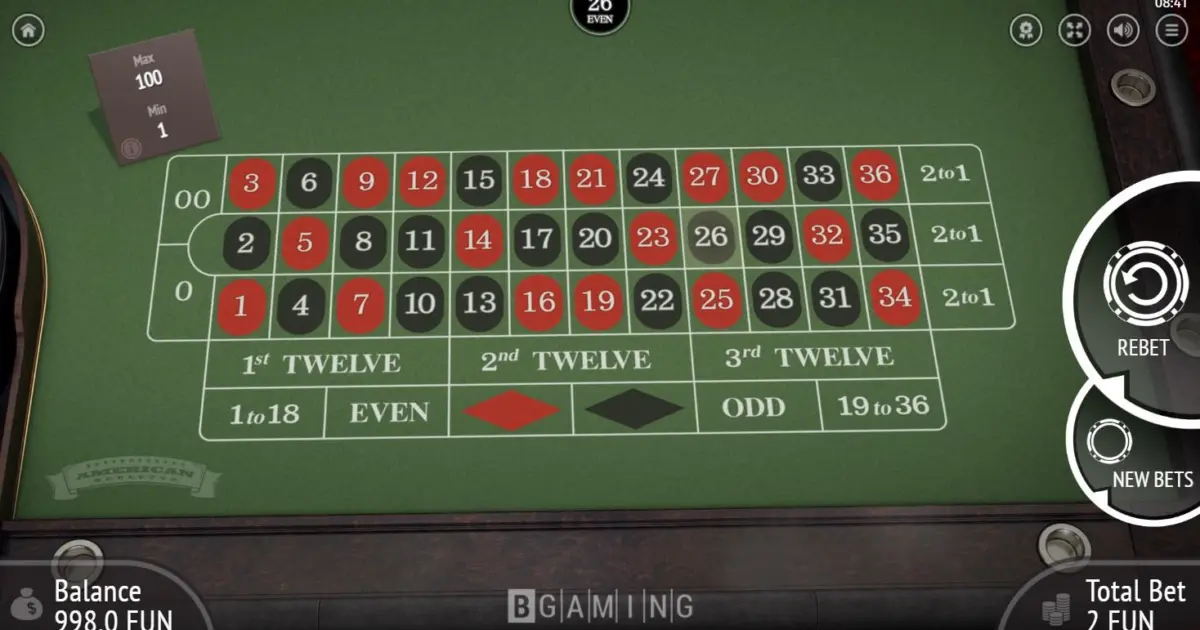
BGaming’s American Roulette gives you the 38-pocket layout with a stated 97.3% RTP, which sits well above the 94.74% you’d expect from a standard American wheel. That figure matters, but the double-zero format still costs you more per spin than any European table. The question is whether the gap is small enough to ignore, or whether you should route your session to a single-zero wheel instead.
How American Roulette (BGaming) plays
You’re working with 38 pockets: numbers 1 through 36, plus 0 and 00. The layout offers the full spread of inside bets—straight-up through six-line—and the standard outside bets: red/black, odd/even, dozens, and columns. The interface is clean, bet confirmation is immediate, and the wheel spins without ceremony. BGaming has kept the mechanics simple: place chips, spin, settle, repeat. No multipliers, no side bets, no progressive features. This is the format as it was designed, with the double-zero tax fully intact.
The pocket count is the whole story
A single-zero European wheel has 37 pockets and a house edge of 2.70% on every standard bet. An American wheel adds a second zero, raising the count to 38 and the house edge to 5.26%. The payout structure stays the same—a straight-up win still pays 35:1—but the true odds shift from 36:1 to 37:1. That one-pocket difference doubles the cost of every bet you make, and no layout strategy can erase it. The 97.3% RTP BGaming quotes here implies a 2.70% house edge, which is the European figure. Confirm that number on the in-game rules screen before committing real money, because if the effective edge is closer to 5.26%, the gap between what you expect and what you get will be wide and expensive.
Reading the 97.3% figure
Return to player is the long-run percentage of all wagers the game pays back. At 97.3%, the house keeps 2.70% of every euro, dollar, or pound you bet, on average, over tens of thousands of spins. That matches the European wheel edge, not the American one. A standard American wheel with both 0 and 00 should return 94.74% on most bets—the five-number basket bet is worse at 92.11%—so this table either applies a modified payout structure or uses a non-standard pocket configuration. BGaming offers both a European and a French roulette table at the same 97.3% figure, which suggests the provider may be running a family of wheels with consistent RTP regardless of label. Check the paytable in-game. If straight-up pays 35:1 and you have two green pockets, the maths don’t reconcile with 97.3% unless something else in the structure has shifted. If you’re choosing between this table and European Roulette (BGaming), and both show the same RTP, the European wheel is the safer default.
Choosing bets for the session you want
Every standard bet on a roulette wheel carries the same house edge—2.70% on European, 5.26% on American. What changes is variance. A straight-up number pays 35:1 and hits roughly once every 37 or 38 spins. An even-money bet pays 1:1 and hits just under half the time. The edge is identical; the ride is not. If you want long, steady sessions with small swings, bet red/black or odd/even. If you’re hunting one large hit and accept that most spins will lose, bet inside numbers. Splitting your stake across multiple inside bets smooths variance without changing expected value—you’ll hit more often, but each win pays less. No combination of bets, no coverage pattern, and no sector strategy alters the percentage the house keeps. The layout is a variance menu, not an edge menu.
Martingale and friends: the honest answer
Betting systems do not work. The Martingale—double after every loss until you win—will recover one unit when it succeeds and lose your entire bankroll when you hit a long streak or the table limit. The Fibonacci and D’Alembert progressions smooth the ride slightly but deliver the same negative expectation. Waiting for five reds in a row before betting black does nothing; the wheel has no memory, and every spin is independent. Tracking hot and cold numbers on an RNG wheel is theater. The only effect a progression has is to redistribute variance: you trade many small wins for the occasional total loss. If you enjoy the structure, play it in demo mode where the consequences are zero. If you’re betting real money, understand that no system, no pattern, and no “due” number changes the fact that the house edge applies to every spin you make.
Bankroll and table limits
Table limits shape how long your session can survive and how far a Martingale progression can run before it hits the ceiling. BGaming has not published the min/max figures for this table in the facts provided, so check the bet panel in the demo or the real-money client before you start. A tight limit—say €1 to €100—will choke a doubling progression after seven losses. A wide limit gives you more rope but doesn’t change the expected outcome. Set a budget in advance, treat it as the cost of entertainment, and stop when it’s gone. Roulette is not an income strategy. No number is due, no system is low-risk, and no run of luck proves the wheel is beatable. Play because you enjoy the game, not because you expect to win. 18+. If gambling is affecting your life, seek support before the cost becomes unmanageable.
Verdict on American Roulette (BGaming)
BGaming’s American Roulette sits in an unusual place. The stated 97.3% RTP matches the European and French wheels in the same provider’s catalog, but the title and format point to a 38-pocket layout that should carry a 5.26% edge. That conflict means you must verify the game’s actual paytable and pocket count before playing for real money. If the 97.3% figure holds and the wheel genuinely has 38 pockets, the provider has altered something in the payout structure to compress the edge, and that’s worth understanding in detail. If the RTP is accurate and the wheel is effectively European under an American label, you’re better served by European Roulette (BGaming) or French Roulette (BGaming), both of which carry the same return figure without the confusion. If the stated RTP is an error and the wheel runs at standard American odds, you’re paying nearly double the house edge of a single-zero table, and every other roulette game in the BGaming lineup becomes a better choice. The game itself is clean, fast, and free of distractions. The demo is available, so test it, read the rules screen, and compare the cost to European Roulette (Red Tiger) before committing your session bankroll. The maths always wins; make sure you know what the maths actually are.
| Bet type | Payout | European true odds | American true odds | European edge | American edge |
|---|---|---|---|---|---|
| Straight-up | 35:1 | 36:1 | 37:1 | 2.70% | 5.26% |
| Split | 17:1 | 17.5:1 | 18:1 | 2.70% | 5.26% |
| Street | 11:1 | 11.33:1 | 11.67:1 | 2.70% | 5.26% |
| Corner | 8:1 | 8.25:1 | 8.5:1 | 2.70% | 5.26% |
| Red/Black | 1:1 | 1.06:1 | 1.11:1 | 2.70% | 5.26% |
| Odd/Even | 1:1 | 1.06:1 | 1.11:1 | 2.70% | 5.26% |
Frequently Asked Questions
Can I play American Roulette (BGaming) for free?
Yes, the free demo is available. Use it to verify the pocket count, confirm the paytable, and check whether the stated 97.3% RTP reconciles with the wheel layout before playing for real money. Demo play is the only risk-free way to test the game's actual structure.
What does the 97.3% RTP mean for my session?
Over tens of thousands of spins, the game returns 97.3% of all wagers and keeps 2.70%. That's the European wheel figure. A standard American wheel with 0 and 00 should return 94.74%, so confirm the in-game rules explain how BGaming reaches 97.3% on a 38-pocket layout.
Is the house edge different on inside versus outside bets?
No. Every standard bet on a roulette wheel carries the same house edge—2.70% on a European wheel, 5.26% on American. Inside bets pay more but hit less often; outside bets pay less but hit more often. The variance changes, the expected loss per euro wagered does not.
Does the Martingale system beat American Roulette?
No. Doubling after every loss recovers one unit when you win and destroys your bankroll when you hit a long streak or the table limit. The house edge applies to every spin, and no progression changes that. Spins are independent; the wheel has no memory.
How does this compare to European Roulette from the same provider?
BGaming lists both wheels at 97.3% RTP. If both figures are accurate, the European wheel is the simpler choice—it carries the expected 2.70% edge without the confusion of a 38-pocket layout that somehow returns European-level RTP. Verify both paytables and pick the one whose maths you can confirm.




