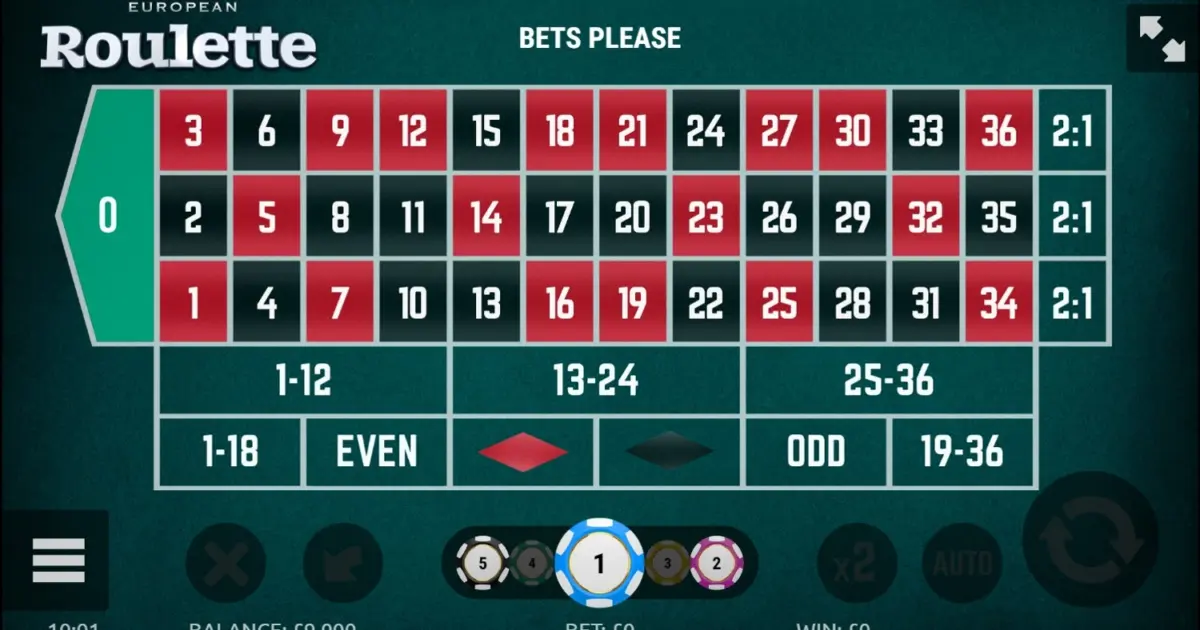
If you want a plain single-zero wheel without side bets or multiplier gimmicks, european roulette (g.games) is built for that job. The published RTP is 97.3%, which lines up with what a standard 37-pocket wheel returns, and a free demo is available so you can look at the layout and the paytable before any money moves. There is nothing here that will change the maths in your favour, and nothing that quietly makes it worse either.
What kind of roulette is European Roulette (G.Games)?
The title names the European wheel, and FACTS records that hint as a single-zero, 37-pocket layout with a 2.70% house edge on every standard bet. Treat that as a strong indication rather than a confirmed table rule. Game titles are marketing copy, and the only place a wheel’s actual pocket count and rule set are guaranteed is the game’s own rules screen. Open it, count the pockets on the wheel graphic, and check whether there is one zero or two before you place a real-money bet.
What is not recorded in FACTS is equally worth knowing. There is no information here on whether this table applies La Partage or En Prison on even-money bets when zero lands. That matters more than almost anything else on the page: with La Partage, the even-money house edge drops from 2.70% to roughly 1.35%, which is the best standard bet in roulette. Without it, red, black, odd, even, high and low carry the same 2.70% as every other standard bet. FACTS also says nothing about table minimums and maximums, a racetrack, call bets such as voisins du zéro or orphelins, or any side bet. If those features matter to how you play, confirm them in the game itself rather than assuming a stripped-back table has them.
Return to player and house edge
The recorded RTP for this table is 97.3%. That is the long-run figure: across a very large number of spins, the game is modelled to return 97.3% of everything staked, leaving 2.7% as the theoretical margin. It is not a session promise and it is not a per-spin figure. A hundred spins can land anywhere.
That 97.3% is exactly the number a standard single-zero wheel produces, which is a useful consistency check against the European hint in the title. On a 37-pocket wheel, a straight-up number pays 35:1 against true odds of 36:1. That one-pocket gap, repeated across every bet type on the felt, is the entire house edge — 1/37, or 2.70%. It does not matter whether you back one number or eighteen; the expected loss per unit staked is identical. The exception on other wheels is the double-zero American layout, where 38 pockets push the edge to 5.26% and the five-number basket bet to 7.89%. Nothing in FACTS suggests this is that kind of table.
For context, G Games lists seven games in this corpus with an average RTP of 97.36%, and the site-wide average across all roulette tables sits at 96.97%. This table is 0.33 points above that broader average, which is a small but real advantage over a typical wheel — and a large one over any double-zero table.
Reading the G Games paytable before you bet
Standard roulette payouts are fixed by geometry, so a classic table’s paytable should hold no surprises: 35:1 straight up, 17:1 split, 11:1 street, 8:1 corner, 5:1 six-line, 2:1 column and dozen, 1:1 on the even-money bets. If the paytable in front of you shows those numbers, the game is behaving like a conventional wheel and the 97.3% figure makes sense.
The reason to look anyway is that multiplier formats change the deal. Lightning-style games fund their headline multipliers by cutting the base straight-up payout — often to 29:1 or lower — so the effective return on a straight bet is not the same as on a classic wheel, and has to be read from that game’s own paytable rather than inferred from the category. FACTS records no multipliers, no side bets and no bonus mechanics for this table, so there is no reason to expect a reduced straight-up payout here. But the check costs ten seconds.
Two other things to look for on the rules screen: what happens to even-money bets when zero lands, since that is the La Partage question and FACTS does not answer it, and the minimum and maximum stakes per bet type. Outside bets and inside bets usually carry different limits, and that ceiling is what determines whether a staking plan survives a losing run at all.
Bet coverage, variance and session length
Choosing between inside and outside bets changes the shape of your results, not the expected value. The table below shows standard single-zero figures, assuming this wheel follows the conventional layout its name implies.
| Bet | Pockets covered | Payout | True odds | Win chance |
|---|---|---|---|---|
| Straight up | 1 | 35:1 | 36:1 | 2.70% |
| Split | 2 | 17:1 | 17.5:1 | 5.41% |
| Street | 3 | 11:1 | 11.33:1 | 8.11% |
| Corner | 4 | 8:1 | 8.25:1 | 10.81% |
| Six-line | 6 | 5:1 | 5.17:1 | 16.22% |
| Column or dozen | 12 | 2:1 | 2.08:1 | 32.43% |
| Red, black, odd, even, high, low | 18 | 1:1 | 1.06:1 | 48.65% |
Read the last column as session length. Even-money bets land just under half the time, so a fixed-stake session drifts slowly and lasts longer for a given bankroll. A straight-up number lands roughly once in 37 spins and pays 35 units, which produces long dry stretches punctuated by sharp spikes. Neither is a better bet; they are different ride profiles with the same 2.70% cost per unit staked.
Patterns, hot numbers and the gambler’s fallacy
Spins on an RNG wheel are independent. The wheel does not remember what it did, so no number, colour or sector is ever due, hot or cold. Eight reds in a row tells you nothing about the ninth spin, which remains 18 pockets out of 37 for red, 18 for black and one for zero — exactly as it was before.
That independence is why no staking system changes expected value. Martingale, Fibonacci, D’Alembert, Labouchère, waiting for five reds before backing black: every one of them redistributes variance without touching the 2.70% margin. Martingale in particular trades many small wins for occasional catastrophic ones, and the table maximum is the wall it eventually hits. If you have to double from 1 unit, ten consecutive losses means a 1,024-unit bet to recover 1 unit, and most tables cap out long before that. If you arrived looking for a system that works, the honest answer is that none does, and the useful part is knowing what to expect instead. Any tracking display, statistics panel or history strip in a roulette game is decoration, not information.
Trying the demo
A free demo is available for this table, which makes it straightforward to try European Roulette (G.Games) with no download and no deposit. Use the demo for what it is good at: confirming the pocket count, reading the paytable, checking the zero rule on even-money bets, and finding the bet minimums and maximums. Those are the four facts FACTS cannot give you and the game can. Demo results do not predict real-money results — the sample is small and the outcomes are not money either way.
Roulette is entertainment, not income. Play only if you are 18 or over, decide your budget before you open the game rather than during a losing run, and treat that amount as the cost of the session. If chasing losses starts to feel reasonable, close the table.
Worth comparing alongside it: Turbo Roulette if you want faster spin cycles at the same 97.3% RTP, and 10c Roulettte if a low stake floor matters more to you than speed. LeoVegas European Roulette is another single-zero table at the same published return, useful if you want to see how a different studio lays out the same maths.
Verdict on European Roulette (G.Games)
A straightforward single-zero table with a published 97.3% RTP, a free demo, and no mechanics layered on top that would erode the base payouts. Against a site-wide roulette average of 96.97% it is modestly ahead, and against any double-zero wheel it is far ahead — 2.70% versus 5.26% per unit staked is the biggest single decision in roulette. The gaps are informational rather than structural: FACTS does not confirm the zero rule on even-money bets, the table limits, or whether a racetrack and call bets are present. The first of those is worth a look before you bet, because La Partage would roughly halve the even-money edge. Check the rules screen, pick a bet type that matches how long you want the session to last, and accept that the 2.70% applies to all of them equally.
Frequently Asked Questions
Can I play European Roulette (G.Games) for free?
Yes, a free demo is available for this table, so you can spin without a deposit or download. Use it to confirm the pocket count, read the paytable, and find the bet limits. Demo results tell you nothing about how a real-money session would go, since the sample is small and no money is at stake.
What is the RTP of European Roulette (G.Games)?
The recorded RTP is 97.3%, meaning the game is modelled to return 97.3% of total stakes over a very large number of spins. That leaves a 2.7% theoretical margin. It is a long-run average, not a session forecast, and it sits 0.33 points above the 96.97% average across roulette tables on this site.
Is this a single-zero or double-zero wheel?
The title points to a European wheel, which normally means 37 pockets, one zero and a 2.70% house edge on every standard bet. The 97.3% RTP is consistent with that. Confirm it on the game's own rules screen before betting real money, since a double-zero layout would carry 5.26% instead.
Does the Martingale system work on this table?
No. Spins are independent and the wheel has no memory, so no progression changes the 2.70% expected cost per unit staked. Martingale swaps frequent small wins for rare large losses and runs into the table maximum quickly: ten straight losses from one unit requires a 1,024-unit bet to recover a single unit.
Who makes European Roulette (G.Games) and what else do they offer?
G Games develops it, and the studio has seven titles in this corpus with an average RTP of 97.36%. Their other roulette tables share the same 97.3% figure, including Turbo Roulette for faster spins and 10c Roulettte for lower stakes. FACTS does not record a release date for this particular table.




