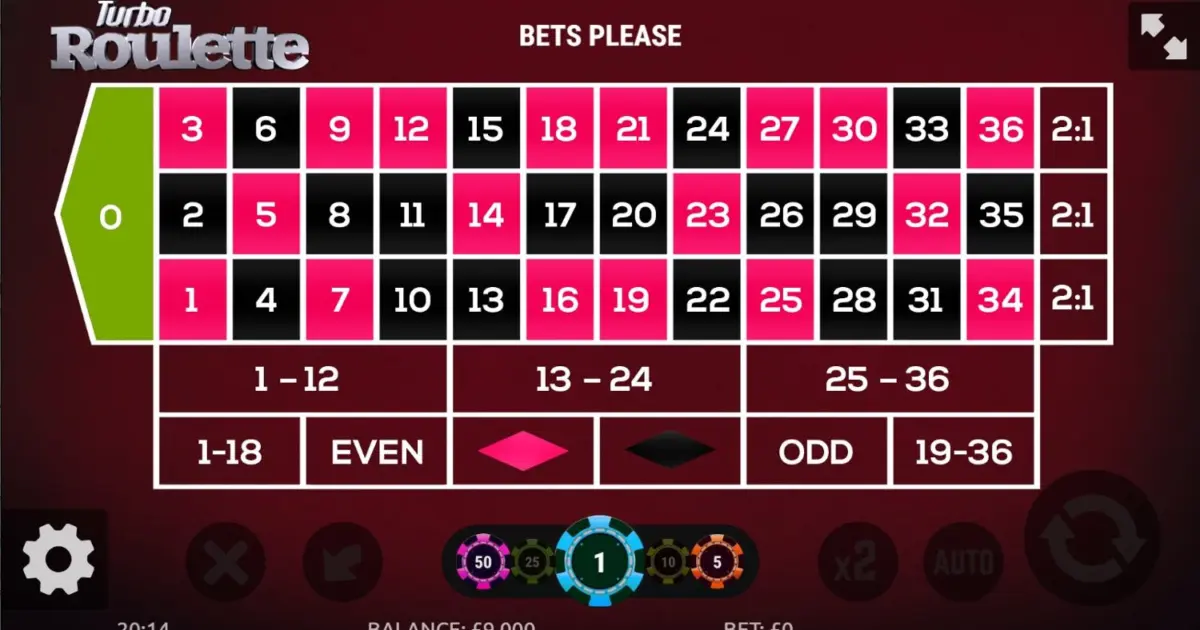
Turbo Roulette strips away wait time and auto-plays the maths you already know, for better or worse. The 97.3% RTP confirms this is built on European wheel foundations—single zero, 2.70% house edge on standard bets—but the turbo format means you’ll burn through twenty or thirty decisions in the time a live dealer would deal eight. If you’re playing for entertainment on a fixed budget, that budget disappears faster. If you’re chasing a number, you’ll get more chances per minute, but the house edge doesn’t sleep.
The variant is the speed, not the structure. Every rule that governs a classic European wheel governs this one. The question is whether you want to play it at double tempo.
Is Turbo Roulette worth your spins?
Worth it if you understand what “turbo” costs. The 97.3% return-to-player figure matches the European standard exactly, so over infinite spins you’re losing 2.70% of total money wagered whether the wheel spins every eight seconds or every thirty. But infinite spins is a textbook concept. In practice, you’re sitting down with a fixed amount of money and a fixed amount of time, and turbo format chews through both.
Thirty spins per hour at €2 per spin risks €60. Ninety spins per hour at the same stake risks €180. The house edge applies to the larger number. Faster play does not change expected value, but it does change the speed at which variance can flatten or inflate your stack. If you’re playing for the thrill of coverage bets or the long-shot dopamine of a straight-up hit, turbo delivers. If you’re trying to make a small bankroll last, this is the wrong format.
The 97.3% RTP is real, and it’s as good as single-zero roulette gets without French rules. The turbo mechanism is the trade: same fairness, compressed time, higher emotional and financial tempo.
G Games and this wheel
G Games publishes seven roulette titles in the demo database, and Turbo Roulette sits in the middle of that range at 97.3% RTP—identical to the provider’s average of 97.36%. That consistency suggests a house committed to European wheel maths rather than inventing edge variations across formats. The provider’s other speed and standard wheels include 10c Roulettte, LeoVegas European Roulette, and European Roulette Darkmode, all carrying the same 97.3% return.
G Games is not a household name in the tier occupied by Evolution or NetEnt, but the maths here is transparent and the RTP disclosure is complete. For roulette, that’s what matters. The game logic is centuries old; what separates one publisher’s wheel from another is interface quality, speed options, and whether they publish the figures. G Games does.
House edge: 2.70%, 5.26% or 1.35%?
The 97.3% RTP figure tells you this is a single-zero European wheel, which yields a house edge of 2.70% on every standard bet. The maths is simple: 37 pockets, one of them zero. A straight-up bet pays 35:1, but true odds are 36:1. That one-unit gap, multiplied across the layout, is the house edge. It applies equally to red/black, dozens, corners, splits—every bet except those covered by French rules, which this wheel does not advertise.
A double-zero American wheel would show 94.74% RTP (5.26% house edge) because 38 pockets shrink your probability on every bet while payouts stay fixed. The five-number basket bet (0, 00, 1, 2, 3) is even worse at 92.11% RTP. Turbo Roulette avoids that trap entirely by using the European layout.
French rules—La Partage or En Prison—return half your stake on even-money bets when zero lands, cutting the house edge on those bets to roughly 1.35%. That’s the best standard roulette bet available anywhere. FACTS does not confirm French rules for this table, so assume the edge is the standard 2.70% until you see “La Partage” or “En Prison” printed in the game’s rules screen. The name “Turbo Roulette” says nothing about rule variants; it describes spin cadence, not payout structure.
If you’re choosing between wheels and one offers La Partage at the same speed, take that one. If this is your only single-zero option, 2.70% is as fair as roulette gets without the French refinement.
Bet types, payouts and true odds
The table below shows the European wheel structure this game is built on. Every bet listed carries the same 2.70% house edge because the payout structure is calibrated to 37 pockets with one zero.
| Bet type | Payout | True odds (single-zero) | House edge |
|---|---|---|---|
| Straight-up (one number) | 35:1 | 36:1 | 2.70% |
| Split (two numbers) | 17:1 | 17.5:1 | 2.70% |
| Street (three numbers) | 11:1 | 11.33:1 | 2.70% |
| Corner (four numbers) | 8:1 | 8.25:1 | 2.70% |
| Line (six numbers) | 5:1 | 5.17:1 | 2.70% |
| Dozen / Column | 2:1 | 2.08:1 | 2.70% |
| Red / Black, Even / Odd, High / Low | 1:1 | 1.056:1 | 2.70% |
Inside bets (straight-up through line) offer high payouts and high volatility. Outside bets (dozens, columns, even-money) offer frequent small wins. Neither changes your expected loss per euro wagered. The difference is in how variance plays out: a straight-up bettor will see long stretches of nothing punctuated by occasional 35:1 hits; an even-money bettor will see something close to breakeven interrupted by zero landings and short streaks.
In turbo format, both profiles accelerate. You’ll see more wins and more losses per hour, and the swings—up or down—arrive faster.
What experienced players actually do
Experienced roulette players accept the house edge as the cost of entry and manage variance instead of fighting it. That means flat staking: same bet size every spin, no progression, no doubling after losses. Martingale and Fibonacci systems feel like control, but they only redistribute risk. A six-step Martingale on a €5 base requires €315 in total to recover a €5 loss, and table limits will block you before you finish the sequence half the time.
In turbo format, progressions become especially dangerous because you hit the ceiling faster. If your system needs eight spins to recover, and you’re playing ninety spins per hour instead of thirty, you’ll encounter your stop-loss or table-limit wall three times as often.
The lowest-edge bet on a standard European wheel is any even-money option—red, black, odd, even, high, low—all at 2.70%. If French rules applied, those same bets would drop to 1.35%, making them the only rational choice. FACTS does not confirm La Partage here, so treat all standard bets as equivalent in expected value and choose based on volatility preference: inside for long-shot entertainment, outside for smoother ride.
Session limits matter more than bet selection. Decide in advance how much you’re willing to lose, set that number in your account or your head, and stop when you hit it. Turbo format will test that discipline faster than any other roulette variant.
Free play before real money
Turbo Roulette offers free demo play, and you should use it. Not because demo results predict anything—the RNG doesn’t care whether you’re playing for free or for cash—but because ten minutes in demo will tell you whether the pace suits your temperament. If you feel rushed, if you’re placing bets before you’ve decided, if the speed turns the game into a reflex test rather than a choice, real money will make that worse.
Demo mode also lets you test the interface at full tempo: chip placement, undo and confirm buttons,bet history, how the timer displays. Turbo means less time between decision and commit, so a clumsy UI becomes expensive. If the controls feel sluggish or you’re accidentally covering sectors you didn’t intend, find a different wheel.
When you do switch to real money, set a budget in advance and treat it as entertainment spend, not investment. Roulette is a negative-expectation game. Over enough spins, the house edge will take its 2.70%. You’re paying for the experience of variance and the possibility of a short-term win, not a reliable income stream. Play only with money you can afford to lose, set a session limit before you start, and never chase losses. If you’re under 18, you cannot play legally. If the game stops being fun, stop playing.
Final take
Turbo Roulette is exactly what it claims: European wheel maths delivered at maximum speed. The 97.3% RTP and 2.70% house edge are standard for a single-zero layout, and G Games publishes the figures clearly. The turbo mechanism doesn’t touch the fairness of the game, but it does touch the speed at which your bankroll moves. More spins per hour means more opportunities to win and more opportunities to lose, with the house edge grinding on a larger total wagered.
If you’re comfortable with that tempo and you’ve set a hard stop-loss, this wheel is as fair as single-zero roulette without French rules can be. If you want your money to last longer, play a standard-speed European wheel instead. The maths is identical, but the clock is kinder.
Frequently Asked Questions
Is Turbo Roulette available in free demo mode?
Yes, Turbo Roulette offers free demo play. Use it to test the interface and pace before committing real money—the turbo format plays much faster than standard roulette, and ten minutes in demo will show you whether that tempo suits your decision-making style and temperament.
What is the RTP and house edge for Turbo Roulette?
Turbo Roulette has a 97.3% RTP, confirming a 2.70% house edge typical of European single-zero wheels. That edge applies equally to every standard bet on the layout, from straight-up numbers to even-money outside bets like red or black.
Does the turbo speed change the house edge or RTP?
No. The turbo format only increases spin frequency; it does not alter the 2.70% house edge or 97.3% RTP. However, more spins per hour means you wager more total money in the same session, so the house edge applies to a larger sum and your bankroll depletes or grows faster.
Can I use a betting system like Martingale on Turbo Roulette?
You can place the bets, but no progression system changes the house edge or expected value. Martingale and similar strategies only redistribute variance and increase the risk of hitting table limits quickly—especially dangerous in turbo format, where you'll cycle through a progression sequence three times faster than on a standard wheel.
How does Turbo Roulette compare to other G Games wheels?
G Games publishes seven roulette titles, and Turbo Roulette shares its 97.3% RTP with several others including 10c Roulettte and European Roulette Darkmode. The distinguishing feature here is speed, not odds—if you prefer slower play with identical maths, those alternatives are available from the same provider.




