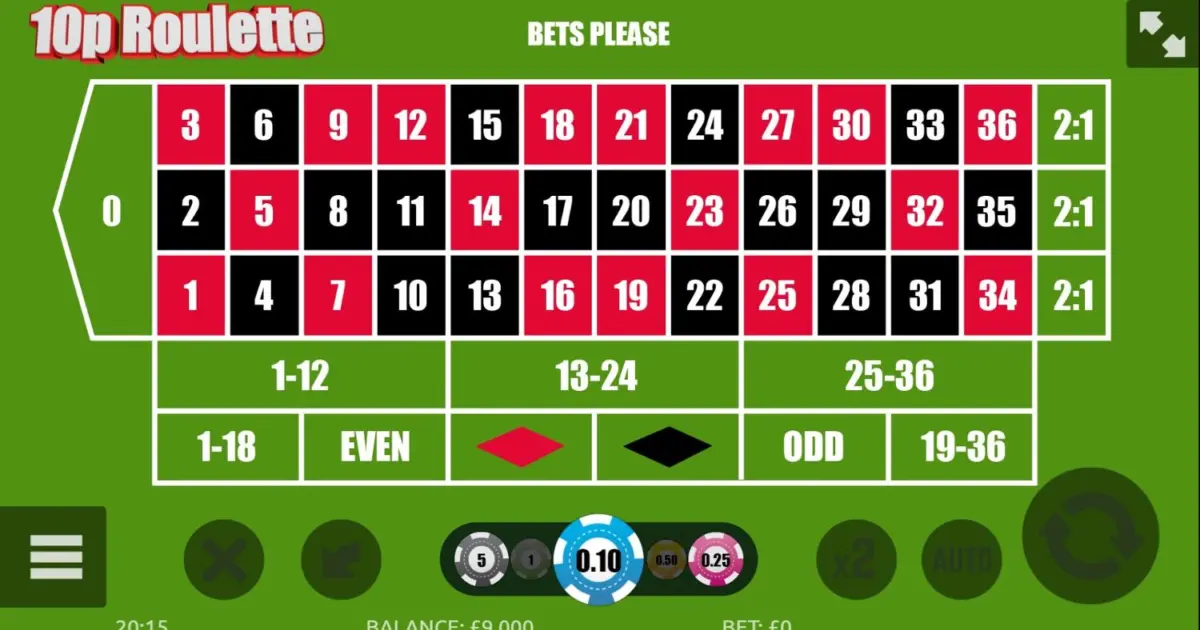
The one number worth knowing before anything else: G Games publishes an RTP of 97.3% for this table, and a free demo is available. That RTP is the mirror image of a 2.70% house edge, the figure attached to a standard single-zero wheel, though the FACTS available here do not confirm the pocket count or the zero rules directly.
So this is a table where the published number is good by roulette standards and the demo costs nothing. What it is not is a table you should stake real money on before opening the rules screen and reading what the wheel actually does with a zero.
Is 10c Roulettte worth your spins?
On the published figures, yes — with one caveat you have to resolve yourself. A 97.3% RTP is 0.33 points above the average of 96.97% across the roulette tables covered on this site. In practical terms, that is the difference between an expected loss of roughly 2.70 per 100 staked and roughly 3.03 per 100 staked. Over a long session those decimals matter more than they look.
The caveat is that RTP alone does not tell you which wheel you are spinning. A 97.3% return is exactly what a single-zero wheel with no special zero rules produces on every standard bet. But the same number can turn up on tables built differently, and nothing in the information available here states the pocket count, whether La Partage or En Prison apply, what the table limits are, or whether a racetrack and call bets are offered. Those are all decision-relevant, and all of them are printed in the game’s own rules panel.
The table sits at rank 104 on this site, in the 53.8th percentile for popularity. That is squarely mid-pack: not a headline release, not obscure.
G Games and this wheel
G Games has seven games in the catalogue covered here, with an average RTP of 97.36% across them. Seven titles is a compact portfolio, and the tight clustering around 97.3% suggests a studio that builds to a consistent target rather than mixing high- and low-return products under one brand.
You can see that consistency in the sibling tables. Turbo Roulette lists the same 97.3% RTP and is the one to look at if you want faster spin cycles at the same published return. LeoVegas European Roulette also sits at 97.3% and names its wheel type in the title, which removes the ambiguity you have to resolve manually here. If you prefer a darker interface for long sessions, European Roulette Darkmode matches the same figure again.
The practical takeaway: within this group, RTP is not the differentiator. Speed, interface, bet-placement layout and stated table limits are. Compare those instead of chasing a return figure that is identical across all four.
House edge: 2.70%, 5.26% or 1.35%?
Three numbers cover almost every roulette table you will meet, and they come from the wheel and the zero rules, not from the graphics.
- 2.70% — a single-zero European wheel with 37 pockets. Every standard bet carries this edge, from a straight-up number to red/black. It corresponds to an RTP of 97.30%.
- 5.26% — a double-zero American wheel with 38 pockets. The extra pocket almost doubles the edge. The five-number basket bet on that layout is worse still at 7.89%, and there is never a reason to place it.
- 1.35% — a French-rules table where La Partage returns half your even-money stake when zero lands, or En Prison holds it for one more spin. This applies only to even-money bets, and it is the best standard bet available anywhere in the game.
The published 97.3% here matches the first of those three exactly. That is a strong pointer toward a 37-pocket single-zero layout, but it is a pointer, not a confirmed rule for this table. Nothing available states the pocket count. Open the rules screen, count the pockets on the wheel graphic, and check whether zero triggers any stake return on even-money bets. If it does, your even-money edge is better than the headline RTP suggests. If it does not, 2.70% is what you are playing against on every bet you place.
Bet types, payouts and true odds
The table below assumes a 37-pocket single-zero wheel, the layout the 97.3% figure points to. Confirm the pocket count in-game before relying on it. Notice that the edge is identical on every line — the payout gap is always exactly one pocket wide.
| Bet | Numbers | Payout | True odds | Win chance | House edge |
|---|---|---|---|---|---|
| Straight up | 1 | 35:1 | 36:1 | 2.70% | 2.70% |
| Split | 2 | 17:1 | 17.5:1 | 5.41% | 2.70% |
| Street | 3 | 11:1 | 11.33:1 | 8.11% | 2.70% |
| Corner | 4 | 8:1 | 8.25:1 | 10.81% | 2.70% |
| Line | 6 | 5:1 | 5.17:1 | 16.22% | 2.70% |
| Column / dozen | 12 | 2:1 | 2.08:1 | 32.43% | 2.70% |
| Red/black, odd/even, high/low | 18 | 1:1 | 1.06:1 | 48.65% | 2.70% |
Inside and outside bets change the shape of your session, not its expected cost. A straight-up number wins 2.70% of the time and pays 35 times your stake; red/black wins 48.65% of the time and pays once. Same edge, wildly different swings.
What experienced players actually do
They stake flat. The same chip value every spin, no doubling after a loss. Martingale, Fibonacci, D’Alembert and “wait for five reds then bet black” do not change expected value by a single decimal place, because spins are independent and the wheel has no memory. What progressions do is compress your losses into fewer, larger events and drive you into the table limit faster. That is a change in variance, not a change in maths.
They also refuse to treat past results as information. A number that has not landed in 200 spins is not due. A red streak does not make black more likely. On an RNG wheel every spin is drawn fresh, and any tracking display the game offers is decoration.
Beyond that, the habits are unglamorous: pick the lowest-edge bet the table offers, which means even-money bets if La Partage is present and otherwise anything you like since all standard bets cost the same 2.70%; set a session budget and a spin count before you start; and decide in advance what you do when the budget is gone, which is stop.
Free play before real money
A free demo is available for this table, and it has one genuinely useful job: letting you read the rules screen, count the wheel pockets, check the stated minimum and maximum stakes, and see whether a racetrack or call-bet panel exists. None of that information is available in the data covered here, and all of it is available in the game itself for zero cost. Use the demo as a rules inspection, not a rehearsal.
What the demo cannot do is tell you anything about how real-money sessions will go. Demo results have no predictive value whatsoever. A hot run in free play and a cold run in free play carry exactly the same information about your next real spin: none.
Roulette is 18+ only. Set a budget before you open the game, treat it as the cost of entertainment rather than a way to make money, and never stake funds you need for anything else. If the amount you are betting has stopped feeling like entertainment, that is the signal to close the tab and use a deposit limit or self-exclusion tool.
Final take
10c Roulettte free demo access plus a published 97.3% RTP makes this a reasonable table to look at, sitting slightly above the 96.97% corpus average. The G Games catalogue is small at seven titles but consistent, and the three sibling tables all land on the same return figure.
The honest summary is that the published number is good and the specifics are unverified. Pocket count, zero rules, table limits and call-bet availability are all unstated in the information available, and every one of them affects what you are actually playing. The demo answers all four in about thirty seconds. Do that first, then decide.
Frequently Asked Questions
Can I play 10c Roulettte for free without downloading anything?
Yes. A free demo is available for this table, so you can spin with virtual credits and no download or deposit. Use it to read the rules screen, count the wheel pockets and check the stated stake limits, since none of those details are confirmed in the published data available here.
What is the 10c Roulettte RTP?
G Games publishes 97.3% for this table. That is 0.33 points above the 96.97% average across the roulette games covered on this site, and it matches the G Games portfolio average of 97.36% across their seven titles. It equates to an expected loss of about 2.70 per 100 staked.
Which wheel is this and what is the house edge?
The 97.3% RTP points to a single-zero 37-pocket wheel with a 2.70% house edge, but the pocket count is not confirmed in the available data. A double-zero wheel would be 5.26%, and French La Partage rules would cut even-money bets to about 1.35%. Check the rules screen.
Does the Martingale system work on this table?
No. No betting system changes expected value, because spins are independent and the wheel has no memory. Martingale, Fibonacci and D'Alembert redistribute variance into fewer, larger losses and push you toward the table maximum faster. At a 2.70% edge, doubling your stake also doubles your expected loss per spin.
How does it compare to other G Games roulettes?
All three sibling tables list the same 97.3% RTP: Turbo Roulette, LeoVegas European Roulette and European Roulette Darkmode. Return is not the differentiator, so compare spin speed, interface and stated table limits instead. LeoVegas European Roulette names its wheel type in the title, which removes the ambiguity here.




