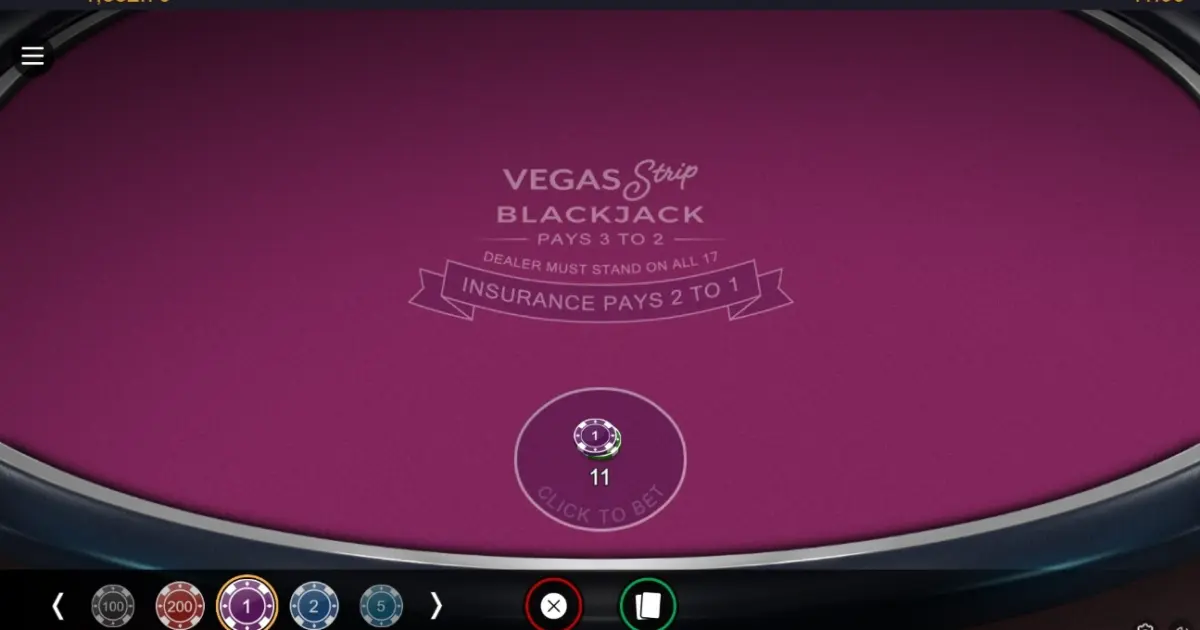
Vegas Strip Blackjack is Switch Studios’ answer to the classic Las Vegas Boulevard table: a standard multi-deck game with a published RTP of 99.7%. The short answer on whether it is worth your time is yes, provided you are willing to verify the specific rule set inside the game before you risk a real-money session. The name carries strong implications about the rules, and those implications work in your favour if Switch Studios has followed convention here.
Vegas Strip Blackjack and the Switch Studios table range
Switch Studios maintains a catalogue of 22 blackjack titles with an average RTP of 99.61%, placing this game slightly above its provider’s mean. Across the wider corpus of reviewed tables the average sits at 99.41%, so Vegas Strip Blackjack clears that benchmark by a meaningful margin.
If you are comparing tables within the same provider, Classic Blackjack carries a higher published RTP of 99.9%, while ReDeal Blackjack sits at 99.6%. The gaps are small — between a third of a percent and two-tenths of a percent — so at this level of return the rules you confirm in the paytable matter more than the headline figure. A 6:5 payout would erase every one of these differences in a single rule change.
Ranked 35th among reviewed blackjack tables with a popularity percentile of 74.4, this game sits in the upper-middle band of the niche without being the most-played variant on the market.
| Provider | Switch Studios |
|---|---|
| RTP | 99.7% |
| Free demo | Yes |
The 99.7% figure, and the assumption behind it
The 99.7% RTP on this table assumes you play perfect basic strategy on every single hand. That is the only assumption, and it is the one that matters most to your actual session.
Basic strategy is a fixed chart derived from combinatorial analysis. It tells you the mathematically optimal action for every player-upcard and dealer-upcard combination, given a specific rule set. When a player follows it without error, the house edge equals 100% minus the RTP — in this case 0.3%. A casual player who deviates even occasionally might face a real edge closer to 1% or 2%, depending on how frequently errors occur.
Published RTP on any RNG blackjack table is therefore a ceiling, not a floor. The gap between 99.7% and your realised return is entirely your responsibility, not the game’s. If you plan to play for money, memorise the chart for the exact ruleset before you sit down, or keep it open on a second screen.
Rules to confirm before you bet real money
Switch Studios labels this game with “Vegas Strip” in the title. In blackjack convention, that name indicates four decks, a dealer standing on all 17s including soft 17, and doubling after split permitted. These are the rules that normally define a Vegas Strip variant.
However, a naming convention is not a confirmed rule set. Treat all three as strong hints and verify them in the in-game information screen before you place a real-money bet. Here is why each matters to your expected return:
- Dealer stands on soft 17 reduces the house edge by roughly 0.2% compared to a hit-soft-17 table. If this rule is inverted at the actual table, your real edge is worse than the 0.3% implied by the 99.7% RTP.
- Four decks is neither the best nor the worst configuration for the player. Single deck is superior; more decks raise the edge by a few hundredths of a percent per additional deck.
- Doubling after split is player-favourable. If it is restricted on this table, that costs you approximately 0.14%.
Paytable details such as the blackjack payout (3:2 versus 6:5) and surrender availability are not specified in the data available here. Check them explicitly.
Strategy: the chart, not a system
Basic strategy minimises the house edge to its theoretical floor. It does not eliminate the edge, and no modification to it does. The 0.3% figure attached to this table represents what remains after you play every decision correctly.
Betting progressions do not alter this. Whether you stake flat, double after a loss, or follow any other pattern, your expected value per hand stays negative. Progressions redistribute the shape of your variance across the session — making your drawdowns steeper or your peaks flatter — without shifting the mean. A Martingale system that requires you to survive six consecutive losses does not change the probability of those six losses occurring; it only changes the size of the bet you must risk when you eventually lose the seventh.
Card counting does not function against an RNG table that reshuffles every hand. Each round is dealt from a fresh shuffle, meaning the count is always zero and no past round informs any future one. This applies to Vegas Strip Blackjack as it applies to every other RNG blackjack game. Counting requires deck penetration and continuity between rounds, neither of which exists here.
Variance at the blackjack table
Blackjack variance depends on rule specifics, but the general shape is well understood. A 0.3% edge table with standard rules produces a session standard deviation roughly between 1 and 1.5 times your total wagered amount. Over a short session of 100 hands at flat bets, you can expect to swing both above and below your expected loss without that indicating a strategy failure.
Unit sizing should reflect that volatility. A common framework is to divide your session budget into 100 units, so that a single hand costs 1% of your bankroll. At that scale, even a string of ten consecutive losses leaves you with 90% of your budget intact — enough to play through without feeling forced to alter your bet size.
Side bets, if this table offers them, carry a materially higher house edge than the base game. Insurance at standard odds is a losing proposition over time and should be declined unconditionally. If Perfect Pairs or 21+3 are present, their edges typically run between 2% and 7% depending on the paytable.
Free play first
Vegas Strip Blackjack offers a free demo mode. Use it before any real-money session to check two things: the exact rule set displayed in the in-game help screen, and whether the chart you are using for strategy matches those rules. The demo does not predict real-money results because outcomes are independent each hand, but it does let you verify the game’s parameters at zero cost.
Switch to real money only after you have confirmed the rules and are comfortable with your bankroll plan. Blackjack is entertainment with a mathematical structure, not an income source. Set a budget before you sit down, treat it as the cost of the session, and stop when it is gone regardless of how the last few hands went. This game is intended for players aged 18 and over.
If you find yourself chasing losses or extending a session beyond the budget you set, that is the signal to stop rather than a reason to increase your bet. Resources like GamCare and GamStop exist for players who want structure around their play.
Who this table is for
Vegas Strip Blackjack suits players who want a straightforward RNG table with a competitive published RTP and no gimmicks. The 99.7% figure, if the underlying rules match the Vegas Strip convention, puts it among the better RNG blackjack options without requiring you to navigate unusual rule sets or special cards.
It is not the right choice if you are comparing providers for the absolute highest RTP in the niche. High Streak Blackjack from the same provider also sits at 99.6%, while the 99.9% figure on Classic Blackjack edges this table out by two-tenths of a percent — a gap that real strategic errors will overwhelm many times over anyway. Players who already know this is RNG and that counting is irrelevant here, and who value a clean traditional interface over feature-heavy alternatives, will find this table well matched to their preferences.
>>
Frequently Asked Questions
Can I play Vegas Strip Blackjack for free?
Yes. Switch Studios provides a full free demo mode for Vegas Strip Blackjack. You can play every hand without wagering real money, which lets you confirm the exact rule set and test your familiarity with basic strategy before committing any funds. The demo uses the same RNG as the real-money version.
What is the RTP of Vegas Strip Blackjack and does it apply to me?
The published RTP is 99.7%, which means a theoretical house edge of 0.3%. That figure assumes perfect basic strategy on every hand. If you deviate from optimal play even occasionally, your realised return will be meaningfully lower. The gap between 99.7% and your actual session result is entirely about your decisions, not the game.
Does card counting work on Vegas Strip Blackjack?
No. Card counting requires tracking which cards have left the shoe across multiple hands from the same deck penetration. RNG blackjack tables like Vegas Strip Blackjack reshuffle every hand, so each round is dealt from a fresh, complete deck. The count resets to zero after every round and provides no informational advantage on the next.
Who makes Vegas Strip Blackjack?
Switch Studios developed this table. The provider offers 22 blackjack titles in total with an average RTP of 99.61% across that catalogue. Vegas Strip Blackjack ranks at the 74.4th popularity percentile among reviewed blackjack games, placing it in the upper-middle band of the niche.
How does Vegas Strip Blackjack compare to Classic Blackjack from the same provider?
Classic Blackjack from Switch Studios carries a published RTP of 99.9%, which is 0.2 percentage points higher than Vegas Strip Blackjack's 99.7%. In house-edge terms that is the difference between 0.1% and 0.3%. Both assume perfect basic strategy, and the practical gap is smaller than the penalty for a single recurring strategy error.




