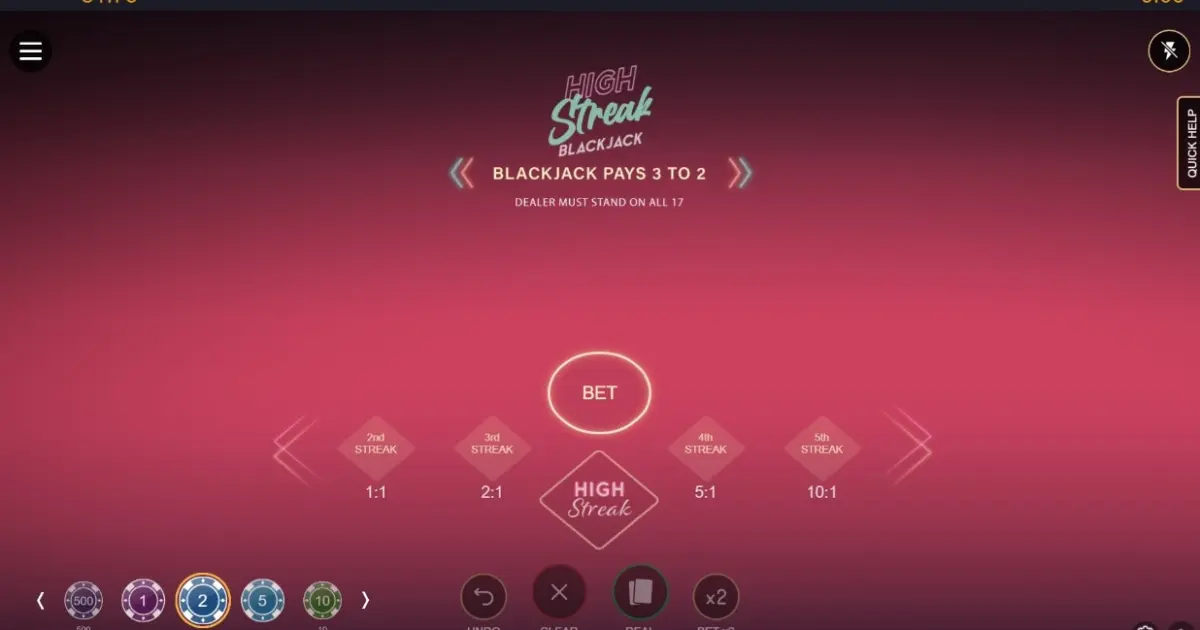
High Streak Blackjack is a digital blackjack table from Switch Studios that publishes an RTP of 99.6%. That number is slightly above the 99.41% corpus average across the demo tables reviewed on this site, which tells you the base math is competitive. But competitive is not the same as transparent. Several rule details that materially move the house edge are absent from the available data, and that gap is the main thing a serious player needs to resolve before deciding whether this table deserves real-money time.
What kind of blackjack is High Streak Blackjack?
Switch Studios categorises this table under “Black Jack” and offers a free demo, meaning you can play without risking anything to get a feel for the flow. The provider maintains 22 blackjack titles in total, and the average RTP across that catalogue is 99.61%, so this table sits precisely on brand. What distinguishes one digital blackjack from another is the rule set: how many decks, what happens on soft 17, whether you can surrender, and the blackjack payout ratio. The title gives no variant clue — nothing that hints at European no-hole-card or single-deck structure — and Switch Studios does not publish those specifics on this table’s data sheet. The in-game rules screen is your only reliable reference, so open it before your first real-money session.
| Provider | Switch Studios |
|---|---|
| RTP | 99.6% |
| Free demo | Yes |
Return to player: 99.6%
The published 99.6% translates to a house edge of 0.4% — a low number by any standard, and the kind you would associate with favourable rules. There is a critical caveat. RTP is calculated assuming perfect basic strategy on every single hand. No casual player achieves that consistently. A player who misplays roughly one hand per hour in a way that costs half a percent will realise materially less than 99.6% over a long session. The figure is a ceiling, not a forecast.
Against the corpus average of 99.41%, this table is +0.19% better on paper. That gap is small enough that unconfirmed rule details could easily explain it — or reverse it. The practical takeaway: trust the number as a signpost, not a guarantee.
Deck count, dealer rules and the payout that matters most
None of these three parameters appear in the available data for this table. That absence is itself the most important fact, because each one moves the edge by measurable amounts.
Deck count affects the house edge by a few hundredths of a percent. Fewer decks favour the player, but only if the blackjack payout stays at 3:2. Dealer soft 17 is worth roughly 0.2%: if the dealer hits soft 17, the edge rises. And the blackjack payout is the single most consequential number on any blackjack table. A 3:2 return pays $15 on a $10 blackjack; 6:5 pays $12. That reduction costs the player approximately 1.4% in house edge — nearly triple the entire published advantage on this table. A 6:5 payout would make the 99.6% RTP figure impossible, so the payout is almost certainly 3:2, but “almost certainly” is not “confirmed.” Check the paytable in-game.
If you want a comparison table with more rules data, Switch Studios’ own Classic Blackjack publishes a 99.9% RTP, suggesting a rule set that is even more player-friendly.
Playing your first ten hands
The free demo is available and requires no registration. That is the correct place to start. Open the rules screen first and note the deck count, the soft-17 instruction and the blackjack payout. Once those three facts are confirmed, you can evaluate whether the 99.6% figure is achievable for you.
Play ten hands and note how the dealer behaves. If the dealer hits soft 17, your standing decisions change on several hands — dealer 2 through 6 with a total of 12 becomes a hit rather than a stand under H17 rules. If the table allows surrender, that is a further edge reduction of roughly 0.07% you can exploit. None of this strategy content is guesswork; it follows from the rules once they are visible to you.
The interface from Switch Studios’ ReDeal Blackjack may look similar at a glance since both carry the same 99.6% RTP, but identical RTP does not guarantee identical rules. Treat each table as its own configuration.
Side bets: the maths behind the temptation
The available data does not specify which side bets, if any, are offered at this table. Switch Studios does list side bet availability for some of its other blackjack titles, so the absence here could mean none, or it could mean the information simply was not published.
The general maths is unforgiving regardless of the specific variant. The base blackjack bet at a 0.4% edge is already one of the best bets in a casino. Side bets almost universally carry house edges between 2% and 8%. Perfect Pairs commonly sits around 3-5% depending on the payout ladder. 21+3 is similar. Insurance pays 2:1 but the probability of a dealer ten-value card is roughly 4:9 against an infinite deck, giving it a house edge near 5.8% — a losing proposition at standard odds no matter what your hand shows.
If this table offers a side bet, the smart default assumption is that it exists to increase the house advantage. The base game is where the 99.6% figure lives. Do not mix bets with different edges and expect a blended result that matches the headline.
Session limits and bankroll
No table limits are published for this specific game. Minimum and maximum bets determine whether a 99.6% table is practical for your budget, so confirm them in the demo before depositing anywhere.
The principle applies universally: set a session budget you are prepared to lose entirely, before you open the game. Blackjack variance is real. Even at a 0.4% edge, losing sessions of fifty or more hands happen routinely because short-term results are dominated by card distribution, not by mathematical expectation. A unit size of one to two percent of your total bankroll keeps drawdowns survivable over a reasonable number of sessions.
Card counting has no application at an RNG table that reshuffles after every hand. No sequential advantage is exploitable. No betting progression — Martingale, D’Alembert or otherwise — changes the expected value of a negative-edge game; it only redistributes when the losses arrive. This is an 18+ entertainment product. Budgets set in advance, losses accepted as the cost of play.
Verdict on High Streak Blackjack
The 99.6% RTP is competitive and places this table above the site average, but the missing rule details — deck count, soft-17 stance, blackjack payout, side bet availability and table limits — prevent any player from verifying that figure for themselves before committing real money. That is not necessarily a criticism of Switch Studios, which may publish these details in-game. But from a review standpoint, unverifiable data is unverifiable.
If the in-game rules confirm 3:2 blackjack, dealer stands on soft 17 and multiple decks, then 99.6% is credible and the table is worth playing. If you find a 6:5 payout or H17 without compensating rules elsewhere, the edge is materially worse than the headline suggests. The Vegas Strip Blackjack entry from the same provider, at 99.7% RTP, may offer a slightly clearer rule set for comparison purposes.
Frequently Asked Questions
Can I play High Streak Blackjack for free?
Yes. Switch Studios provides a free demo that requires no registration. This lets you open the in-game rules screen and confirm the deck count, dealer soft-17 behaviour, blackjack payout and table limits before risking real money. The demo does not predict real-money outcomes, but it does let you verify the rule set that the published RTP assumes.
What is the RTP on High Streak Blackjack and does it apply to my play?
The published RTP is 99.6%, meaning a 0.4% house edge. That figure assumes perfect basic strategy on every single hand. A casual player who makes even occasional errors will realise a meaningfully lower return. The 99.6% is a theoretical ceiling under ideal conditions, not an average you should expect to achieve over a typical session.
How do the rules at this table affect the actual house edge?
The available data does not confirm the deck count, whether the dealer hits or stands on soft 17, or the blackjack payout ratio. Each parameter matters: a 6:5 payout instead of 3:2 adds roughly 1.4% to the house edge, dealer hitting soft 17 adds about 0.2%, and fewer decks slightly reduce the edge. Until these are confirmed in the game's own paytable, the 99.6% figure cannot be independently verified.
Does card counting or any betting system work on this table?
No. This is an RNG-based digital blackjack that reshuffles after every hand, so there is no deck composition to track. Card counting requires a finite deck that is not reshuffled between hands. Betting progressions like Martingale or D'Alembert change the shape of your variance but do not alter the expected value, which remains negative by whatever the true house edge is.
How does High Streak Blackjack compare to Classic Blackjack from the same provider?
Switch Studios' Classic Blackjack publishes a 99.9% RTP versus 99.6% here, which is a 0.3% difference in house edge. Both titles sit above the site average of 99.41%. Without published rule details for either table, the RTP gap likely reflects a difference in one or more parameters such as deck count or surrender availability. Both offer free demos for rule verification.




