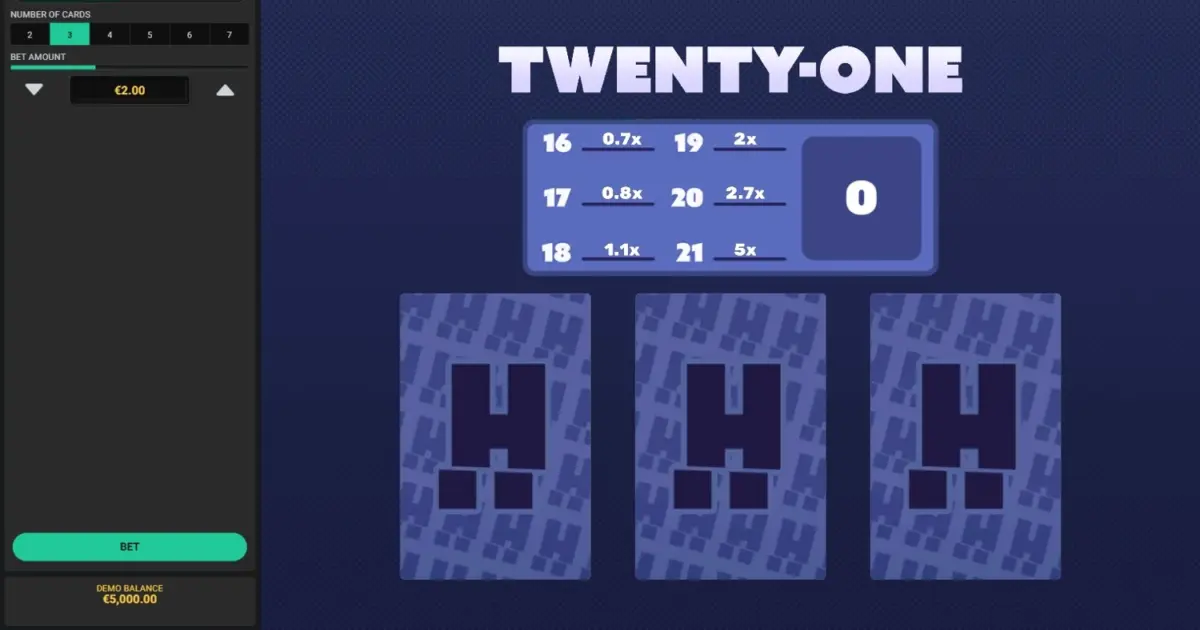
The twenty-one blackjack table from Hacksaw Gaming is a fair product in the sense that it pays out at a stated, verifiable rate — but that rate is notably thin compared to what other RNG blackjack games deliver. At 98.0% RTP, you are giving back two percent per unit wagered even when playing perfect basic strategy, whereas most competitive blackjack tables push that figure closer to 99.5%. The published RTP assumes you never make a strategic error, so a casual player’s real return will be lower still. Whether that gap is worth accepting depends entirely on what else you value — interface speed, volatility, or simply the novelty of a Hacksaw title at the table — but from a pure expected-value standpoint, better options exist.
Is Twenty-One a fair table?
Fairness in a blackjack context means two things: the game deals a random shuffle each round, and the return it publishes is achievable under perfect play. Both conditions are satisfied here. Hacksaw Gaming is a licensed provider whose RNG outputs are certified, and the 98.0% RTP is a declared figure, not something you need to reverse-engineer.
The important caveat is the word “achieved.” A published RTP of 98.0% on a blackjack table presupposes that every single hand is played according to basic strategy for the exact rule set in effect. Deviate from that chart even a handful of times per hour and your real return drops. Blackjack is already the game where the skill-to-luck ratio is highest among casino offerings, but that skill advantage is one-directional: playing correctly costs you nothing, playing incorrectly extracts a real price.
Compared to the corpus average of 99.41%, this table sits 1.41 points below benchmark. On a $10 minimum, that gap amounts to roughly $0.14 per hand in expected loss difference — small on a single decision, but over several hundred hands per session the compounding effect is visible in your session results. You should understand what you are giving up before you commit time here.
Hacksaw Gaming and this table
Hacksaw Gaming is a relatively young studio that has built its reputation on high-volatility video slots rather than table games. Within our reviewed corpus, Twenty-One is the only blackjack title they offer, so there is no provider-specific catalogue to compare against or a family of related tables to benchmark within. That single entry means the company has not iterated on blackjack mechanics the way established table-game studios have across multiple variants.
If you are drawn to Hacksaw’s visual design or interface conventions, that preference is valid — but understand that you are accepting a mathematically inferior blackjack product compared to what dedicated table-game providers offer. For a sense of what closer-to-optimal looks like, you might compare the rules on American Blackjack, which returns 99.5% and represents a different design philosophy about what players should be given.
The absence of related provider games also means there is no internal consistency to verify. When a studio offers five or ten blackjack variants, you can compare their rule sets and spot patterns. Here, Twenty-One stands alone as a data point, so its quality assessment rests entirely on the published RTP relative to external alternatives.
Rule set: what the twenty-one blackjack title implies
The title “Twenty-One” is the historical name for the game, predating the blackjack variant that introduced the bonus payout for a suited Jack and Ace of spades. Using the older name does not, by itself, tell you anything specific about the rules — it is marketing language, not a rule indicator. It does not confirm or deny a 3:2 blackjack payout, nor does it specify the number of decks or whether the dealer hits soft seventeen.
Hacksaw Gaming does not publish the deck count, the soft-seventeen rule, the double-after-split policy, or whether late surrender is available for this table in the data available to us. Each of those rules moves the house edge by a measurable amount — dealer hitting soft seventeen costs roughly 0.2%, a 6:5 payout versus 3:2 costs approximately 1.4%, and the absence of surrender rules removes a player option worth around 0.1%. Without knowing these specifics, you cannot confirm that the published 98.0% RTP matches a rules environment you would find acceptable.
Before playing for money, open the in-game rules screen and read every clause. If the blackjack pays 6:5, that single detail explains most of the 1.4-point gap between this table and the corpus average, and you should look elsewhere.
The maths of a blackjack hand
Blackjack is a game of conditional probability where your decisions on each hand alter the distribution of outcomes that follow. The house edge emerges from a structural asymmetry: the player busts first, meaning that some dealer hands that would have beaten you never get played because you have already exceeded twenty-one. The casino converts that asymmetry into profit, and every rule you accept either widens or narrows the gap.
Basic strategy is the mathematically optimal response to each possible player hand against each dealer up-card, derived by exhaustively computing expected values across every decision node in the game tree. It is not a system in the sense of a betting progression — your wager stays fixed regardless of what happened on the previous hand. Strategy governs your play decisions only; it does not govern your bet sizing, and conflating the two is a common source of confusion.
The 98.0% figure for this twenty-one blackjack table tells you that after all those optimal decisions are made, Hacksaw retains two percent. That is a real, repeatable extraction that compounds over time. No pattern of wins in a short session changes it.
Common mistakes that cost you the edge
Insurance is the most persistent error in live and RNG blackjack alike. At a 3:2 payout, insurance carries a house edge of approximately 7% — roughly three and a half times worse than the base game even on a mediocre table. If the blackjack payout were 6:5, insurance becomes an even worse proposition. The hand feels dangerous when the dealer shows an Ace, which is precisely why the side bet works as a marketing tool: it exploits your emotional response rather than offering genuine protection.
Deviating from basic strategy is the second major leak. Every “hunch” you follow — hitting a hard sixteen against a dealer ten, or splitting a pair of eights versus a dealer ten — has been evaluated against millions of simulated hands. The chart already accounts for those intuitions and overrides them where the math disagrees. If you are unsure of the correct play on a marginal decision, surrender the hand to the chart rather than to your judgment.
Chasing side bets compounds both problems. Perfect Pairs and 21+3 variants routinely carry house edges between 5% and 15%, regardless of your base-game skill. They are slot-like propositions wearing a blackjack costume.
Trying it free first
A free demo of this table is available, and that is the correct place to start regardless of your skill level. Use the demo not to test whether you feel lucky, but to locate the rules screen and confirm the specific parameters we discussed above. Count the decks, check the blackjack payout, note whether the dealer hits soft seventeen, and read the double and split rules. That information changes the expected value calculation, and you can perform it offline before risking a cent.
Remember that demo play cannot predict real-money results. The RNG operates identically, but your decision quality under no financial pressure differs from your decision quality when outcomes are consequential. Treat the demo as a rules-verification tool, not a performance rehearsal.
This game is intended for entertainment, not income. You must be 18 or over to play where you reside, and you should set a firm budget before you start a session. If gambling stops feeling like a leisure activity and starts feeling like an obligation, that is a signal worth taking seriously.
Final take on Twenty-One
Twenty-One is a functional, certified blackjack table that underperforms on the single metric most relevant to mathematically engaged players. The 98.0% RTP represents a meaningful cost compared to alternatives that sit near 99.5%, and that gap is unlikely to be recovered by anything except a superior interface experience or a genuine preference for Hacksaw’s design. If you play occasionally and value the presentation, it is acceptable. If you are optimizing for return, Classic Blackjack offers 99.28%, and Blackjack (Mascot Gaming) reaches 99.5% — both measurably closer to what this game should be paying.
Before you deposit at a Hacksaw-powered casino specifically to play this table, confirm the in-game rules and run the arithmetic yourself. If the blackjack pays 3:2 and the rule set is standard, the remaining shortfall between 98.0% and 99.5% may point to an unfavorable hidden clause — perhaps restricted doubling, no surrender, or a deck composition that tilts the maths against you. The title tells you almost nothing; the paytable tells you everything.
| Metric | Value |
|---|---|
| RTP (published) | 98.0% |
| House edge (perfect strategy) | 2.0% |
| Corpus average blackjack RTP | 99.41% |
| Deviation from corpus average | −1.41 pp |
| Free demo | Available |
| Provider | Hacksaw Gaming |
| Blackjack variants from this provider | 1 |
Frequently Asked Questions
Can I play Twenty-One Blackjack for free?
Yes, Hacksaw Gaming's Twenty-One is available as a free demo on review sites like this one. Use the demo to find and read the in-game rules screen — confirm the blackjack payout, deck count, and whether the dealer hits soft seventeen before you decide whether the 98.0% RTP is achievable under a rules environment you accept.
What does the 98.0% RTP mean for my real returns?
The published RTP assumes you play perfect basic strategy on every single hand for that exact rule set. A casual player who deviates even a few times per hour will realize materially less than 98%. At 2.0% house edge, this table already costs more per hand than competitive alternatives near 99.5%, so any strategic errors compound an already disadvantageous baseline.
Why is this table's RTP lower than other blackjack games?
A 98.0% blackjack RTP means the underlying rule set is unfavorable compared to tables that pay 3:2 blackjacks, offer surrender, or allow liberal doubling. Hacksaw does not publish the specific rules for this table externally, so the most likely explanation is either a 6:5 payout or restricted double and split options. Check the in-game paytable to confirm which.
Does card counting work at this twenty-one blackjack table?
No. This is an RNG table that shuffles all virtual decks before every hand, so no card removal effect carries forward from one round to the next. No counting system, shuffle tracking, or pattern-based strategy can reduce the house edge on a continuously reshuffled deck. The 2.0% edge remains fixed regardless of what you track.
How does Twenty-One compare to other blackjack games available here?
It sits well below alternatives at 99.5% or better. American Blackjack and Blackjack (Mascot Gaming) each return 99.5%, giving back only half a percent versus this table's two percent. On identical wagering volume, that difference accumulates rapidly over hundreds of hands, making Twenty-One the more expensive option in this comparison set.




