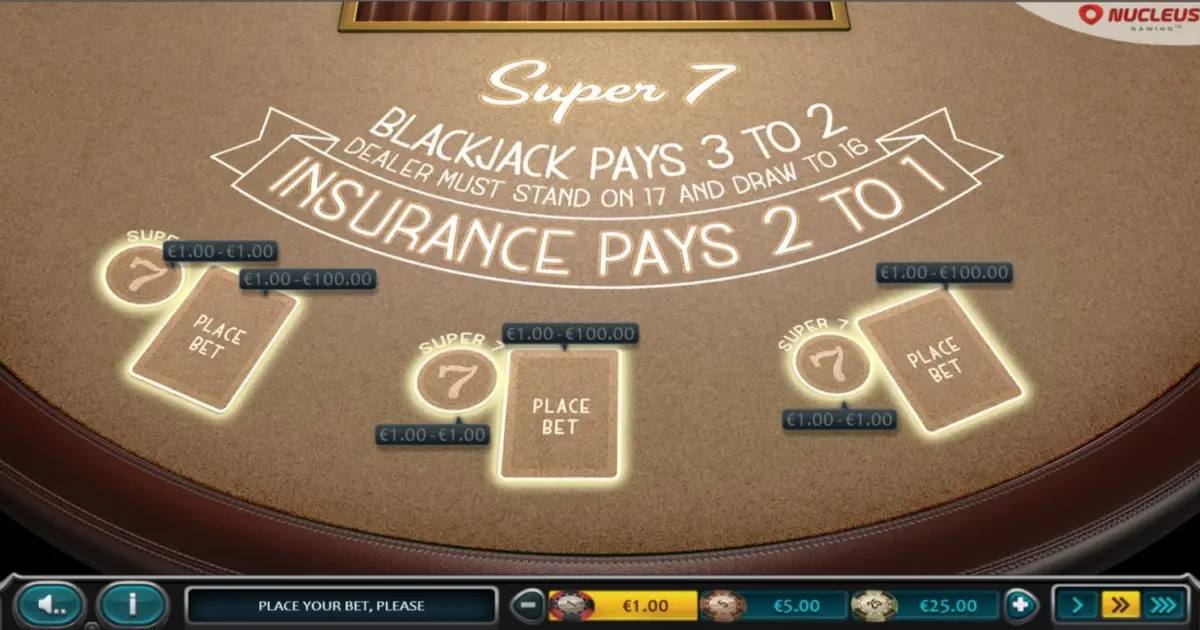
Super 7 blackjack is worth your time if you want a table with a published return at the top end of the blackjack range and you are willing to play it properly. Nucleus Gaming lists the RTP at 99.5%, which is a strong figure for the format, and a free demo is available so you can read the rules screen before committing a bankroll. The catch is that Nucleus does not publish the detailed rule set alongside the RTP, so the specifics that produce that number are something you have to confirm in the game itself.
Super 7 Blackjack and the Nucleus Gaming table range
Nucleus Gaming is a relatively small studio in this space, with five games in our blackjack corpus. What stands out is the consistency: the provider’s average RTP across those tables is 99.5%, which is exactly what this one is listed at. In other words, Nucleus does not appear to be running a tiered range where one table is generous and another quietly clips the player. If you like the maths here, the rest of the range reads the same on paper.
That makes cross-checking easy. If you want to see how the same studio handles a stripped-down rule set, Single Deck Blackjack (Nucleus Gaming) is listed at the same 99.5% and the name points to a different deck configuration, which changes the strategy chart even at an identical return. 21 Burn Blackjack adds a rule twist to the base game and is also listed at 99.5%, which is a reminder that a headline RTP figure does not tell you how a table plays. And European Blackjack from the same studio is a useful comparison because European rules typically remove the dealer hole-card peek, and that single difference costs the player roughly 0.1% when doubling and splitting go wrong.
Against the wider set of blackjack titles we list, which averages 99.41%, this table sits about 0.09 percentage points ahead. That is a small edge in absolute terms but it points in the right direction.
| Provider | Nucleus Gaming |
|---|---|
| RTP | 99.5% |
| Theme | Cards |
| Free demo | Yes |
The 99.5% figure, and the assumption behind it
An RTP of 99.5% is the same statement as a house edge of 0.5%. Over a long run of hands, the table expects to keep half a unit for every hundred wagered. That is a genuinely good number for blackjack and far better than almost anything on the slots side of a casino lobby.
The assumption buried inside it matters more than the number itself. Any published blackjack RTP is calculated on the basis that the player makes the mathematically correct decision on every single hand. Hit, stand, double, split — all of it, every time, with no deviation for hunches. That is the only way the 0.5% edge holds.
Play the same table casually and the return drops. Standing on 16 against a dealer 7 because it feels safer, declining a double on 11, splitting tens because two hands look better than one: each of those decisions hands back a fraction of a percent. A player working from instinct rather than the chart is typically giving up somewhere between one and two percentage points on top of the base edge, which turns a 0.5% house edge into something several times larger. The RTP figure is a ceiling, not a promise.
Nucleus does not publish a breakdown showing which rules produce the 99.5% figure, so treat it as the studio’s own calculation for its own rule set and verify the rules separately.
Rules to confirm before you bet real money
This is where the missing data actually costs you. Nucleus Gaming does not publish the deck count, the dealer’s soft 17 behaviour, the blackjack payout, the double and split rules, the surrender option, or the available side bets for this table. None of that is in the public information, so the in-game rules screen is your only source. Read it before your first real-money hand.
The items worth checking, in rough order of how much they move the edge:
- The blackjack payout. A natural must pay 3:2. A table paying 6:5 costs the player roughly 1.4%, which is the single most damaging rule change in the game and would swamp the published RTP entirely. If you see 6:5, close the table.
- Soft 17. A dealer who stands on soft 17 is worth about 0.2% to you compared with one who hits.
- Deck count. Fewer decks favour the player, though the difference between six and eight decks is only a few hundredths of a percent.
- Double after split, re-splitting aces and late surrender. Each is worth roughly 0.1% or a little less, and together they add up.
If side bets such as Perfect Pairs or 21+3 are offered, they carry a house edge many times the base game — often in the 2% to 6% range depending on the paytable. Insurance is the same story: at the standard 2:1 payout it is a losing bet, and the 99.5% figure does not cover it.
Strategy: the chart, not a system
Basic strategy is not a system and not a trick. It is a solved chart: for every combination of your hand and the dealer’s up-card, one action has the highest expected value, and the chart tells you what it is. There is nothing to believe in and nothing to tune. You either follow it or you pay for not following it.
What the chart does is minimise the house edge. It does not remove it. Played perfectly, this table still keeps 0.5% of everything you wager over the long run, and no sequence of decisions changes that. Any claim that a strategy beats the house edge is wrong.
Card counting is worth addressing directly because it comes up constantly. It does not work here. An RNG blackjack table reshuffles the virtual deck before every hand, so the composition of the next deal carries no memory of the last one. There is no depletion to track and no count to build. That is not a restriction the operator imposes on you — it is simply how the shuffle works.
The same applies to betting progressions. Doubling after a loss, or any Martingale or D’Alembert variant, changes the shape of your variance: more small wins, occasional catastrophic sessions. It does not change your expected value by a single unit. No hand is ever due.
Variance at the blackjack table
A 0.5% house edge is thin, which means the short run is dominated by swings rather than by the edge. Blackjack has lower variance than most casino games, but a bad hour still looks bad: doubles that lose, splits that both bust, a run of dealer twenties. None of that is evidence the table is broken.
Practical bankroll handling matters more than anything clever. Size your unit so a normal losing run does not end the session — many players use something in the region of 1% of the session bankroll per hand — and decide your stopping point before you sit down rather than during a downswing. Remember that doubles and splits put more than one unit at risk on a single hand, so your real exposure per hand is higher than your base bet suggests.
Free play first
A Super 7 Blackjack free demo is available, and given how much of the rule set is unpublished, the demo is the practical answer. Open it, read the paytable, confirm the blackjack payout and the soft 17 rule, and play a few hundred hands with a strategy chart open beside you until the correct decisions stop needing thought. That is what demo mode is genuinely good for.
What it cannot do is predict real-money results. A winning demo session tells you nothing about what happens when your own money is on the table.
Blackjack is for players aged 18 or over. Set a budget before you start and treat it as spent on entertainment rather than as money you expect back. Gambling is not income, and if a session stops being fun, stop playing.
Who this table is for
This suits a player who already knows basic strategy, or is willing to learn it, and who wants a low-edge base game without side-bet distractions. The 99.5% listing is competitive and slightly above the average across the blackjack tables we cover.
It suits you less well if you want full rule transparency before you open the game, because Nucleus publishes the RTP and little else. If that bothers you, Multihand Blackjack is listed at the same 99.5% and lets you play several hands per round, which suits a player who already has the chart memorised and wants more decisions per session.
Frequently Asked Questions
Can I play Super 7 Blackjack for free?
Yes, a free demo is available with no download and no deposit. That matters here because Nucleus Gaming does not publish the deck count, soft 17 rule or blackjack payout for this table, so the in-game rules screen reached through the demo is the only reliable place to confirm what you are actually playing.
What is the Super 7 Blackjack RTP?
Nucleus Gaming lists it at 99.5%, equal to a 0.5% house edge. That figure assumes perfect basic strategy on every hand. Play from instinct instead of the chart and your realised return drops materially, often by one to two percentage points, so 99.5% is a ceiling rather than an expected outcome.
How do the table rules affect the house edge?
Heavily, and the specifics are unpublished for this table. A 6:5 blackjack payout instead of 3:2 costs roughly 1.4%, dwarfing the 0.5% base edge. A dealer standing on soft 17 is worth about 0.2% to you, and double-after-split, re-splitting aces and late surrender each add roughly 0.1%.
Does card counting work on Super 7 Blackjack?
No. This is an RNG table, so the virtual deck reshuffles before every hand and no information carries over from the last deal. There is nothing to count. Betting progressions like Martingale fare no better — they reshape your variance but leave the 0.5% expected loss untouched.
Who makes this game, and how does it compare to their other tables?
Nucleus Gaming, which has five blackjack titles in our listings and an average RTP of 99.5% across them. European Blackjack from the same studio is listed at the same return, though European rules usually drop the dealer hole-card peek, which costs the player roughly 0.1% on doubles and splits.




