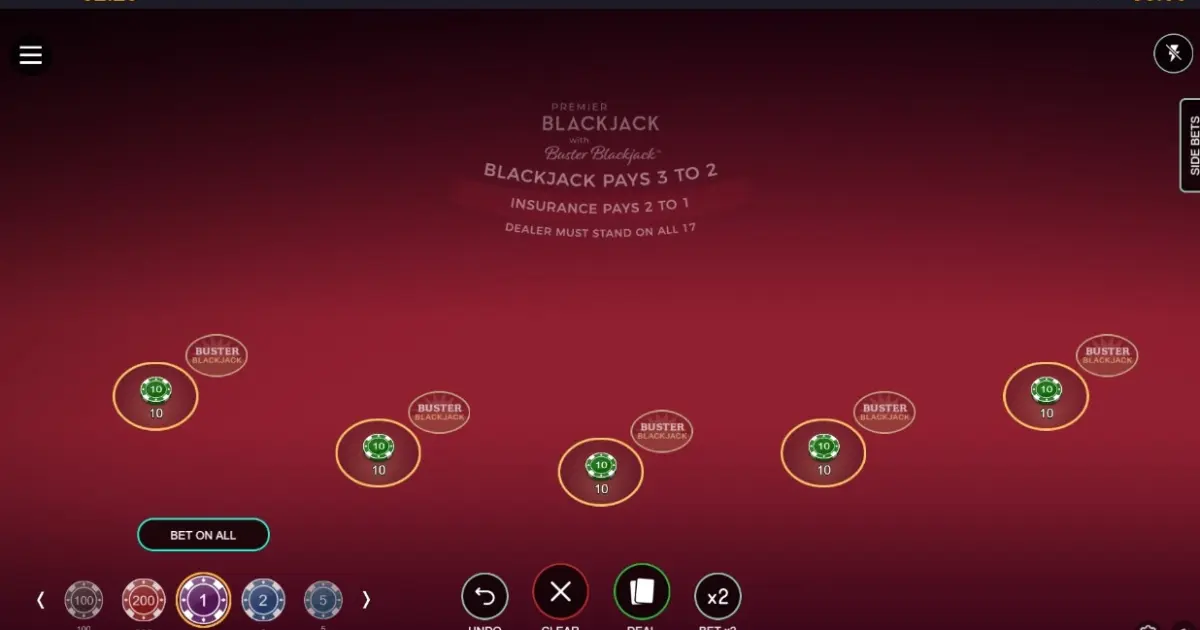
Premier Blackjack with Buster Blackjack sits at the upper end of the RTP spectrum for online blackjack, offering 99.6% return to player on the base game. That figure alone makes it competitive, and the Buster Blackjack side bet adds a layer of variance for players chasing bigger payouts when the dealer goes over 21. Switch Studios has built a table that rewards disciplined play while leaving room for occasional side-action if you understand the trade-off.
The question is whether the rule set underneath that RTP figure aligns with how you play, and whether the side bet is worth the cost. This review unpacks both.
Premier Blackjack with Buster Blackjack at a glance
Switch Studios is a relatively focused provider with 22 blackjack titles in their catalogue, and they maintain an average RTP of 99.61% across those games—slightly above the 99.41% corpus average for online blackjack. Premier Blackjack with Buster Blackjack hits 99.6%, which places it 0.19 percentage points above the broader market and within a hundredth of the provider’s own standard.
| Attribute | Value |
|---|---|
| Provider | Switch Studios |
| Base game RTP | 99.6% |
| House edge | 0.4% |
| Free demo available | Yes |
| Provider game count | 22 |
| Provider average RTP | 99.61% |
A free demo is available, which means you can test the interface, the speed of the deal, and the behaviour of the Buster side bet before committing real money. That’s particularly useful here, because the side bet changes the rhythm and risk profile of the session in ways you need to experience to evaluate.
What a 99.6% RTP means at a blackjack table
Return to player of 99.6% translates to a house edge of 0.4%, which is strong for online blackjack and better than many live and RNG tables you will encounter. But that figure comes with a non-negotiable condition: it assumes you play perfect basic strategy on every single hand. If you deviate—hitting when you should stand, failing to double on advantageous counts, taking insurance at the wrong times—you are handing the house a larger edge, and your realised return drops below 99.6%, sometimes substantially.
Basic strategy is not a system or a heuristic; it is a mathematically solved chart that tells you the correct play for every combination of your hand and the dealer’s upcard. Playing perfectly means consulting that chart or having it memorised. Casual play, even thoughtful casual play, typically costs an additional 1–2% in edge, which turns a 0.4% house advantage into something closer to 1.5–2.5%. That is the difference between a tight game and a steep grind.
The RTP figure is also a long-run expectation. Over thousands of hands, your return should converge toward 99.6% if you play correctly. Over a single session of a few hundred hands, variance dominates, and you can finish up or down regardless of perfect play. Understanding this distinction keeps your expectations calibrated.
The rules that move the house edge
Switch Studios does not publish the full rule set in their marketing materials, so the specific deck count, whether the dealer hits or stands on soft 17, the blackjack payout ratio, and the availability of double-after-split, re-split aces, or surrender are not confirmed in the data available for this table. These details matter: a 3:2 blackjack payout versus 6:5 alone shifts the house edge by roughly 1.4 percentage points, and whether the dealer hits soft 17 costs you another 0.2%. The number of decks in play moves the edge by a few hundredths of a percent per deck.
Given the 99.6% RTP, you can infer that the rule set is player-friendly—most likely 3:2 blackjack, dealer stands on soft 17, and a reasonable deck count, probably six or eight—but you should confirm these specifics in the game’s own paytable or rules screen before playing for money. A single rule change can invalidate the published RTP if the version you are playing differs from the one tested.
As a general rule of thumb across all blackjack variants: favour tables with 3:2 blackjack over 6:5, dealer standing on soft 17 over hitting, fewer decks over more, and rules that permit double-after-split, late surrender, and re-splitting aces. Each of these moves the edge in your favour, and their cumulative effect determines whether a table is playable or punishing. If you are comparing this table to Vegas Strip Blackjack, check the surrender and deck rules carefully—those two factors often account for the RTP difference between similar-looking games.
Basic strategy, and what it can and cannot do
Basic strategy is the foundation of competent blackjack play. It is a fixed decision matrix, derived from computer simulations of millions of hands, that tells you the play with the lowest expected loss for every situation: your total, the dealer’s upcard, whether your hand is hard or soft, whether you hold a pair. You do not need to understand the probability trees behind it; you only need to follow it without deviation.
What basic strategy does: it minimises the house edge to the figure published in the RTP. At this table, perfect basic strategy reduces the house advantage to 0.4%, which is about as low as you will find outside of single-deck games with extremely liberal rules. What basic strategy does not do: eliminate the house edge. You are still playing a negative-expectation game. Over time, the house wins. Basic strategy slows that process and gives you the longest run and the most entertainment value for your bankroll, but it does not flip the edge in your favour.
Card counting does not work here. This is an RNG table that reshuffles after every hand, which means the deck composition resets and no count you maintain has any predictive value for the next deal. Counting is a tool for penetration-dependent games with a physical shoe, not for online RNG blackjack. If you are used to counting at Classic Blackjack tables in live casinos, understand that the skill does not transfer to this format.
Betting progressions—Martingale, D’Alembert, doubling after a loss—change the shape of your variance but not your expected value. They can produce short-term wins or steeper short-term losses, but they do not alter the underlying 0.4% house edge. No progression system beats the maths of the game.
Side bets and insurance
The Buster Blackjack side bet is the distinguishing feature of this table. It pays when the dealer busts, with progressively higher odds the more cards the dealer takes before going over 21. A three-card bust might pay 2:1, a four-card bust 3:1, and so on, often with a premium payout if the dealer busts with eight or more cards. The exact paytable varies by implementation, so check the game’s help screen for the specific schedule.
Like all side bets, Buster Blackjack carries a significantly higher house edge than the base game. Where the main bet gives the house 0.4%, the side bet typically runs between 4% and 10% depending on the number of decks and the payout structure. That is not a defect; it is the cost of the higher volatility and the chance at a larger payout on a single hand. If you are playing the side bet, you are paying for variance, not value.
Insurance is a side bet offered when the dealer shows an ace, paying 2:1 if the dealer has blackjack. At standard odds, insurance is a losing proposition unless you are counting cards in a penetration-dependent game—and as already noted, counting does not work here. The house edge on insurance is typically around 7% at a six- or eight-deck table. Decline it unless the specific paytable and deck count make it neutral or better, which is rare.
If you do take the Buster side bet, treat it as entertainment spend and size it as a small fraction of your main bet. A common approach is to bet one unit on the side and five or more on the main hand, so the side bet does not dominate your bankroll exposure. For a comparison of side bet volatility across providers, ReDeal Blackjack offers a different risk-reward structure worth evaluating alongside this one.
Playing the Premier Blackjack with Buster Blackjack demo
The free demo gives you full access to the base game and the Buster side bet without risking real money. Use it to understand the pacing of the deal, the clarity of the interface, and how often the side bet hits. Pay attention to how the game displays your hand total, the dealer’s upcard, and the available actions—double, split, stand, hit. A clean interface reduces decision fatigue and helps you stick to basic strategy.
Demo results do not predict real-money outcomes. The RNG that powers the demo is the same as the one used in real-money play, but the sample size of a single session is too small to tell you anything meaningful about the RTP or the frequency of the side bet paying. What the demo does show you is whether you enjoy the table’s rhythm and whether the side bet feels worth the cost when you see it play out over fifty or a hundred hands.
If you do move to real-money play, set a budget in advance and treat it as the cost of entertainment, not a path to income. Blackjack is a negative-expectation game even at 99.6% RTP, and no session is guaranteed to finish in profit. Play only with money you can afford to lose, and take breaks if the session stops being enjoyable. This is a game, not an investment. You must be 18 or older to play for real money, and most jurisdictions require you to be 21. Check your local regulations before depositing.
Verdict: who should sit at this table
Premier Blackjack with Buster Blackjack is a sound choice for players who want a low house edge and understand basic strategy well enough to execute it consistently. The 99.6% RTP is competitive, and the 0.4% house edge is among the better figures you will find in the online RNG blackjack space. If you are looking for a straightforward, high-return table without gimmicks in the base game, this one delivers.
The Buster side bet is best suited to players who enjoy variance and are willing to pay a higher house edge for the chance at a larger payout when the dealer busts with multiple cards. It is not a value bet, and it should not be the focus of your strategy, but it adds a layer of interest if you budget for it appropriately. Players who prefer to minimise total house edge exposure should skip the side bet entirely and focus on the base game.
This table is not ideal for players who have not yet learned basic strategy, because the published RTP assumes perfect play and casual decisions will erode your return significantly. It is also not the right choice if you are looking for live dealer interaction or the ability to count cards—this is an RNG table that reshuffles every hand, and those dynamics do not apply. For players who meet those conditions and want a high-RTP game with an optional side bet, this table is worth your time.
Frequently Asked Questions
Is there a free demo of Premier Blackjack with Buster Blackjack?
Yes, a free demo is available. It gives you full access to the base game and the Buster Blackjack side bet without risking real money, so you can test the interface, the deal speed, and how the side bet behaves over a sample session. Demo results are powered by the same RNG as real-money play, but a single session is too small a sample to predict long-term RTP or side bet frequency.
What does the 99.6% RTP actually mean for my bankroll?
The 99.6% return to player assumes you play perfect basic strategy on every hand, which reduces the house edge to 0.4%. Over thousands of hands, you should lose an average of 40 cents per hundred dollars wagered if you play correctly. Casual play—hitting or standing based on feel rather than the strategy chart—typically costs an additional 1–2% in edge, which turns a tight game into a much steeper grind.
Does card counting work on this table?
No. Premier Blackjack with Buster Blackjack is an RNG table that reshuffles after every hand, so the deck composition resets and no count carries predictive value for the next deal. Card counting only works in penetration-dependent games with a physical shoe, not online RNG blackjack. Basic strategy is the correct approach here, and no betting progression will change the house edge.
Is the Buster Blackjack side bet worth playing?
The Buster side bet pays progressively higher odds when the dealer busts with multiple cards, but it carries a house edge typically between 4% and 10%—far higher than the 0.4% edge on the base game. It is a variance bet, not a value bet. If you play it, size it as a small fraction of your main bet and treat it as entertainment spend. Players focused on minimising total house edge should skip it entirely.
How does this table compare to other Switch Studios blackjack games?
Switch Studios maintains an average RTP of 99.61% across their 22 blackjack titles, and this table's 99.6% sits right in line with that standard. Classic Blackjack from the same provider offers 99.9% RTP with a tighter 0.1% house edge, which makes it a better choice if you want the lowest possible edge and do not care about the Buster side bet. The rule sets differ, so confirm deck count, dealer soft-17 behaviour, and blackjack payout in each game's paytable.




