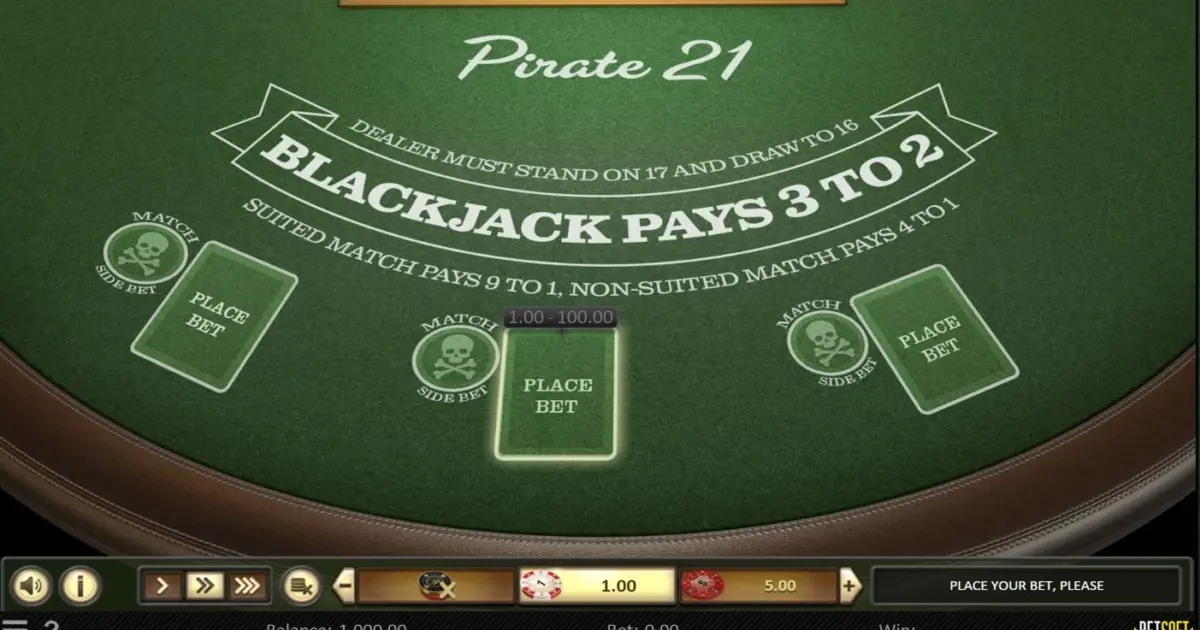
Pirate 21 Blackjack is worth your time if you want a solid-RTP table from a provider that doesn’t fill its catalogue with dozens of mediocre variants. At 99.5% RTP it equals the best blackjack tables available, but that figure assumes perfect basic strategy on every single hand. A casual player who deviates even occasionally will realise a materially lower return, so the question is whether the rule set underneath that headline number is as tight as the RTP suggests.
Betsoft Gaming publishes the RTP but leaves critical rules unstated in the marketing material, and those gaps matter because the house edge can shift by tenths of a percent depending on deck count, soft-17 handling, and blackjack payout structure. The “Pirate 21” name gives no universally recognised rule hint the way “European” or “Spanish” would, so you’re relying on the in-game paytable to confirm what you’re actually playing.
Is Pirate 21 Blackjack a fair table?
The published RTP is 99.5%, which translates to a house edge of 0.5% and places this table among the fairest in the category. For context, the average RTP across all blackjack tables in the data set is 99.41%, so Pirate 21 Blackjack sits 0.09 percentage points above that mark. That difference sounds tiny, but over a few hundred hands it changes your expected loss by a measurable amount.
The critical caveat: that 99.5% figure assumes you play perfect basic strategy on every decision. Basic strategy is not a betting system or a hunch; it is a solved chart that tells you the mathematically correct play for every possible hand against every dealer upcard. If you hit when you should stand, or fail to double down in a profitable spot, you hand back edge to the house. A player who makes even one mistake per shoe will see a real-world return closer to 98% or lower, which erases the entire advantage of choosing a high-RTP table in the first place.
| Metric | Value |
|---|---|
| RTP | 99.5% |
| House edge | 0.5% |
| Provider | Betsoft Gaming |
| Free demo | Yes |
| Category average RTP | 99.41% |
Betsoft Gaming and this table
Betsoft Gaming offers exactly one blackjack table in its portfolio, and Pirate 21 Blackjack is it. That focus is unusual in an industry where most providers publish half a dozen variants with different themes and minor rule tweaks. The narrow catalogue means Betsoft has staked its blackjack reputation on a single rule set, and the 99.5% RTP suggests they chose to compete on fairness rather than volume.
The provider average RTP across all Betsoft blackjack tables is 99.5%, which by definition matches this table because it is the only one. For comparison, American Blackjack also publishes 99.5% RTP and gives you a well-documented rule set to verify, while Classic Blackjack sits at 99.28% and makes the tradeoff explicit in its paytable.
Rule set: what the title implies
The “Pirate 21” name is thematic rather than descriptive, and it offers no hint about the underlying rule family. Compare that to titles like “European Blackjack” or “Single Deck,” which immediately tell an experienced player what to expect. Betsoft does not publish the deck count, the dealer’s soft-17 behaviour, the blackjack payout ratio, or whether surrender and double-after-split are available, so you cannot calculate the house edge from first principles before you sit down.
In the absence of stated rules, the only way to confirm what you’re playing is to open the game and read the paytable or rules screen. The difference between 3:2 and 6:5 blackjack payout alone costs you roughly 1.4%, which would drag the effective RTP well below the published figure if the worse payout were in play. Similarly, a dealer hitting soft 17 instead of standing adds about 0.2% to the house edge, and an eight-deck shoe costs you a few hundredths compared to a single deck.
Given that Betsoft publishes 99.5% RTP, the rule set underneath must be relatively player-friendly to hit that mark, but the lack of transparency means you’re taking the provider’s word rather than verifying the maths yourself. Check the in-game rules before you play for money.
The maths of a blackjack hand
Blackjack is a negative-expectation game, meaning the house holds an edge on every hand no matter how well you play. That edge comes from the fact that you act first: if you bust, you lose immediately, even if the dealer busts on the same round. Basic strategy minimises that edge by dictating the play that loses you the least money over the long run, but it never turns the game positive.
The house edge shifts based on the rules in force. A 3:2 blackjack payout is the standard; 6:5 payouts, increasingly common in low-limit games, cost the player roughly 1.4% and are the single most damaging rule change you’ll encounter. The number of decks matters because a smaller shoe increases the probability of drawing a ten or ace when you need one; a single-deck game with otherwise identical rules offers about 0.2% better edge than an eight-deck shoe. Whether the dealer hits or stands on soft 17 changes the edge by roughly 0.2%, with the dealer hitting being worse for the player. Double-after-split, resplitting aces, and late surrender each shave a few hundredths off the house edge when allowed.
Card counting does not work against an RNG-based table that reshuffles after every hand. Counting exploits the fact that a deck rich in tens and aces favours the player, but that information is worthless if the deck resets before the next deal. Pirate 21 Blackjack uses a random number generator, so the composition of one hand tells you nothing about the next. Count if you’re playing a live dealer shoe game with a physical deck and a cut card; skip it here.
Common mistakes that cost you the edge
Insurance is a losing bet at standard 2:1 odds. When the dealer shows an ace, the true odds of the dealer having a ten in the hole are slightly worse than 2:1, which means the house holds an edge on the insurance wager that is far higher than the 0.5% edge on the base game. Taking insurance when you don’t have a blackjack yourself increases the house edge by roughly 0.3% over the long run. The only time insurance is mathematically correct is when you are counting cards in a live shoe and the true count indicates a ten-rich deck, which does not apply to an RNG table.
Deviating from basic strategy because a hunch feels right costs you money. The strategy chart is derived from millions of simulated hands and represents the play that loses the least over time. Hitting 16 against a dealer 10 feels reckless, but standing loses more in the long run. Failing to double down on 11 against a dealer 6 feels cautious, but you’re passing up the single most profitable situation in blackjack. Every deviation hands a slice of edge back to the house, and a player who trusts gut feel instead of the chart will see their real-world RTP drop by a full percentage point or more.
Side bets such as Perfect Pairs and 21+3 carry house edges far higher than the base game, often in the range of 3% to 8%. They add variance and the chance of a large payout, but they erode your bankroll faster than the main hand. If you’re playing for entertainment and the volatility is part of the appeal, side bets are fine in moderation; if you’re trying to minimise losses, skip them entirely.
Trying it free first
Pirate 21 Blackjack offers a free demo mode, and it’s worth using to confirm the rule set and test your strategy execution before you risk real money. The demo uses the same RNG and paytable as the real-money version, so you can open the rules screen, verify the blackjack payout ratio, check the dealer’s soft-17 behaviour, and confirm which doubles and splits are allowed. That verification step takes two minutes and eliminates any ambiguity about what you’re playing.
Demo mode also lets you drill basic strategy without financial pressure. If you’re still learning the chart, the free version gives you a consequence-free environment to practice, and you’ll see quickly where your instincts diverge from correct play. The results you see in demo mode will not predict your real-money results in any given session—variance dominates over short samples—but the long-run edge remains the same.
Set a budget in advance, treat the game as entertainment rather than income, and never chase losses with progressions like Martingale or D’Alembert. Betting systems change the shape of your variance but do not change the expected value; you will still lose 0.5% of total action over time. This game is restricted to players aged 18 and over, and if you feel your play is becoming compulsive, seek support before it becomes a problem.
Final take on Pirate 21 Blackjack
Pirate 21 Blackjack delivers a competitive 99.5% RTP and sits in the top tier of available tables by that measure. The RTP figure alone makes it worth considering, but the lack of published rules means you’re relying on Betsoft’s transparency and your own verification rather than being able to calculate the house edge independently before you start. For a player who wants a high-RTP table and is willing to check the in-game paytable to confirm the rule set, this is a reasonable choice.
The single-table catalogue from Betsoft is either a strength or a limitation depending on how you view it. It signals focus and a commitment to that 99.5% RTP, but it also means you have no fallback variant within the same provider if you want a different balance of rules. If you value a known rule set over a themed presentation, Blackjack by Mascot Gaming offers the same 99.5% RTP with clearer documentation, though you’ll sacrifice the thematic elements Betsoft built into this version.
Play perfect basic strategy, verify the rules in demo mode first, and understand that the 99.5% RTP is a long-run expectation that assumes flawless play. Do that, and Pirate 21 Blackjack gives you one of the fairest games in the category.
Frequently Asked Questions
Is Pirate 21 Blackjack available in free demo mode?
Yes, Pirate 21 Blackjack offers a free demo version that uses the same RNG and paytable as the real-money game. You can use it to verify the rule set, check the blackjack payout ratio and dealer soft-17 behaviour, and practice basic strategy without financial risk before you play for money.
What is the RTP of Pirate 21 Blackjack and what does it assume?
The RTP is 99.5%, which translates to a 0.5% house edge and places it among the fairest blackjack tables available. That figure assumes you play perfect basic strategy on every single hand; a casual player who makes even occasional mistakes will realise a materially lower return, often closer to 98% or worse depending on how far their play deviates from the chart.
Does card counting work on Pirate 21 Blackjack?
No, card counting does not work on this table because it uses a random number generator that reshuffles after every hand. Counting exploits the changing composition of a physical deck, but when the deck resets before each deal, the result of one hand tells you nothing about the next, and the edge you would gain from a ten-rich or ace-rich shoe disappears entirely.
How does Pirate 21 Blackjack compare to American Blackjack?
Both tables publish 99.5% RTP and sit at the top of the category by that measure. American Blackjack offers a well-documented rule set that lets you verify the house edge before you play, while Pirate 21 Blackjack leaves critical rules unstated in the marketing material, so you must check the in-game paytable to confirm what you're actually playing. If transparency matters more than theme, American Blackjack is the safer choice.
Should I take insurance when the dealer shows an ace in Pirate 21 Blackjack?
No, insurance is a losing bet at standard 2:1 odds because the true probability of the dealer having a ten in the hole is slightly worse than 2:1, giving the house an edge on that wager far higher than the 0.5% edge on the base game. Taking insurance when you don't hold a blackjack yourself costs you roughly 0.3% over the long run and should be declined every time in an RNG-based game.




