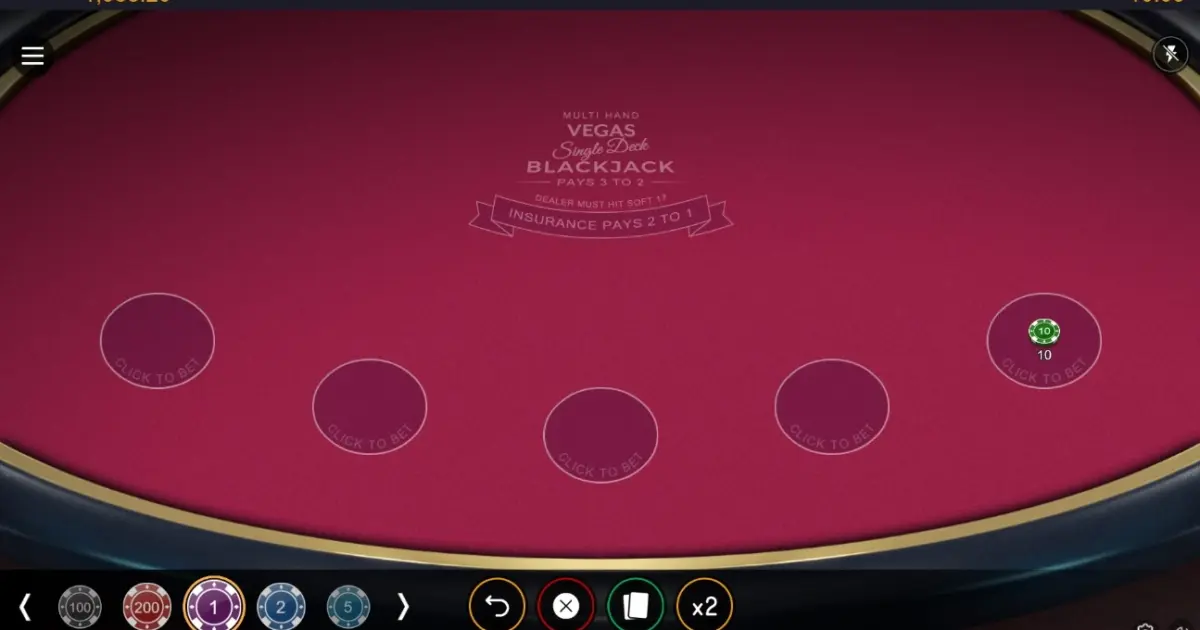
Multihand Vegas Single Deck Blackjack from Switch Studios sits at 99.7% RTP, which translates to a 0.3% house edge under perfect play. That figure is excellent, but the game’s title carries three claims—single deck, Vegas Strip rules, and multi-hand capability—that can pull the edge in opposite directions. The question is whether the published RTP holds up once you check the in-game rules screen.
Multihand Vegas Single Deck Blackjack at a glance
Switch Studios operates a portfolio of 22 blackjack tables with an average RTP of 99.61%, and this title sits just above that line. The 99.7% figure places it 0.29 percentage points above the corpus average of 99.41%, which makes it competitive. A free demo is available, so you can confirm the rule set before committing real money.
| Attribute | Value |
|---|---|
| Provider | Switch Studios |
| RTP | 99.7% |
| House edge | 0.3% |
| Free demo | Yes |
| Popularity percentile | 64.7 |
The multi-hand format lets you play several boxes per round against a single dealer hand, which accelerates both action and hourly exposure. If you normally bet one unit per hand, spreading that same unit across three hands triples your stake per round.
What a 99.7% RTP means at a blackjack table
An RTP of 99.7% means the house edge is 0.3%, but that figure is valid only if you execute perfect basic strategy on every single hand. Basic strategy is a solved chart of mathematically optimal decisions for every player total versus every dealer upcard. Any deviation—standing on 12 versus a dealer 3, doubling soft 18 versus a 9, taking insurance—raises the house edge, sometimes by several percentage points.
A casual player who plays by feel will realise an RTP materially lower than 99.7%, often in the 97–98% range. The published figure is a ceiling, not a guarantee, and it assumes you have memorised the chart or keep it open while you play. Even a handful of mistakes per hundred hands will cost you a meaningful fraction of a percent.
The 0.3% edge is strong for online blackjack, where many tables sit between 0.5% and 0.7%. Over a long session that edge difference compounds: at 60 hands per hour and £5 per hand, a 0.3% edge costs you £0.90 per hour in expectation, versus £1.50 at 0.5% or £2.10 at 0.7%. The savings are real, but only if your strategy is tight.
The rules that move the house edge
The game’s title suggests single-deck play, which normally lowers the house edge by around 0.5% compared to an eight-deck shoe, all else equal. Fewer decks increase the probability of drawing a ten after an ace, making naturals slightly more likely. However, many single-deck games offset that advantage by paying 6:5 on blackjack instead of 3:2, and that rule change alone costs the player roughly 1.4%—wiping out the deck advantage and then some.
The “Vegas Strip” label typically indicates four decks, dealer stands on soft 17, and doubling after split allowed. That description conflicts with the single-deck claim, so you must check the in-game paytable to know which rules actually apply. If the dealer hits soft 17, that adds about 0.2% to the house edge; if re-splitting aces is prohibited, that costs another 0.08%; if late surrender is absent, you give up roughly 0.05% in a typical rule set.
Switch Studios does not publish granular rule details in advance, and each tenth of a percent matters when you are comparing tables. The 99.7% RTP suggests the rule set is player-friendly overall, but you should verify the blackjack payout ratio, the soft-17 rule, and any restrictions on doubling or splitting before you play for real money. If the table pays 6:5 on naturals, the published RTP cannot be correct under standard rulesets, so that figure becomes your clue that 3:2 is in force.
One certainty: this is an RNG table that reshuffles every hand, so card counting does not work. The count resets to neutral before every deal, and no amount of tracking will give you an edge.
How multi-hand play affects variance
Playing multiple hands per round does not change the house edge, but it does flatten short-term variance because your results are partially correlated—all your hands face the same dealer upcard and the same dealer outcome. If the dealer makes 21, you lose all boxes at once; if the dealer busts, you win them all. The effect is that your bankroll swings are smaller per unit risked than they would be across independent rounds, but your total stake per round is higher, so your hourly exposure increases.
Basic strategy, and what it can and cannot do
Basic strategy is not a betting system or a progression; it is a fixed decision chart derived by computer simulation of every possible hand combination. It tells you whether to hit, stand, double, or split based solely on your total and the dealer’s upcard. Following it perfectly minimises the house edge to the figure published by the provider, but it does not eliminate the edge or turn blackjack into a positive-expectation game.
The strategy chart changes slightly depending on the number of decks and whether the dealer hits or stands on soft 17. Single-deck strategy, for example, tells you to double 11 versus a dealer ace, whereas multi-deck strategy says to hit. If this table truly uses one deck, you need the single-deck chart; if it uses four, you need the four-deck chart. Using the wrong chart costs you a few hundredths of a percent, which is not catastrophic but is avoidable.
No betting progression—Martingale, D’Alembert, doubling after losses—changes your expected value. These systems reshape your variance, often by raising the probability of small wins and lowering the probability of large losses, but they all converge on the same house edge over time. If you want to compare this table to others, try Classic Blackjack, which offers 99.9% RTP, or Vegas Strip Blackjack at the same 99.7%.
Side bets and insurance
Switch Studios does not publish which side bets, if any, are available on this table. Common options include Perfect Pairs and 21+3, both of which carry house edges in the 3–7% range depending on paytable and deck count. Those edges are an order of magnitude higher than the 0.3% base-game edge, so any side bet is a poor-value proposition for a player focused on minimising long-term cost.
Insurance is offered whenever the dealer shows an ace. At standard 2:1 odds, insurance is a losing bet: you are laying 2:1 on an event that occurs less than one time in three (in a single deck, 16 tens remain out of 49 unseen cards, a 32.7% probability). The house edge on insurance is roughly 6% in a single-deck game and 7.5% in multi-deck. Do not take it, even when you hold a natural—so-called “even money” is mathematically identical to insurance and just as bad.
Playing the Multihand Vegas Single Deck Blackjack demo
The free demo lets you test the interface, confirm the rule set, and practice basic strategy without financial risk. Demo results are generated by the same RNG as real-money play, but short sessions will show variance, not edge, so do not extrapolate a twenty-hand winning streak into a belief that the game is beatable or that a particular betting pattern works.
Use the demo to check the blackjack payout, watch whether the dealer hits or stands on soft 17, and confirm which doubles and splits are permitted. Those rules determine whether the 99.7% RTP is achievable, and you will not find that information reliably published elsewhere. If you are learning basic strategy, the demo is a zero-cost training ground, but keep the chart open—guessing will lock in the wrong habits.
Responsible gambling: this game is for players aged 18 and over. Set your budget in advance, treat the session as entertainment rather than income, and stop when you hit your limit. No strategy, progression, or “due” hand will overcome the house edge, and chasing losses raises your risk of material harm.
For a different take on Switch Studios tables, ReDeal Blackjack offers 99.6% RTP with a unique mechanic that lets you redraw weak starting hands.
Verdict: who should sit at this table
Multihand Vegas Single Deck Blackjack is a strong choice for a player who already knows basic strategy and wants a low house edge with the option to play several hands per round. The 99.7% RTP is competitive, sitting above both the provider average and the category average, and the single-deck claim—if accurate—should deliver slightly better natural frequency than a shoe game, provided the blackjack payout is 3:2.
The game is not suitable for a beginner who is still learning when to double or split, because the published RTP assumes perfect play and any mistakes will push your realised return down into the mid-97% range. The multi-hand format accelerates hourly stake, so it demands tighter bankroll discipline than a single-box game; if you typically play one £5 hand per round, spreading three £5 hands triples your exposure and will drain your budget three times faster if variance runs against you.
The unresolved tension between “single deck” and “Vegas Strip” in the title means you must check the in-game rules before you commit real money. If the table pays 6:5 on naturals, walk away—that rule alone would make the 99.7% RTP impossible under any plausible deck count. If it pays 3:2, stands on soft 17, and permits doubling after split, the published figure is credible and the table is worth your time. The demo exists precisely so you can verify those details without risking a penny.
Frequently Asked Questions
Is a free demo of Multihand Vegas Single Deck Blackjack available?
Yes, Switch Studios offers a free demo of Multihand Vegas Single Deck Blackjack. The demo runs on the same RNG as real-money play, so you can confirm the rule set, test the multi-hand interface, and practice basic strategy without financial risk before deciding whether to play for cash.
What does the 99.7% RTP mean in practice?
The 99.7% RTP translates to a 0.3% house edge, but that figure is valid only if you play perfect basic strategy on every hand. Any deviation from the optimal decision chart—standing when you should hit, doubling when you should stand—will lower your realised return, often into the 97–98% range for casual players who rely on intuition.
Does the single-deck format give me an edge, or can I count cards?
Single-deck blackjack typically lowers the house edge by around 0.5% compared to eight-deck shoes, all else equal, because naturals become slightly more frequent. However, this is an RNG table that reshuffles every hand, so card counting is impossible—the count resets to neutral before every deal. The 99.7% RTP already accounts for the deck count, and you cannot push it lower.
How does multi-hand play affect my bankroll and variance?
Playing multiple hands per round increases your total stake exposure—three £5 hands cost £15 per round instead of £5. Your results are partially correlated because all your boxes face the same dealer outcome, which flattens short-term variance per unit risked but accelerates how quickly you cycle through your bankroll, demanding tighter session discipline.
Should I take insurance or play the side bets?
No. Insurance at standard 2:1 odds carries a house edge around 6% in single-deck games, far worse than the 0.3% base-game edge, and side bets like Perfect Pairs or 21+3 typically run 3–7% edges. Both are poor-value propositions; stick to the main game and skip insurance even when you hold a natural.




