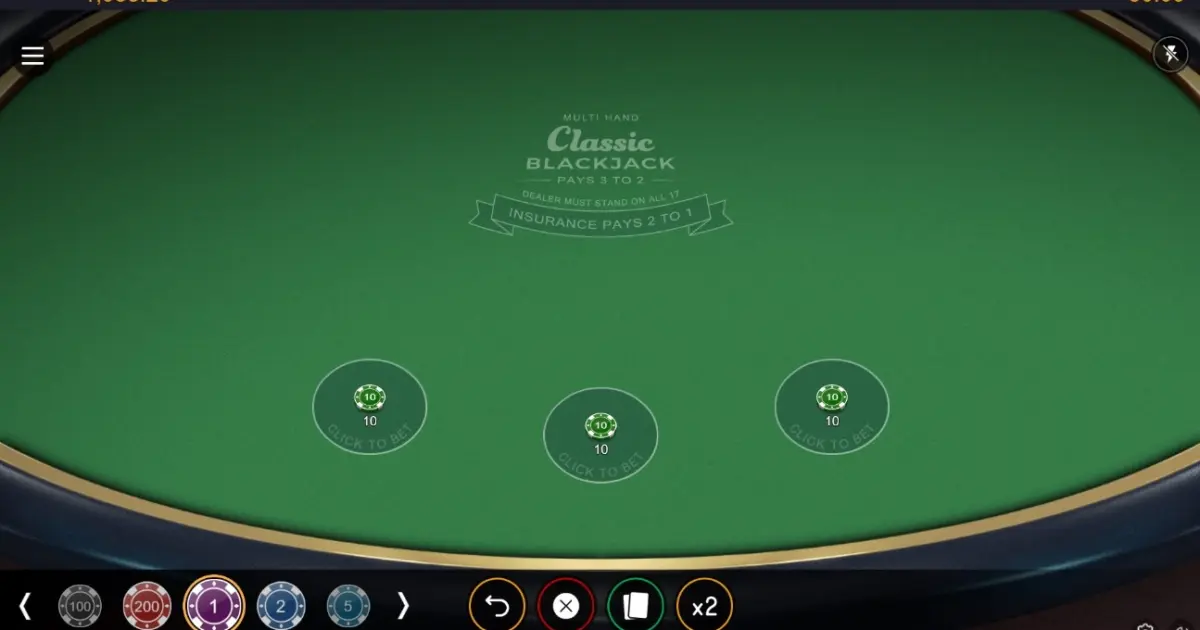
Is Multihand Classic Blackjack worth your time? If you want a clean, maths-first table with a very low house edge on paper, it is — Switch Studios lists this version at 99.9% RTP, which is among the highest figures you will see for an online blackjack. That number only holds if you play perfect basic strategy on every hand, and playing several hands at once increases how much you stake per round, so disciplined unit sizing matters more here than at a single-hand table.
You can try it as a free demo with no download, which is the right way to check the feel of a multi-hand layout and to rehearse decisions before any real-money play. The paragraphs below explain what the published return really means, which rules normally move the edge, and how to approach the demo sensibly.
Multihand Classic Blackjack at a glance
Multihand Classic Blackjack is a Switch Studios title filed under Black Jack. The provider has 22 blackjack variants in this corpus, with an average RTP of 99.61% across its range, and this table sits above both that and the corpus average of 99.41% by 0.49 percentage points. Its rank in the current set is 72, with a popularity percentile of 46.6, so it is a mid-field title rather than a chart-topper.
The name indicates two things which normally mean specific structures, but treat them as hints until you confirm them in the in-game paytable. Multi-Hand normally means you can play several spots against a single dealer hand in the same round, which raises hourly stake exposure even when the per-hand edge is low. Classic normally means a baseline rule set that most strategy charts are written for, without the elaborate rule twists seen in some variants.
Switch Studios does not publish a full rule sheet in the FACTS available for this review, so several specifics that move the edge are unconfirmed here: the number of decks, whether the dealer stands or hits on soft 17, the blackjack payout, and whether options like double after split, re-splitting aces or late surrender are offered. That absence matters, because each of those rules shifts the house edge by a few hundredths to more than a percent, so check the help screen inside the game before you play for money.
| Item | Detail |
|---|---|
| Game | Multihand Classic Blackjack |
| Provider | Switch Studios |
| RTP (published) | 99.9% |
| House edge on perfect play | 0.10% |
| Free demo | Available |
| Variant hints (unconfirmed) | Multi-Hand; Classic |
If you want a same-provider comparison, Classic Blackjack is listed at the same 99.9% RTP and gives a useful single-hand baseline, while Vegas Strip Blackjack at 99.7% shows how a small rule difference trims return.
What a 99.9% RTP means at a blackjack table
A 99.9% RTP means the theoretical house edge is 0.10%, but that figure assumes perfect basic strategy on every hand with no mistakes, no hunches and no deviations. It is a long-run average across millions of hands, not a promise for a single session. In practice, any error — standing when you should hit, failing to double in a high-value spot, or misplaying soft hands and pairs — increases the effective edge you face.
For a casual player who does not follow the chart precisely, the realised return will be materially lower than 99.9%. Even a small, systematic mistake repeated across many hands can cost several tenths of a percent. Playing multiple hands at once does not change the per-hand edge, but it does increase total amount staked per round, so the same edge applies to a larger turnover. That raises both expected hourly loss in absolute currency and the size of normal swings.
Variance is the other half of the story. Blackjack has frequent pushes and a relatively tight distribution compared with slots, yet short-term results still swing widely around the expectation. A 0.10% edge does not mean you will be within 0.10% after 100 or 1,000 hands. It means that, if you could play with perfect accuracy indefinitely, your average loss would converge toward one unit per 1,000 staked. The demo is useful precisely because it lets you see that variance without financial risk while you practise accuracy.
The rules that move the house edge
House edge in blackjack is not a fixed property of the name on the felt; it is the sum of many small rule choices. Because the FACTS for this table do not confirm the specifics, the honest approach is to explain how the usual rules move the maths and what to verify in the paytable.
The single most damaging change any table can make is paying blackjack at 6:5 instead of 3:2. That one rule costs the player roughly 1.4% in expected value and dwarfs most other adjustments. Always confirm that a Classic-labelled table pays 3:2 for a natural. The next most material rule is whether the dealer stands or hits on soft 17. Hitting soft 17 adds about 0.22% to the house edge compared with standing. Number of decks matters, but less than players often think: moving from one deck to eight, with all else equal, adds on the order of 0.5% in total, a few hundredths per added deck.
Other rules fine-tune the edge. Double after split is player-friendly by roughly 0.14%. Re-splitting aces helps by about 0.08%. Late surrender, where offered, saves about 0.07% when used correctly. Dealer peek versus European no-hole-card changes both edge and correct strategy for doubles and splits against a ten or ace. Multi-hand dealing itself does not change composition or odds per hand; it simply lets you play more spots per round, which increases exposure per hour.
For multihand classic blackjack, the name indicates a Classic rule family, which normally means a conventional set of the above options, and a Multi-Hand layout, which normally means several spots versus one dealer hand. Until you open the in-game rules and see the exact line-by-line specification, treat those as strong hints, not guarantees, and do not assume deck count or soft-17 behaviour.
Basic strategy, and what it can and cannot do
Basic strategy is a solved decision chart that tells you the highest-expectation action — hit, stand, double or split — for every combination of your hand and the dealer’s upcard given the table’s rules. It is not a betting system and it does not predict the next card. It minimises the house edge for the rules in front of you; it never eliminates it.
The chart changes with the rules. The correct play for soft 18 against a dealer 9, or for whether to double 11 against an ace, depends on soft-17 handling and on hole-card procedure. That is why playing a Classic-labelled table by a generic chart is usually close, but you get the full 99.9% only with the chart that matches the exact paytable you have confirmed in the game. If the game offers surrender, the chart has an extra row for it; if it does not, those hands revert to hit or stand.
Two common misconceptions are worth clearing. No progression — Martingale, D’Alembert or any “increase after a loss” idea — changes expected value; progressions only reshape variance, making wins and losses clump differently while the edge per unit staked stays the same. Card counting does not work against an RNG table that reshuffles every hand, because there is no depleted shoe to track. If this Switch Studios table uses a fresh RNG shuffle each round, as most online RNG blackjacks do, the count is always zero.
Practically, the value of basic strategy is accuracy under time pressure across multiple spots. In a multi-hand round you will face two to five independent decisions in quick succession. Rehearsing with a printed chart beside the demo helps you avoid the rushed misplay that most often separates a player’s realised return from the published figure.
Side bets and insurance
The FACTS for this table do not list any side bets, so do not assume Perfect Pairs, 21+3 or other extras are present. If side bets do appear in the lobby version you load, treat them as separate wagers with their own, much higher house edge than the base game. As a general rule-of-thumb, Perfect Pairs and 21+3 typically carry edges in the 3–7% range depending on paytable and deck count, an order of magnitude above a tight base-game edge like 0.10%.
Insurance deserves a specific note because it is offered at many tables and is often misunderstood. Insurance is a side bet that the dealer has blackjack when showing an ace, usually paying 2 to 1. At standard odds it carries a house edge of roughly 7–8% in a multi-deck shoe and is a losing bet for a non-counter. Basic strategy says to decline insurance, and that recommendation holds whether you are playing one hand or several; insuring multiple spots simply multiplies a negative-expectation wager.
If your goal is to keep the overall return as close as possible to the published 99.9%, the cleanest approach is to ignore side bets and insurance entirely and focus on correct base-game decisions. Side bets can be entertaining if you accept the higher cost per unit staked, but they should not be conflated with the main game’s edge. Where you want to compare how side-bet-free tables behave, ReDeal Blackjack at 99.6% is a same-provider example that isolates base-game decisions without extra wagers.
Playing the Multihand Classic Blackjack demo
Free demo availability is confirmed as available for this title, so you can load it with no download and play with fun credits. Use the demo to verify the exact rules that were not in FACTS: open the help or paytable screen and note decks, soft-17 rule, blackjack payout, double and split permissions, and whether surrender or peek applies. Then set the number of hands you intend to play and keep it consistent while you practise.
A useful demo routine is short and deliberate. Play 20–30 minutes with a basic strategy chart visible, keep bets flat, and focus on the marginal spots that drive most errors: soft doubles, pair splits, and 12–16 against a dealer 2–6. Because multi-hand tables increase hands per hour, flat betting and a fixed number of spots help you see variance without inflating turnover. Do not use the demo to test progressions; as noted, they do not change expected value and can mislead you about risk.
Demo play does not predict real-money results. Cards are random, short-term outcomes vary widely, and a good demo session does not make the next session more likely to win.
Play responsibly and treat blackjack as entertainment, not income. You must be 18+ to play. Set a budget before you start, use deposit and time limits where available, and stop when you reach them. If you need support, use a recognised help service in your jurisdiction.
Verdict: who should sit at this table
This table suits players who want a straightforward, low-edge game and are willing to match it with accurate play. The published 99.9% RTP is as good as it gets for an online Classic-style table, equal to Classic Blackjack in the same Switch Studios range and a touch above the provider’s 99.61% average. If you already play faultless basic strategy and prefer a clean layout without side-bet clutter, the multi-hand format lets you get more decisions per hour without changing the per-hand maths.
It is less suitable if you are still learning and tend to play by feel, because the gap between published and realised return will be larger here than the headline suggests. Newer players may prefer to start single-hand in demo, master the chart for the confirmed rules, then add extra spots only when accuracy stays high under time pressure. Anyone who values side bets or insurance as part of the fun should look elsewhere or accept the higher cost those wagers bring.
Final check before you sit down for real: confirm the paytable lines — 3:2 blackjack, soft-17 behaviour, decks and double/split permissions — so the chart you use matches the table you are actually playing. Do that, keep stakes flat and hands few, and the demo gives you an honest preview of what this high-RTP Classic table offers.
Frequently Asked Questions
Can I play Multihand Classic Blackjack as a free demo with no download?
Yes. The free demo is listed as available, so you can load Multihand Classic Blackjack in your browser and play with fun credits. Use it to check the paytable, practise basic strategy across multiple spots and see variance before any real-money play.
What is the RTP of Multihand Classic Blackjack and what does it assume?
The published RTP is 99.9%, which equals a 0.10% house edge on perfect play. That figure assumes you make the mathematically optimal hit, stand, double or split decision on every hand. Any deviation lowers your realised return, so the average player experiences a lower effective RTP.
How do the rules affect the house edge on this table?
Specifics like blackjack payout, soft-17 handling, deck count, double after split and surrender each shift the edge by hundredths to more than a percent. The FACTS do not confirm those rules for this table, so verify 3:2 blackjack, whether dealer stands on soft 17 and double/split permissions in the in-game help screen.
Does card counting or a betting system work on this RNG multi-hand table?
No. Card counting requires a shoe that depletes; an RNG table that reshuffles every hand has no trackable composition. Betting progressions such as Martingale do not change expected value either — they only reshape variance, making results more volatile while the 0.10% theoretical edge remains.
Who makes Multihand Classic Blackjack and how does it compare to related tables?
It is made by Switch Studios. At 99.9% RTP it matches Classic Blackjack at 99.9% and sits above Vegas Strip Blackjack at 99.7% and ReDeal Blackjack at 99.6% from the same provider, so differences come down to confirmed rules and whether you prefer single-hand or multi-hand dealing.




