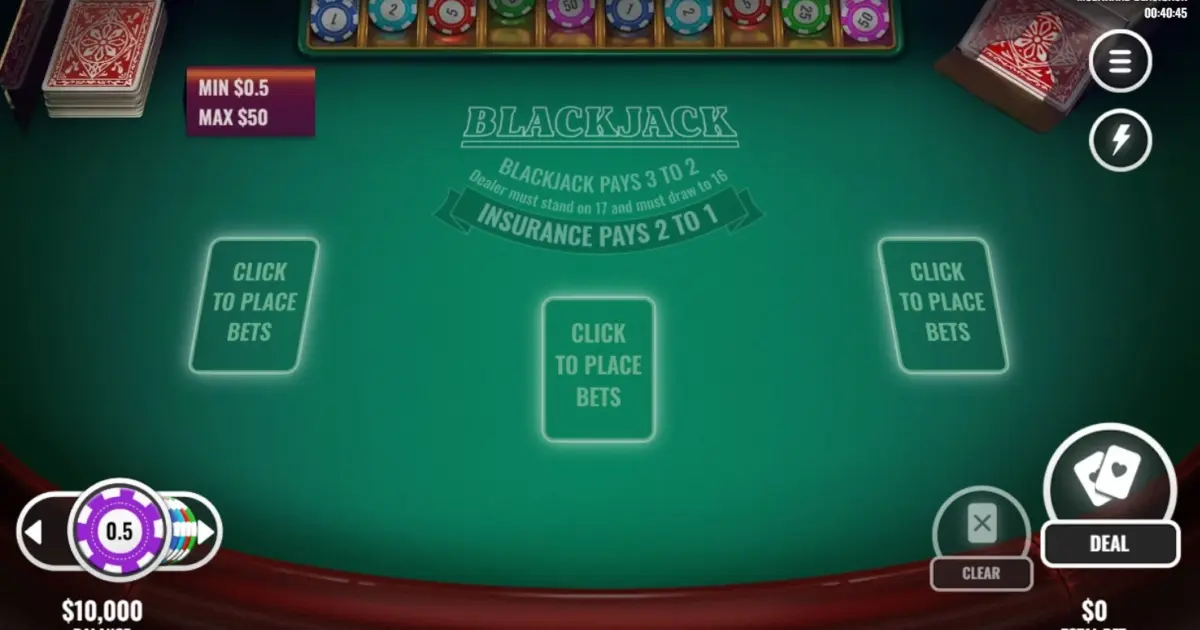
Multihand Blackjack (Platipus) posts a 99.51% RTP, ten basis points above the blackjack corpus average and tied for the upper end of the range. The multi-hand format lets you play several boxes simultaneously against one dealer hand, which accelerates decision volume and stake exposure. That structure suits players who want more action per round, but it also means your bankroll cycles faster. The table’s appeal hinges on whether the unpublished rule set justifies that 99.51% figure under perfect basic strategy.
Platipus operates a single blackjack title in the review database, so this table is the entire provider catalogue for the game. The lack of rule transparency is the immediate friction point: no published deck count, no stated dealer soft-17 behaviour, no confirmed blackjack payout ratio. Each of those variables moves the house edge by measurable fractions, and a tenth of a percent matters when you are comparing tables at this RTP level.
What kind of blackjack is multihand blackjack (platipus)?
The multi-hand format is the defining feature. You occupy multiple betting boxes on the same layout and play each hand independently against a single dealer upcard. Each box receives its own two-card deal, you make hit-stand-double-split decisions for each in turn, and then the dealer completes one hand that resolves all your boxes. The mechanic is standard across multi-hand variants; the difference between tables lies in how many boxes the interface allows and whether the rule set underneath is player-friendly or house-skewed.
Because you are playing multiple hands per round, your total stake per round is the sum of all active boxes. If you bet one unit on three hands, you are wagering three units per round. That raises the hourly churn compared to a single-box game played at the same hand-per-hour rate. The edge per hand remains identical, but variance compounds across the boxes, and your session bankroll depletes faster if you size your bets the same way you would on a single-hand table.
RNG blackjack tables reshuffle after every round, so the deck composition resets before each deal. Card counting does not work here—there is no penetration, no deck depletion, and no positive count to exploit. The only skill edge available is perfect basic strategy, which minimises the house advantage to the figure implied by the rule set.
Return to player: 99.51%
The stated 99.51% RTP translates to a 0.49% house edge, assuming you play perfect basic strategy on every decision. That strategy is a solved chart—derived from exhaustive simulation of every possible hand versus every dealer upcard—and it tells you the mathematically optimal play in each situation. Deviating from it costs you expected value, hand by hand, and a casual player who relies on intuition or partial strategy will realise an RTP materially lower than 99.51%.
| Metric | Value |
|---|---|
| RTP | 99.51% |
| House edge | 0.49% |
| Corpus average RTP | 99.41% |
| RTP versus corpus | +0.10% |
| Provider game count | 1 |
| Free demo available | Yes |
That tenth-of-a-percent lead over the corpus average is genuine but small. At one hundred hands, the difference in expected loss between 99.51% and 99.41% is one tenth of a unit per hundred wagered. Over a long session the gap accumulates, but short-term variance will dominate your results far more than the RTP differential. The figure is a tiebreaker between otherwise equivalent tables, not a reason to override other preferences.
Deck count, dealer rules and the payout that matters most
Platipus does not publish the deck count for this table. Blackjack house edge drops as the deck count falls: a single deck played with otherwise identical rules offers roughly 0.2% better odds than an eight-deck shoe. A few hundredths of a percent separate four-deck from six-deck. The omission means you cannot verify whether the stated 99.51% RTP aligns with the deck composition, and you cannot compare this table’s rule set to another on equal terms.
The dealer soft-17 rule is similarly unpublished. When the dealer hits soft seventeen, the house edge rises by approximately 0.2% compared to the dealer standing. That swing is large enough to move a table from the top quartile to the middle of the pack. Check the in-game rules screen before you play for money—this is not a figure you should assume.
The blackjack payout ratio is the single most consequential rule. A natural blackjack paying 3:2 is the baseline; a table that pays 6:5 on naturals costs the player roughly 1.4% in edge, which is catastrophic. No combination of favourable rules elsewhere—liberal doubling, surrender, deck count—can offset that penalty. If this table pays 6:5, the 99.51% RTP figure is impossible under standard blackjack rules, which suggests it pays 3:2. But “suggests” is not “confirms,” and you should verify it in the paytable before placing a real-money bet.
For context, American Blackjack posts a 99.50% RTP with a transparent rule set, and Classic Blackjack sits at 99.28% with known deck count and dealer behaviour. The absence of published rules here is an outlier, not an industry standard.
Playing your first ten hands
The multi-hand interface presents several betting boxes; you activate as many as you want for the round. Set your unit size, distribute chips across the boxes, and confirm the deal. Each box receives two cards face-up, the dealer takes one upcard, and you resolve each hand in sequence from your rightmost box to your leftmost.
The strategy chart applies independently to each box. If you hold 16 versus a dealer ten on one hand and 11 versus a dealer six on another, you make the correct play for each situation without regard to the other boxes’ composition. The dealer’s hole card is the same random draw whether you are playing one hand or five, so there is no informational advantage or cross-hand inference to exploit.
Your first error will likely be sizing your bets as if you were playing a single hand. If you normally bet five units per round on one box, betting five units on each of three boxes triples your exposure, not your edge. The correct approach is to divide your intended round stake across the active hands, so three boxes at five units total means roughly 1.7 units per box. The per-hand edge is unchanged, but the variance profile shifts: multiple hands smooth short-term swings compared to a single hand at the same total stake.
Side bets: the maths behind the temptation
Platipus does not list which side bets, if any, this table offers. The common options in multi-hand blackjack are Perfect Pairs, 21+3, and insurance. All three carry a higher house edge than the base game, typically in the range of 3% to 7% depending on the paytable and deck count. That edge is an order of magnitude worse than the 0.49% you face on the main hand.
Insurance is the side bet you will see most often, offered whenever the dealer shows an ace. The payout is 2:1, which looks like even money on your original stake if you also hold a blackjack. At standard deck composition, the true odds of the dealer holding a ten in the hole are worse than 2:1, which makes insurance a losing proposition in the long run. The exception is a deck depleted of tens in a shoe game with deep penetration, but this is an RNG table that reshuffles every round—there is no count, and insurance is always a bad bet here.
Perfect Pairs and 21+3 bets resolve based on your initial two cards or the combination of your cards and the dealer’s upcard. The payouts for rare combinations can reach 25:1 or higher, but the probability of hitting those hands is calibrated to give the house a wide margin. If you play these bets, treat them as entertainment with a known cost, not a strategy to improve your session result.
Session limits and bankroll
The multi-hand format amplifies stake velocity. If you play three hands per round at the same pace you would play one, you are wagering three times as much per hour. Your bankroll requirement scales accordingly: a session stake that would support two hours of single-hand play at a given unit size will last roughly forty minutes on a three-hand multi-hand table, assuming identical edge and variance. Size your units to fit the number of hands you intend to play, not the unit size you use on a single-box game.
A common guideline is to hold at least fifty times your total round stake in session bankroll to weather normal variance without reloading. If you are playing three hands at two units each—six units per round—you should start with three hundred units. That buffer does not eliminate the possibility of a losing session; it reduces the probability that ordinary negative swings will exhaust your stake before variance regresses toward the mean.
Set a budget before you start, treat the session as entertainment rather than income, and stop when the limit is reached. Blackjack carries a house edge that no strategy or progression can eliminate, and the outcome of any individual session is dominated by variance, not skill. Play only with money you can afford to lose, and remember that 18+ and responsible gambling practices are not suggestions—they are the baseline for sustainable play.
Verdict on multihand blackjack (platipus)
The 99.51% RTP is legitimate and better than most blackjack tables in the corpus, but the absence of published rules is a material weakness. You cannot verify the deck count, the dealer soft-17 behaviour, or the blackjack payout ratio without opening the game and reading the rules screen yourself, and those three variables determine whether the stated RTP is accurate. A tenth of a percent is not large enough to override transparency concerns when Blackjack (Mascot Gaming) delivers a 99.50% RTP with a clearer rule set.
The multi-hand format is well-executed for players who want higher action density, but it is not a feature that improves your edge or your expected return. It accelerates stake churn, raises variance across the boxes, and demands tighter bankroll discipline than single-hand play. If you prefer that structure and the 99.51% RTP holds under scrutiny, this is a viable table. If rule transparency and provider depth matter to you, there are better-documented alternatives at nearly the same return.
Frequently Asked Questions
Is there a free demo version of Multihand Blackjack (Platipus)?
Yes, a free demo is available. You can test the multi-hand interface and practice basic strategy without wagering real money. Demo results use the same RNG as real-money play but do not predict your actual session outcomes, since variance dominates short samples and the demo does not impose bankroll or psychological pressure.
What is the RTP of Multihand Blackjack (Platipus) and does it assume perfect play?
The stated RTP is 99.51%, which translates to a 0.49% house edge. That figure assumes you play perfect basic strategy on every hand—hit, stand, double, and split decisions made according to the mathematically optimal chart. Casual play or intuitive decisions will yield a lower realised return, often by a full percentage point or more.
Does Platipus publish the deck count and blackjack payout for this table?
No. Platipus does not disclose the deck count, whether the dealer hits or stands on soft seventeen, or the blackjack payout ratio in the public spec. Each of those rules moves the house edge by measurable amounts—up to 1.4% for a 6:5 blackjack payout versus 3:2—so check the in-game rules screen before playing for money.
Can I count cards or use a betting system to beat the house edge?
No. This is an RNG table that reshuffles after every round, so card counting has no penetration to exploit and no deck depletion to track. Betting progressions such as Martingale change the variance shape but not the expected value—you still face the same 0.49% house edge per hand, and no progression can eliminate it.
How does Multihand Blackjack (Platipus) compare to American Blackjack?
American Blackjack delivers a 99.50% RTP, one basis point below this table, with a more established provider footprint and clearer rule documentation. The RTP difference is negligible over any realistic session length—variance will dominate—so the choice depends on whether you value the multi-hand format and whether Platipus's lack of rule transparency is acceptable for your use case.




