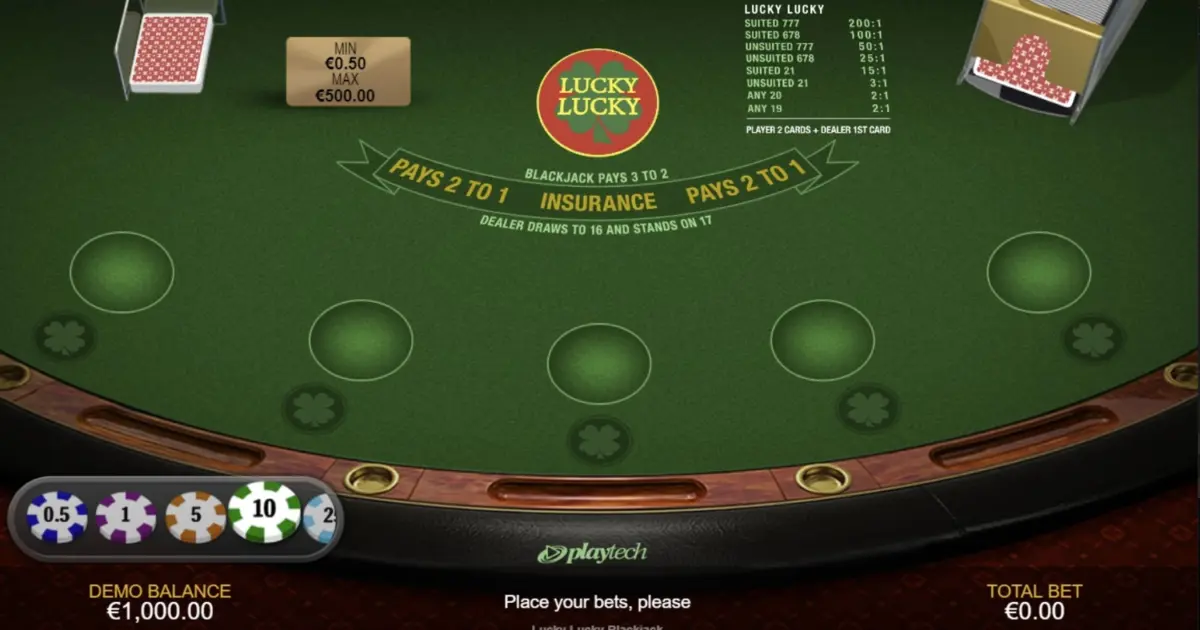
If you want a low-edge blackjack table to practise on, this one qualifies on the numbers: the published return is 99.58%, which puts the theoretical house edge at roughly 0.42%. That is slightly better than the 99.41% average across the blackjack tables in our database, and it sits right on the 99.6% average for Origins (Playtech) titles. The catch, as always, is that the figure assumes flawless play, and Playtech does not publish the full rule set alongside it.
Lucky Lucky Blackjack at a glance
Here is everything Origins (Playtech) confirms about this table. Anything not listed below is not something we can tell you, and you should read the in-game rules screen before you stake real money.
| Detail | Value |
|---|---|
| Game name | Lucky Lucky Blackjack |
| Provider | Origins (Playtech) |
| Category | Blackjack |
| Published RTP | 99.58% |
| Implied house edge | approximately 0.42% |
| Free demo | Available |
| Popularity rank in our blackjack list | 66 (51st percentile) |
| Provider average RTP (9 titles) | 99.6% |
What is absent matters as much as what is present. Playtech does not publish the deck count, the dealer’s soft 17 rule, the blackjack payout, the doubling and splitting permissions, or whether late surrender is offered for this table. Each of those moves the edge, and the paytable inside the game is the only reliable place to check them.
What a 99.58% RTP means at a blackjack table
RTP is simply 100% minus the house edge, so 99.58% means the table is modelled to keep about 0.42% of everything wagered over a very long run. On paper that is excellent. Most casino games do not come close.
But here is the caveat that decides whether the number is useful to you: 99.58% assumes perfect basic strategy on every single hand. Not most hands. Every hand. The figure is calculated by a mathematician running the optimal decision at every decision point, including the awkward ones, the 16 against a 10, the soft 18 against a 9, the pair of 8s against an ace. If you deviate on a handful of hands per hundred, you are not playing a 99.58% game any more. You are playing something meaningfully worse, and casual players routinely give back a full percentage point or more through small, comfortable-feeling mistakes.
Also note that the long run is genuinely long. Over a few hundred hands, variance dominates completely, and your session result tells you nothing about whether the RTP is accurate.
The rules that move the house edge
Since the specific rules are not published, it helps to know the general rules-of-thumb so you can read the paytable yourself and work out roughly where the table sits.
- Blackjack payout is the big one. 3:2 is standard; a table paying 6:5 on blackjack costs the player roughly 1.4%, which is far and away the most damaging single rule change you will encounter. Check this first, always.
- Dealer soft 17. A dealer who stands on soft 17 is better for you by around 0.2% than one who hits it.
- Deck count. Fewer decks favour the player. The difference between single deck and eight decks is worth a few tenths of a percent, and between six and eight decks it is only a few hundredths.
- Doubling and splitting. Double after split, doubling on any two cards, and re-splitting aces each hand a small amount back to the player, typically 0.05% to 0.15% apiece.
- Late surrender is worth roughly 0.07% if you use it correctly.
- Dealer peek. A European no-hole-card rule, where you lose doubled and split stakes to a dealer blackjack, costs about 0.11% versus a peeking dealer.
The name of this table does not signal any particular rule family, so treat all of the above as questions to answer in-game rather than assumptions.
Basic strategy, and what it can and cannot do
Basic strategy is not a system, and nobody invented it in a hotel room. It is a solved chart: for every combination of your hand and the dealer’s up-card, there is one mathematically correct action, and the chart lists it. It has been computed exhaustively, and the answers do not change based on how the last hand went.
What basic strategy does is take the house edge down to its published minimum. What it cannot do is remove it. A 0.42% edge played perfectly is still a 0.42% edge, and no decision sequence, bet size or pattern turns a negative expectation into a positive one.
That includes progressions. Martingale, D’Alembert, doubling after a loss, all of them reshape your variance, making small wins more frequent and the eventual large loss larger. They do not touch expected value. And no hand is ever due; each deal is independent of the last.
Card counting deserves a plain answer here. It does not work against an RNG blackjack table, because the virtual shoe is reshuffled before every hand. There is no depleted deck to track and no count to build. Counting is a live-dealer technique, full stop.
Side bets and insurance
We cannot tell you which side bets this table offers. The name suggests a Lucky Lucky style wager, which typically pays on the combination of your two cards and the dealer’s up-card, but Playtech does not confirm the available side bets or their paytables in the data we hold, so verify in-game.
What is universally true is the maths. Side bets across the genre carry house edges in the range of roughly 2% to 8%, sometimes higher, which is an order of magnitude worse than a sub-1% base game. Blending a few side-bet units into an otherwise well-played shoe quietly drags your effective return down well below the headline RTP.
Insurance is the clearest case. At the standard 2:1 payout it is a losing proposition on its own merits, and taking it every time a dealer shows an ace hands back a chunk of the edge you earned by playing correctly. Basic strategy declines it.
Playing the Lucky Lucky Blackjack demo
The free demo is available here, and it is the sensible place to start. A Lucky Lucky Blackjack free demo lets you read the actual rules screen, confirm the payout and soft 17 behaviour, and drill the basic strategy chart until the awkward decisions stop feeling awkward, all without money on the table. Practising the hands you get wrong is worth more than a hundred comfortable ones.
Do not read anything predictive into demo results. A winning demo session and a losing one are both just variance, and neither forecasts what real-money play will do.
If you do move to real stakes: this is 18+ only, decide your budget before you open the game and treat it as spending on entertainment rather than a way to make income. Set a loss limit you would be genuinely fine with reaching, and stop when you reach it.
Verdict: who should sit at this table
The return is competitive and the free demo is available, so it is a reasonable practice table and a reasonable low-edge option for anyone comfortable with a chart. The weakness is disclosure: without a published deck count, soft 17 rule or blackjack payout, you cannot confirm the 99.58% figure from the outside.
If you want a stated RTP that is a touch higher from the same studio, Quantum Blackjack Plus posts 99.68%. All Bets Blackjack matches this table at 99.58% and is worth comparing if side bets interest you, while Cashback Blackjack sits just behind at 99.55% with a different structure. On the numbers alone there is very little between them, so pick on rules and interface once you have read each paytable.
Frequently Asked Questions
Can I play Lucky Lucky Blackjack for free?
Yes, a free demo is available, so you can play the full table with no deposit and no real money at risk. Use it to read the in-game rules screen and drill basic strategy decisions. Demo outcomes are not predictive of real-money sessions, so treat them as practice rather than a forecast.
What is the RTP of Lucky Lucky Blackjack?
Origins (Playtech) publishes 99.58%, which implies a house edge of roughly 0.42%. That figure assumes perfect basic strategy on every hand, without exception. Deviate on even a few decisions per hundred hands and your realised return drops materially below 99.58%, often by a full percentage point or more.
Which rules affect the house edge on this table?
Playtech does not publish the deck count, soft 17 rule, blackjack payout or surrender terms for this table, so check the paytable in-game. As rules-of-thumb: a 6:5 blackjack payout costs about 1.4%, a dealer standing on soft 17 saves about 0.2%, and late surrender is worth about 0.07%.
Does card counting work on Lucky Lucky Blackjack?
No. This is an RNG table, and the virtual shoe is reshuffled before every hand, so there is no card depletion to track and no running count to build. Counting only applies to live-dealer games. Betting progressions do not help either; they change variance, not expected value.
Who makes Lucky Lucky Blackjack, and how does it compare to their other tables?
Origins, Playtech's studio, which has nine blackjack titles in our catalogue averaging 99.6% RTP. At 99.58%, this table sits right on that average. Quantum Blackjack Plus is marginally higher at 99.68%, while All Bets Blackjack matches it exactly at 99.58%.




