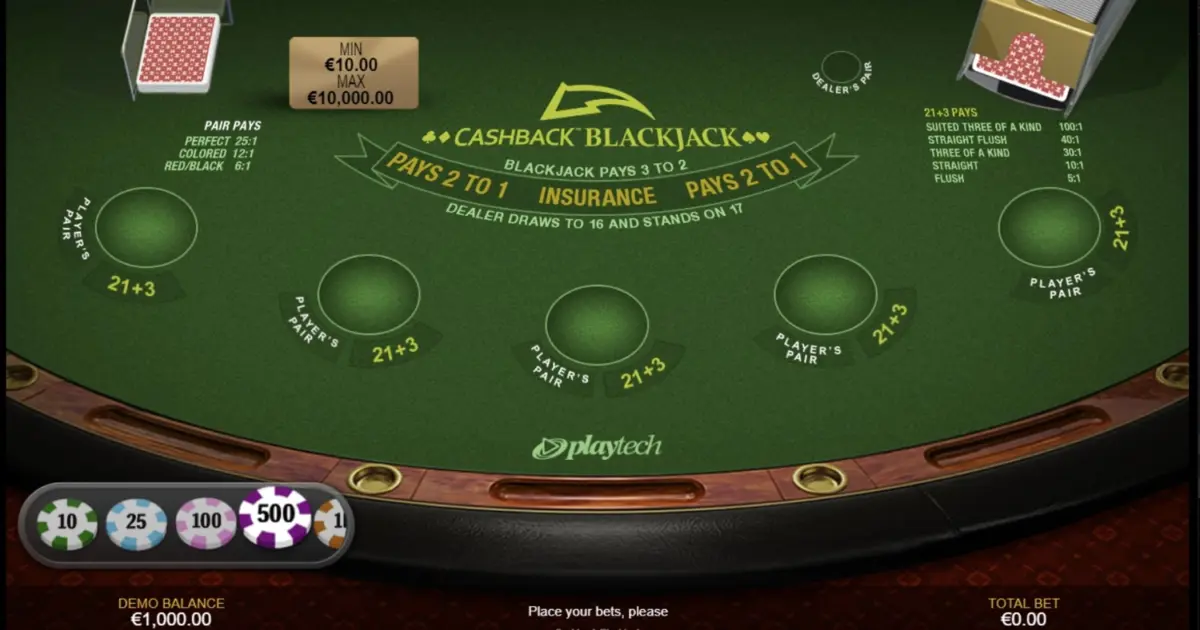
Cashback Blackjack sits in the middle of Origins’ nine-table lineup with a 99.55% RTP, which translates to a 0.45% house edge when you play flawless basic strategy on every hand. That figure is above the 99.41% online blackjack average, though Origins offers tighter tables if you want to squeeze every hundredth of a percent. The “cashback” name suggests a promotional mechanic rather than a rule variation, so treat the RTP and the base ruleset as your decision factors.
Cashback Blackjack in one minute
Origins does not publish the full ruleset for this table—deck count, whether the dealer hits soft 17, the blackjack payout ratio, double-after-split, surrender availability, and side-bet selection are all absent from the supplied data. That makes it impossible to reverse-engineer where the 0.45% house edge comes from or to build a precise basic-strategy chart without opening the game and reading the paytable yourself. The 99.55% RTP tells you the end result but not the path. For a maths-first player, that is frustrating: a single rule change, particularly a 6:5 blackjack payout instead of 3:2, costs you roughly 1.4 percentage points and swamps every other rule combined.
What you do know is that Origins’ average RTP across all nine tables is 99.6%, and this table sits five hundredths below that, so it is not the provider’s flagship offering. If you are comparing Origins tables, Quantum Blackjack Plus at 99.68% and Blackjack Surrender (Origins) at 99.66% both carry materially lower house edges, and the difference compounds over a long session.
| Metric | Value |
|---|---|
| RTP (perfect basic strategy) | 99.55% |
| House edge | 0.45% |
| Provider average RTP | 99.6% |
| Online blackjack average RTP | 99.41% |
| RTP versus corpus | +0.14 pp |
| Free demo | Yes |
House edge versus RTP: the numbers explained
RTP is the long-run expectation expressed as a percentage of total money wagered that is returned to players. A 99.55% RTP means that for every £100 you bet over thousands of hands, the table expects to return £99.55, and the house keeps £0.45. That 0.45% is the house edge. The two figures are mirror images: RTP = 100% minus house edge.
The critical caveat is that 99.55% assumes perfect basic strategy on every hand. Basic strategy is the solved decision chart that tells you whether to hit, stand, double, or split based on your two cards and the dealer’s upcard. It is not a betting system or a hunch; it is the mathematically optimal play derived from exhaustive computer simulation. A casual player who stands on 16 against a dealer 7, takes insurance at standard odds, or doubles soft 18 against a 9 will realise a materially lower return, often costing an additional 1% to 3% in edge.
Session variance is wide. You can lose ten hands in a row or win eight of the next ten, and neither run tells you anything about the RTP. The house edge is a long-run average that emerges over tens of thousands of hands, not a prediction for your next shoe. Bankroll management—betting a small fraction of your total stack per hand—keeps you in the game long enough for variance to settle, but it never turns the 0.45% house edge into a player advantage.
How this table compares to other online blackjack
Cashback Blackjack’s 99.55% RTP sits 0.14 percentage points above the 99.41% online blackjack average, which positions it in the better half of the market but not at the top. Within Origins’ own catalog, All Bets Blackjack at 99.58% edges it out by three hundredths, and the two flagship tables mentioned earlier both crack 99.65%.
The difference between 99.55% and 99.65% sounds trivial, but over 1,000 hands at £10 per hand, the cumulative expected loss shifts from £45 to £35—a £10 swing. That compounds over volume. If you play casually for entertainment, the difference is noise. If you log hundreds of hours, those tenths of a percent matter, and you should hunt for the tightest table you can find.
Without the published ruleset, you cannot identify which specific rule is costing you the extra edge. The most common culprits are a 6:5 blackjack payout, the dealer hitting soft 17, fewer decks (which helps the player when other rules are equal, but can be offset by restricted doubling or splitting), and the absence of late surrender. Check the in-game rules screen before you commit real money, and if you see 6:5 blackjack, walk away—that single rule change is more damaging than every other variable combined.
Why card counting does not work here
This is an RNG-driven online table that reshuffles after every hand. Card counting relies on tracking the ratio of high cards to low cards remaining in the shoe; when the count is positive, the player has a statistical edge and raises the bet. An RNG that resets the deck every hand makes the count always neutral, so there is never an edge to exploit. You can count if you want to practice for live casino play, but it will not change your expected value by even a hundredth of a percent here.
Basic strategy in practice
Basic strategy is a lookup chart, not a progression. You find your two-card total on one axis, the dealer’s upcard on the other, and the intersection tells you the correct play. It does not guarantee you win the hand—blackjack is a negative-expectation game under any legal ruleset—but it minimises the house edge to the published figure. Deviating from basic strategy, even on hands that feel marginal, costs you money over time.
Common mistakes that inflate the house edge: taking insurance (insurance is a side bet that pays 2:1 when the dealer has a ten in the hole, but at standard odds it loses money in the long run), standing on soft 18 against a dealer 9 or 10 (you should hit), splitting tens (never split tens), and failing to double 11 against a dealer 6. Each error looks small in isolation, but they compound.
Because Origins has not published the full ruleset for Cashback Blackjack, you cannot download a perfectly tuned basic-strategy chart before you play. You will need to note the rules from the paytable screen and cross-reference a generic chart, or use one of the strategy calculators available online that lets you input the specific rules. The core principles hold across all blackjack variants—always split aces and eights, never take insurance, double your strong hands against weak dealer upcards—but the edge cases (soft 18 versus 2, 16 versus 10 in a game with surrender) shift depending on whether the dealer hits soft 17 and how many decks are in play.
Betting systems and why they do not change the odds
Martingale, D’Alembert, Fibonacci, and every other progression system change the shape of your session variance but not your expected value. Doubling your bet after a loss (Martingale) means you will recover your losses on the first win, but it also means you will hit the table limit or exhaust your bankroll during a long losing streak, and those streaks happen more often than intuition suggests. The house edge remains 0.45% per hand regardless of your bet size, so a progression cannot manufacture a positive expectation from a negative-edge game.
Flat betting—wagering the same amount every hand—produces the lowest variance and the longest playing time for a given bankroll. Unit sizing is the meaningful decision: betting 1% to 2% of your total stack per hand keeps you in the game through a bad run, while betting 10% or more per hand exposes you to rapid ruin even if the RTP is favorable. The maths is unforgiving: variance is wide in the short term, and no hand is ever “due” to win or lose based on what came before.
If you enjoy the psychological rhythm of a progression, use one that matches your risk tolerance, but never believe it beats the house edge. It does not. The published RTP already accounts for optimal play, and a betting system is not part of optimal play—it is a volatility preference.
The free demo
Cashback Blackjack offers a free demo, so you can test the table, confirm the rules from the paytable, and practice basic strategy without risking money. Demo play runs on the same RNG as real-money play, so the deal is fair, but short-term results in demo mode do not predict real-money outcomes. Variance is wide over dozens or even hundreds of hands; the RTP emerges over tens of thousands.
Use the demo to verify the blackjack payout ratio, whether the dealer hits soft 17, which double and split options are available, and whether side bets are present. Those facts determine whether the 99.55% RTP is achievable with rules you find acceptable. If the table uses 6:5 blackjack, the published RTP is meaningless—you are playing a different game with a house edge closer to 2%.
Set a budget before you play for real money, treat blackjack as entertainment rather than income, and never chase losses. The house edge is persistent, and no session is ever “due” to turn around. If you are under 18, you cannot play for real money, and if gambling is causing you stress or financial harm, seek support from a service like BeGambleAware or your local responsible-gambling resource. Blackjack is a solved game with known odds; play it for the decisions, not the hope of beating the maths.
Verdict
Cashback Blackjack delivers a solid 99.55% RTP that sits above the online blackjack average, but Origins offers tighter tables within the same catalog, and the absence of a published ruleset forces you to verify the paytable in-game before committing money. If the rules include 3:2 blackjack and a reasonable double-and-split policy, this is a defensible choice for casual play. If the rules include 6:5 blackjack or other player-hostile restrictions, the published RTP is unattainable and you should walk.
The free demo is your best tool. Load it, check the rules, and compare the result to the other Origins tables linked in this review. A tenth of a percent might not matter over fifty hands, but it compounds over volume, and there is no reason to give up edge voluntarily when better options are a click away.
Frequently Asked Questions
Is there a free demo for Cashback Blackjack?
Yes, Cashback Blackjack offers a free demo so you can test the table and confirm the ruleset without risking real money. Demo play runs on the same RNG as real-money hands, so the deal is fair, but short-term results do not predict your long-run return. Use the demo to verify the blackjack payout ratio, double and split rules, and whether the dealer hits soft 17 before you commit your bankroll.
What is the RTP for Cashback Blackjack and does it assume perfect play?
Cashback Blackjack has a 99.55% RTP, which corresponds to a 0.45% house edge. That figure assumes perfect basic strategy on every hand—hitting, standing, doubling, and splitting according to the solved chart for the specific ruleset. A casual player who deviates from basic strategy, takes insurance, or makes common errors will realise a materially lower return, often costing an additional 1% to 3% in edge.
Can I use card counting or a betting system to beat the house edge?
No. Cashback Blackjack is an RNG-driven online table that reshuffles after every hand, so card counting produces no edge—the count is always neutral. Betting progressions like Martingale or D'Alembert change the shape of your session variance but not your expected value; the 0.45% house edge applies to every hand regardless of bet size, and no progression can manufacture a positive expectation from a negative-edge game.
How does this table compare to other Origins blackjack games?
Cashback Blackjack sits in the middle of Origins' nine-table lineup with a 99.55% RTP, compared to the provider average of 99.6%. Quantum Blackjack Plus at 99.68% and Blackjack Surrender (Origins) at 99.66% both offer materially lower house edges. Over 1,000 hands at £10 per hand, the difference between 99.55% and 99.65% shifts your expected loss from £45 to £35, which compounds over volume.
Why does Origins not publish the full ruleset for this table?
Origins has not disclosed the deck count, blackjack payout ratio, whether the dealer hits soft 17, or the double and split rules for Cashback Blackjack. That makes it impossible to reverse-engineer the source of the 0.45% house edge or to build a precise basic-strategy chart without opening the game. Check the in-game paytable before you play for real money, and if you see a 6:5 blackjack payout, walk away—that single rule change costs you roughly 1.4 percentage points and swamps every other factor.




