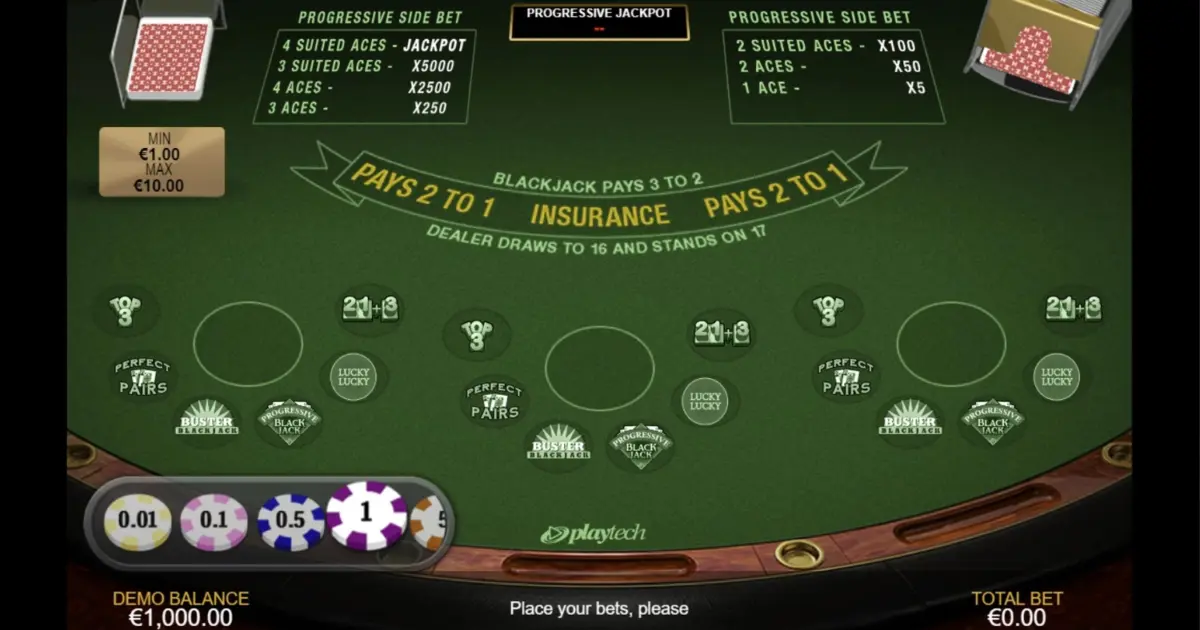
Frankie Dettori’s Magic Seven Blackjack is a title from Origins (Playtech) carrying a published return-to-player figure of 99.58%. That number places it slightly above the site-wide blackjack average, but the critical question for any maths-literate player is whether the underlying rules justify the RTP headline. The short answer: you cannot tell from the published figures alone, and that gap matters.
Magic Seven Blackjack at a glance
Origins (Playtech) publishes 99.58% as the theoretical return for this table. The provider’s portfolio-wide average sits at 99.60%, so Magic Seven lands within two hundredths of a percentage point of its siblings — neither a standout nor a drag.
What the provider does not publish here is the rule detail that actually determines whether that figure is reachable. The deck count, whether the dealer stands or hits on soft seventeen, the blackjack payout ratio, and the surrender and doubling rules are absent from the listing. Those are not minor omissions: the difference between 3:2 and 6:5 on a natural blackjack alone shifts the house edge by roughly 1.4%, which dwarfs the entire gap between this RTP and the corpus average.
You should treat the 99.58% as a ceiling contingent on rules you have not yet confirmed. The game’s rank of 126 and its position in the 6th popularity percentile suggest it has not become a player favourite, which may reflect either obscurity or a paytable that underperforms once you open the rules screen.
What 99.58% RTP means at a blackjack table
The 99.58% figure translates to a house edge of 0.42%. That number assumes you play perfect basic strategy on every single hand, with zero deviations, zero insurance bets, and zero errors under pressure. This is not a soft assumption. Studies of live and online play consistently show that casual players realise returns materially below the published figure because basic strategy involves counter-intuitive decisions — standing on hard sixteen against a dealer ten, splitting eights against anything, never splitting tens — that trip up anyone who has not memorised the chart cold.
For context, if your error rate costs you even 0.3% of your wagered amount, your effective return drops to approximately 99.28%. That single adjustment puts this table at roughly the same level as Cashback Blackjack, which publishes 99.55%. The gap between tables that appear similar on paper can widen significantly once play quality is factored in.
Treat the published RTP as a mathematical maximum for an idealised player, not as a description of what you will experience over a typical session.
The rules that move the house edge
Origins does not publish the specific rule set for this table, so the following general rules-of-thumb tell you what to look for in the in-game paytable. Each adjustment below represents the approximate shift in house edge relative to a baseline of four-to-eight decks, dealer standing on soft seventeen, 3:2 blackjack, double after split permitted, and no surrender.
Blackjack payout: if this table pays 6:5 rather than 3:2 on naturals, the house edge increases by approximately 1.4%. This is the single most damaging rule change a player can encounter and the one most likely to explain a gap between advertised and realised RTP. Confirm it before you deposit.
Dealer on soft seventeen: if the dealer hits rather than stands, the edge moves about 0.2% against you. With a 6:5 payout on top, that compounds quickly.
Deck count: fewer decks favour the player. A single-deck game runs roughly 0.5% better than an eight-deck shoe under otherwise identical rules.
Double after split and re-splitting aces: both reduce the edge by roughly 0.1 to 0.15% each when permitted. Their absence is a quiet tax.
None of these are confirmed for Magic Seven — you must check them yourself. If the table offers All Bets Blackjack from the same provider and that game publishes its rules clearly, comparing the two side by side may reveal which rule set you are actually facing.
Basic strategy, and what it can and cannot do
Basic strategy is a solved chart: a table of optimal decisions derived from exhaustive combinatorial calculation. It is not a system, not a sequence, and not something you can tune to the shoe. It tells you the highest-expected-value action for every player-dealer card combination, and it is the reason the published RTP figure is even meaningful.
What it cannot do is eliminate the house edge. Even played perfectly, you face a negative expectation that no sequence of decisions can reverse over a long enough horizon. What it does is compress the gap between your results and the theoretical maximum. A player who knows the chart well enough to apply it without hesitation converts the 0.42% edge into 0.42% plus a small error penalty. A player who guesses converts it into something far worse.
There is no variant-specific strategy deviation you need to worry about here because the specific rule set is unpublished. Use the standard multi-deck, stand-on-soft-seventeen chart as a starting point and adjust once you confirm the actual rules.
Side bets and insurance
Origins does not list any side bets for this title. If the game interface offers them — Perfect Pairs, 21+3, or something proprietary — the relevant fact is unchanged regardless of branding: side bets carry house edges between roughly 2% and 10%, an order of magnitude worse than the base game. They exist because the player’s edge-free decisions on the main hand make the table boring for the casino.
Insurance is the one side bet that is universally available at blackjack tables. At standard odds of 2:1, insurance carries a house edge of approximately 5.75% under the assumption that the probability of a dealer ten is proportional to the card composition. There is no legitimate basic-strategy argument for taking insurance against a dealer ace at any table. The correct play is always to decline it unless you are counting cards in a live game with penetration short enough to justify the decision — a condition that does not apply to an RNG table.
Playing the Frankie Dettori’s Magic Seven Blackjack demo
A free demo is available for this title. Use it for one specific purpose: open the rules or paytable screen and extract the deck count, blackjack payout, soft-seventeen rule, and any doubling or surrender conditions. The demo play itself tells you nothing about your long-run results because it uses the same RNG logic as the real-money version — you will see variance in both directions without learning anything that transfers.
Quantum Blackjack Plus from the same provider family publishes a higher RTP of 99.68%. If you confirm that Magic Seven uses 6:5 payouts or a less favourable rule set, that comparison becomes immediately actionable.
One note before you move to real money: blackjack is entertainment, not income. Set a session budget before the first hand, treat it as the cost of that entertainment, and stop when it is spent. If gambling stops being fun, resources like GamCare and the National Problem Gambling Helpline exist for a reason. This applies whether you are at Magic Seven or any other table.
Verdict: who should sit at this table
Frankie Dettori’s Magic Seven Blackjack makes sense only after you have verified its rules in the paytable. If it turns out to stand on soft seventeen, pay 3:2, permit double after split, and use four to six decks, the 99.58% figure is roughly what you can target with disciplined play and this becomes a reasonable table. If it hides 6:5 payouts or a soft-seventeen hit behind that headline number, walk away — there are dozens of alternatives that publish their conditions clearly, starting with the related titles linked above.
| Figure | Value |
|---|---|
| RTP (published) | 99.58% |
| House edge (implied) | 0.42% |
| Provider average RTP | 99.60% |
| Corpus average RTP | 99.41% |
| Rank | 126 |
| Free demo | Yes |
Frequently Asked Questions
Can I play Frankie Dettori's Magic Seven Blackjack for free?
Yes. A free demo version is available on this site. It runs the same RNG logic as the real-money game, so you can use it to inspect the paytable and confirm the specific rules — deck count, blackjack payout, dealer soft-seventeen behaviour — before deciding whether to wager actual money.
What does the 99.58% RTP figure assume?
It assumes perfect basic strategy on every hand with no deviations and no side bets. In practice, even a small error rate reduces your realised return. A player who makes mistakes worth 0.3% of wagers sees an effective return closer to 99.28%, so treat 99.58% as a ceiling rather than an expectation.
Which rules would change the house edge for this table?
The blackjack payout (3:2 versus 6:5 costs roughly 1.4%), dealer action on soft seventeen (hitting adds about 0.2%), deck count, double-after-split, and surrender availability all shift the edge. Origins does not publish these details in the listing, so you must check the in-game rules screen.
Does card counting work on Frankie Dettori's Magic Seven Blackjack?
No. This is an RNG-based digital table. Each hand is dealt from a freshly shuffled or continuously reshuffled virtual shoe, so the card composition of the remaining deck carries no predictive information about the next hand. Counting provides no edge against RNG blackjack regardless of deck count or penetration.
How does this table compare to Quantum Blackjack Plus from the same provider?
Quantum Blackjack Plus publishes 99.68% RTP versus Magic Seven's 99.58%, a difference of 0.10%. Both come from Origins (Playtech). Whether that gap translates into real-player advantage depends entirely on the underlying rules — which for Magic Seven remain unpublished in the listing and must be verified in-game.




