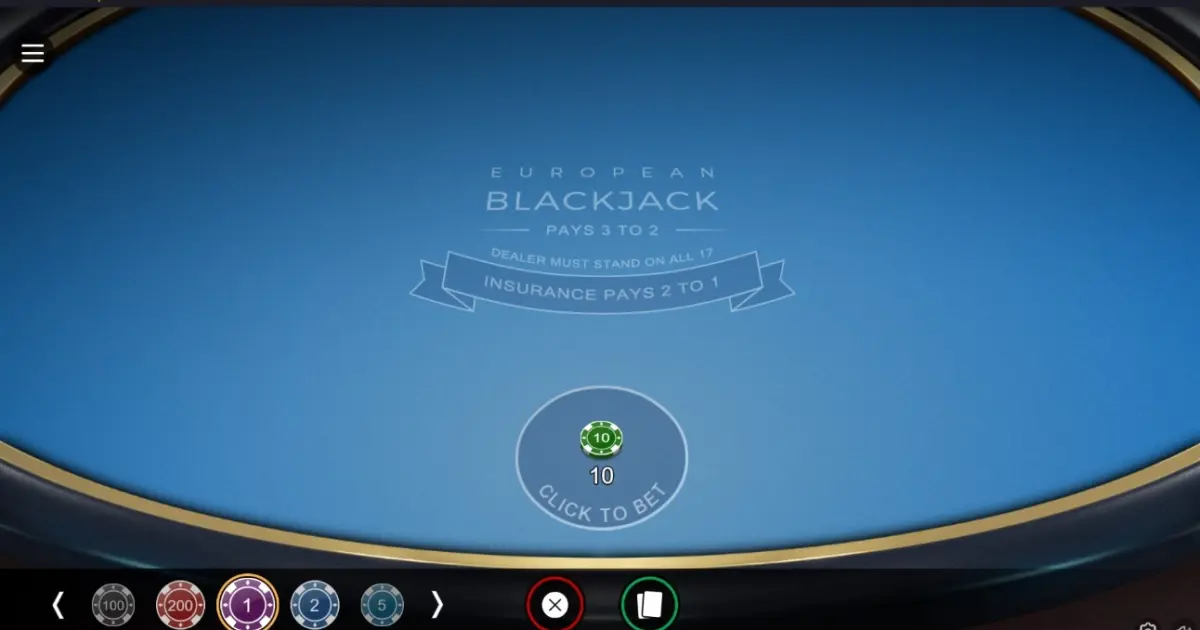
Switch Studios publishes a 99.6% RTP for european blackjack, which puts it near the top of the range for online blackjack tables and slightly ahead of the 99.41% average across the tables in our database. That figure is real, but it is conditional: it assumes flawless basic strategy on every hand you play. Deviate, and your actual return drops well below it.
The other thing worth knowing before you sit down is that the title points to a European rule family, and European rules change how doubles and splits behave. More on that below, and on why you should read the in-game paytable rather than trusting the name.
Is European Blackjack a fair table?
By the published number, yes. 99.6% RTP means a house edge of 0.4%, or roughly 40p of expected loss for every £100 wagered over a long run of hands. Compared with almost anything else in a casino lobby, that is an unusually thin margin in the player’s favour.
The caveat matters more than the number. An RTP figure for a blackjack table is calculated on the assumption that the player makes the mathematically correct decision on every hand — every hit, stand, double and split taken from the optimal chart for that exact rule set. That is not how most people play. Stand on a 16 against a dealer 7 because it feels safer, take insurance because the dealer shows an ace, split tens because the hand looks strong, and you are no longer playing a 0.4% game. Each of those errors adds a fraction of a percent, and they compound across a session.
So treat 99.6% as a ceiling rather than an expectation. It is what the table gives back to a player who does everything right, and it tells you the game is well constructed. It does not tell you what you personally will get back.
| Provider | Switch Studios |
|---|---|
| RTP | 99.6% |
| Free demo | Yes |
Switch Studios and this table
Switch Studios has 22 titles in our database, and the average RTP across them is 99.61% — so this table sits almost exactly on the studio’s own house standard rather than being an outlier in either direction. That consistency is the useful signal here: the studio builds tight tables as a matter of course, not as a one-off marketing figure on a single release.
If you want to compare within the same catalogue, Classic Blackjack is the highest-RTP table Switch Studios lists at 99.9%, which makes it the natural benchmark if the return figure is your main filter. Vegas Strip Blackjack sits between the two at 99.7% and uses American-style rules, so it is the obvious comparison if you specifically want to see what a dealer hole card does to your doubling decisions. ReDeal Blackjack matches this table at 99.6% but adds a redeal mechanic on top of the base game.
Beyond the game count and the RTP averages, Switch Studios does not publish the finer specifications for this table in a form we can quote here, so the rules screen inside the game is your source for anything below.
Rule set: what the title implies
The name indicates a European rule set, which normally means the dealer takes no hole card. The dealer deals themselves a single card, you complete your hand, and only then does the dealer draw. This is a genuine hint, not a confirmed rule, and you should verify it in the paytable before wagering real money.
If the no-hole-card rule is in play, the practical consequence is specific and worth understanding. Because the dealer has not checked for blackjack before you act, you can double down or split against a dealer ace or ten, put extra money on the table, and then lose all of it when the dealer completes a natural. Under American peek rules the dealer checks first and you only lose your original bet. That difference is small in isolation but it changes the correct basic-strategy chart: no-hole-card tables call for more conservative doubling and splitting against high dealer cards.
Everything else that moves the edge — deck count, whether the dealer hits or stands on soft 17, the blackjack payout, double-after-split, re-splitting aces, late surrender — is not published for this table. Those rules are what generate the 99.6% figure, so if you want to know exactly why the number lands where it does, the in-game rules screen is the only place to find out. As a general rule-of-thumb, a 6:5 blackjack payout instead of 3:2 is the single most damaging change a table can make, costing the player roughly 1.4%. A 99.6% RTP is not compatible with a 6:5 payout, so that one is almost certainly not present here.
The maths of a blackjack hand
Basic strategy is not a system and it is not a betting pattern. It is a solved chart: for every combination of your hand and the dealer’s up card, one decision has a higher expected value than all the others, and the chart tells you which. There is nothing to believe in and nothing to tune. Learning it is the entire difference between playing a 0.4% house edge and playing something closer to 2%.
What basic strategy cannot do is remove the edge. Play perfectly for ten thousand hands and the house still keeps its 0.4%. The chart minimises your loss rate; it does not flip the sign.
Card counting is worth addressing directly because players ask. It does not work on an RNG table. Counting depends on cards being removed from a finite shoe so that the remaining composition drifts in your favour. An RNG table draws from full, fresh odds on every hand, so there is no depletion to track and no count to exploit. No amount of card tracking changes a single hand’s probability here.
The same logic kills betting progressions. Martingale, D’Alembert and doubling after a loss redistribute your variance — bigger swings, longer streaks of small wins, occasional catastrophic sessions — but they do not touch expected value. No sequence of bet sizes on a negative-EV game produces a positive-EV game, and no hand is ever due.
Common mistakes that cost you the edge
Insurance is the clearest one. At standard 2:1 odds it is a losing bet on its own merits, and taking it whenever the dealer shows an ace is one of the fastest ways to give back the value that a tight RTP hands you. Basic strategy declines insurance every time on an RNG table.
Deviating from the chart is the expensive habit. Standing on soft 18 against a dealer 9, refusing to hit 12 against a 3, splitting tens because the hand looks strong — every one of those has a measurable cost in expected value, and none of them feel wrong in the moment. If the chart says hit, hit.
Side bets deserve their own warning. Perfect Pairs, 21+3 and similar wagers carry house edges several times higher than the base game — typically in the low single digits of percent rather than fractions of one. Whether this specific table offers any of them is not something Switch Studios publishes, so check the felt. If side bets are available, understand that money placed there is not playing a 99.6% game.
Trying it free first
A European Blackjack free demo is available, and for this table it is genuinely worth using rather than skipping. The demo is where you confirm the things the published data does not tell you: whether the dealer takes a hole card, what the blackjack payout is, how many decks are in play, whether surrender or double-after-split exist, and what side bets sit on the layout. Read the rules screen, then play a few dozen hands with a basic-strategy chart open beside you until the correct decisions stop requiring thought.
What demo play cannot do is forecast real-money outcomes. A hot run in free mode is a short sample, nothing more, and the same is true of a cold one.
Blackjack is for players aged 18 or over. Decide what you are willing to lose before you start, treat it as entertainment rather than a source of income, and stop when you reach the number you set — not when the session feels like it owes you something.
Final take on European Blackjack
The 99.6% figure is legitimate and the studio’s 22-title average of 99.61% suggests it is not a one-off. If you already know basic strategy, this is a table worth your time.
The reservation is informational rather than mathematical. The name hints at no-hole-card rules, which shifts your doubling and splitting decisions, and almost every other edge-relevant rule is unpublished. Open the rules screen first, adjust your chart to what you find, and you are playing one of the tighter blackjack games available.
Frequently Asked Questions
Can I play European Blackjack for free?
Yes, a free demo of European Blackjack is available with no download and no deposit. It is worth using specifically to read the in-game rules screen, since Switch Studios does not publish the deck count, blackjack payout or side bet options for this table. Play a few hands with a basic-strategy chart open before wagering real money.
What is the European Blackjack RTP?
Switch Studios lists this table at 99.6% RTP, equivalent to a 0.4% house edge. That figure assumes perfect basic strategy on every hand — every hit, stand, double and split taken from the optimal chart. A casual player who deviates will realise a materially lower return, often closer to 98%.
What house edge does this table have and what changes it?
The house edge is 0.4%, derived from the 99.6% RTP. Deck count, dealer soft 17 rules, double-after-split, re-splitting aces and surrender all move that number, but none are published for this table. As a rule-of-thumb, a 6:5 blackjack payout instead of 3:2 costs roughly 1.4% — incompatible with 99.6%.
Does card counting work on European Blackjack?
No. This is an RNG table, so every hand draws from fresh, full odds rather than a depleting shoe. Counting relies on tracking cards removed from play, and there is nothing to track here. Betting progressions like Martingale also fail — they reshape variance without altering the 0.4% expected loss.
How does it compare to Classic Blackjack from the same studio?
Classic Blackjack is listed at 99.9% RTP against 99.6% here, so it returns marginally more to a perfect player. Vegas Strip Blackjack sits between them at 99.7% with American peek rules. The European name here hints at no-hole-card dealing, which makes doubles and splits riskier against high dealer cards.




