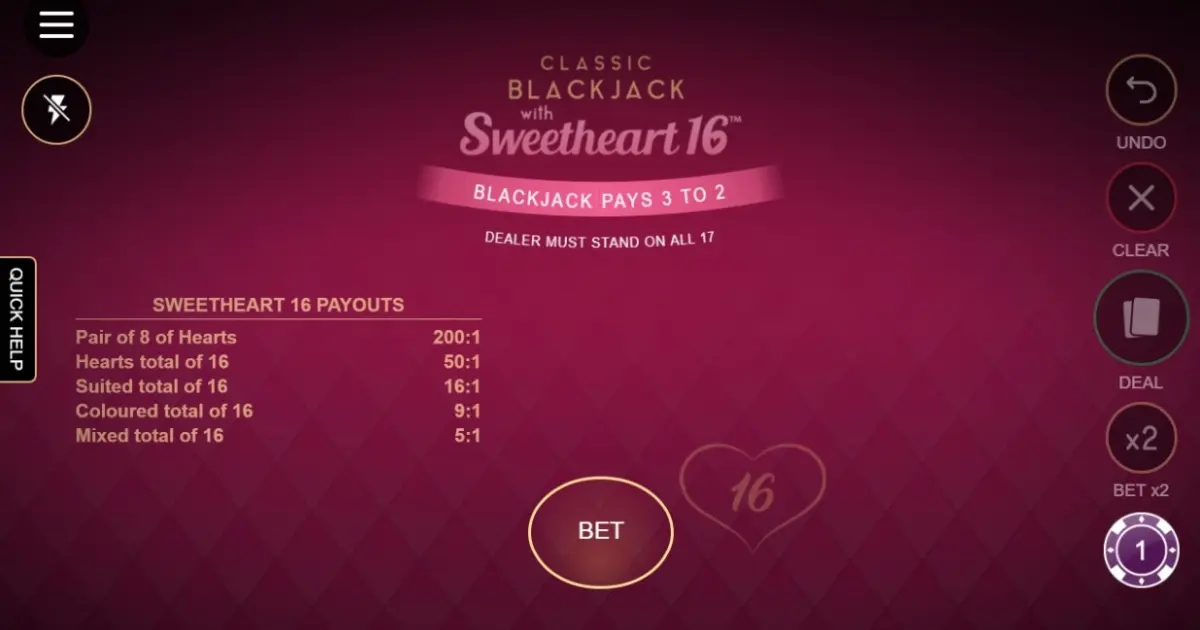
If you want a low-edge blackjack table to practise on, classic blackjack with sweetheart 16 is worth loading in demo mode: Switch Studios publishes a 99.4% RTP, which sits almost exactly on the average for online blackjack tables. The catch is the name itself. The “Sweetheart 16” element is not described in the data available for this review, so you will need the in-game rules screen to find out what it actually does to your hands before you stake money.
Everything below separates what is confirmed about this table from what is general blackjack maths. Where a rule is unknown, that is stated rather than filled in.
Classic Blackjack with Sweetheart 16 in one minute
The confirmed facts are short. Switch Studios is the provider, the published RTP is 99.4%, and a free demo is available so you can work through hands without a balance at risk. The title flags a “Classic” rule set, which is the baseline most strategy charts are written for — but that is a hint from the name, not a documented rule list.
What is not published here matters just as much. The deck count is not listed. Whether the dealer stands or hits on soft 17 is not listed. The blackjack payout, the double-down restrictions, whether you may double after a split, whether aces can be re-split, and whether late surrender exists are all absent. So is any information on side bets or table limits. And the Sweetheart 16 mechanic — presumably something involving hard or soft sixteens, the worst spot in blackjack — is undocumented in these facts.
None of that makes the table bad. It means the paytable and rules screen inside the game are mandatory reading, not optional. A single rule change on a blackjack table can move the edge by more than a tenth of a percent, and a payout change can move it by over a full percent. You cannot evaluate a table properly without seeing those rules, and the demo gives you a free way to read them.
| Provider | Switch Studios |
|---|---|
| RTP | 99.4% |
| Free demo | Yes |
House edge versus RTP: the numbers explained
RTP and house edge are two ways of saying the same thing. A published 99.4% return implies a house edge of 0.6%, meaning that over an enormous number of hands the table keeps roughly 60 cents per $100 wagered. Over a short session that average tells you almost nothing — variance dominates, and both winning and losing runs are entirely normal at this edge.
The caveat that gets ignored most often is this: 99.4% assumes perfect basic strategy on every single hand. Every hit, stand, double and split matches the mathematically correct play for your total against the dealer’s up-card. Deviate, and the return you actually realise is lower. A casual player working on instinct can easily give up one to two percent, which turns a 0.6% edge into something closer to a slot machine. The number on the marketing page describes optimal play, not typical play.
Rules move that figure too, and it is worth knowing the rough magnitudes. A blackjack paying 6:5 instead of 3:2 costs you roughly 1.4% — comfortably the most damaging single rule change in the game, and enough to wipe out any low-edge claim on its own. A dealer who hits soft 17 costs around 0.2%. Fewer decks help the player; eight decks are worse than one by a few tenths. Double after split, re-splitting aces and late surrender each hand back small fractions of a percent. Since none of these are documented for this table, treat 99.4% as the provider’s figure for their configuration and verify the rules yourself.
How this table compares to other online blackjack
The average RTP across the online blackjack tables in this corpus is 99.41%, so at 99.4% this game is dead average — a hundredth of a percent below the mean, which is noise rather than a meaningful gap. Switch Studios averages 99.61% across its 22 tables, so this particular release sits slightly below the studio’s own typical standard.
If you are hunting purely for the lowest edge, the studio has sharper options. Classic Blackjack is listed at 99.9%, which is about as low a house edge as blackjack gets and half a percent better than this table over the long run. Vegas Strip Blackjack sits at 99.7%, and ReDeal Blackjack at 99.6%.
Those gaps are small in absolute terms but real if you play volume. Half a percent on $10,000 of total action is $50 of expected cost. That said, published RTP is only one dimension. A table with a marginally higher edge but rules you understand and a mechanic you enjoy can be the better choice, and the Sweetheart 16 twist may be exactly why you are here. Compare the rules screens side by side in demo mode rather than choosing on the headline percentage alone.
Basic strategy in practice
Basic strategy is not a system or a betting method. It is a solved chart: for every combination of your hand and the dealer’s up-card, one play has the highest expected value, and the chart lists it. It has been computed exhaustively. There is nothing to guess at and nothing to improve on.
Playing it correctly minimises the house edge. It never removes it. Even flawless play leaves the casino its margin, which is why 99.4% is a ceiling rather than a target to beat.
One important practical point: the correct chart depends on the rules. Deck count and the dealer’s soft 17 rule change a handful of borderline decisions, so you need the actual rules for this table before you can be sure you are using the right chart. If the Sweetheart 16 mechanic alters how sixteens resolve, it may change the correct play on those hands specifically — sixteen is already the ugliest total in blackjack, and standard charts assume nothing unusual happens there.
Card counting is worth addressing directly, because it comes up constantly. It does not work against an RNG table that reshuffles the deck before every hand. Counting depends on the composition of a shrinking shoe. When the shoe resets each round, no information carries forward, and there is nothing to track. Insurance is a separate trap: at standard 2:1 odds it is a losing bet, and without a count there is no situation in which taking it improves your expectation.
Betting systems and why they do not change the odds
Doubling your stake after a loss, adding a unit after a loss and subtracting one after a win, or any of the dozens of named variations — none of them change the expected value of a single hand. The edge is fixed by the rules at 0.6% here, and it applies to every bet you make regardless of what the last hand did.
What progressions do change is the shape of your variance. A Martingale produces many small wins and occasional catastrophic losses, because a run of losses escalates the required stake geometrically until it hits your bankroll or the table maximum. A flat bet spreads outcomes more evenly. Neither is more profitable; they simply distribute the same negative expectation differently across sessions.
No hand is ever “due”. The RNG has no memory of the previous result, and six losses in a row do not raise the probability of the seventh being a win.
Practical bankroll management is more useful than any system. Decide on a session budget before you sit down, size your unit so that a normal losing run does not exhaust it — many players use one to two percent of the session bankroll per hand — and treat the number you brought as the number you are prepared to lose. That is not a strategy for winning. It is a way to control how long a session lasts and how it feels.
The free demo
A free demo of this table is available, and it is the right place to start. Use it to read the rules and paytable, confirm the deck count and soft 17 rule, find out what Sweetheart 16 actually does, and drill basic strategy until the correct plays are automatic. Working through a few hundred hands with no money at stake is the cheapest possible way to learn a table.
Be clear about what the demo does not tell you. Demo results do not predict real-money results. A hot run in practice mode is variance, not evidence, and the same 0.6% edge applies whether the chips are real or not.
Real-money blackjack is for adults aged 18 or over. Set a budget before you play, keep it to money you can afford to lose, and treat it as entertainment rather than a source of income. If tracking losses or chasing them starts to feel necessary, stop and use the deposit limits, time-outs and self-exclusion tools your operator provides.
Verdict
A 99.4% published RTP is a genuinely respectable figure — average for online blackjack and far better than almost anything else in a casino lobby — provided you play perfect basic strategy. Switch Studios has sharper tables in its own catalogue if the lowest possible edge is your only criterion, with Classic Blackjack at 99.9% leading the range.
The real caveat is documentation. The rules that determine the edge — deck count, soft 17, blackjack payout, doubling and splitting permissions — are not published in the information available here, and neither is the Sweetheart 16 mechanic the game is named after. Load the demo, read the rules screen, confirm the payout is 3:2 rather than 6:5, and only then decide whether the table earns your real-money action.
Frequently Asked Questions
Can I play Classic Blackjack with Sweetheart 16 for free?
Yes, a free demo is available, so you can play Classic Blackjack with Sweetheart 16 free with no deposit and no balance at risk. It is the best way to read the rules screen, confirm the deck count and soft 17 rule, find out what the Sweetheart 16 mechanic does, and drill basic strategy before staking money.
What is the RTP of Classic Blackjack with Sweetheart 16?
Switch Studios publishes 99.4%, which corresponds to a 0.6% house edge. That figure assumes perfect basic strategy on every hand — the correct hit, stand, double and split decision each time. Play on instinct instead and your realised return will be materially lower, potentially by one to two percent.
Which rules affect the house edge on this table?
The blackjack payout matters most: 6:5 instead of 3:2 costs roughly 1.4%. A dealer hitting soft 17 costs about 0.2%, more decks cost a few tenths, and double after split, re-splitting aces and late surrender each return small fractions. None of these are documented in the data here, so check the in-game rules.
Does card counting work on Classic Blackjack with Sweetheart 16?
No. Counting relies on tracking a shrinking shoe, and an RNG table that reshuffles before every hand carries no information forward. Betting systems like the Martingale fail too — they redistribute variance without touching the 0.6% edge implied by the 99.4% RTP. No hand is ever due.
Who makes this table and how does it compare to their other games?
Switch Studios, which has 22 blackjack tables averaging 99.61% RTP. At 99.4% this release sits slightly below the studio average and dead level with the 99.41% corpus average. Their Classic Blackjack is listed at 99.9%, with Vegas Strip Blackjack at 99.7% and ReDeal Blackjack at 99.6%.




