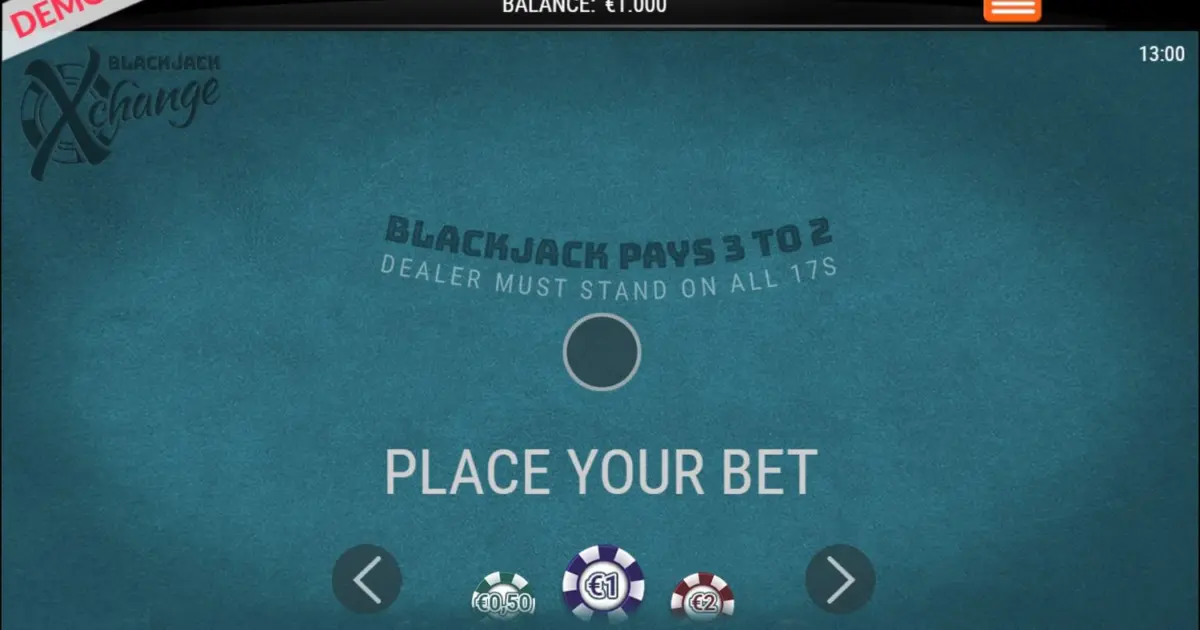
Blackjack Xchange is worth your time if you want one of the lowest house edges available in online blackjack. At 99.68% RTP, this Slingo release gives up just 0.32% to the house under perfect basic strategy, which puts it ahead of most standard tables. The defining feature is the xchange rule: you can swap cards between two simultaneously played hands before deciding how to play them, and that option—used correctly—shaves meaningful points off the edge.
Blackjack Xchange in one minute
You play two hands at once. After the deal, you have the option to exchange the top cards between the two hands. That swap happens before you hit, stand, double, or split, so you can turn a stiff 16 and a bust-risk 15 into a playable 18 and a double-down opportunity if the cards align. The xchange is optional on every round, and knowing when to use it is where the strategy depth lives.
Slingo does not publish the full rule set—deck count, whether the dealer hits soft 17, the blackjack payout ratio, double-after-split permissions, or surrender availability are not confirmed in the data available to this review. That means the 99.68% RTP figure is the headline number, but the exact combination of rules that delivers it requires checking the in-game paytable before you commit real money. The xchange mechanic itself is the known differentiator.
| Attribute | Value |
|---|---|
| RTP | 99.68% |
| House edge | 0.32% |
| Provider | Slingo |
| Free demo | Yes |
House edge versus RTP: the numbers explained
RTP is the long-run theoretical return to the player, expressed as a percentage of all wagers. The house edge is simply 100% minus the RTP, so a 99.68% RTP means a 0.32% house edge. That 0.32% is the casino’s mathematical advantage over an infinite number of hands, assuming you make the optimal play decision on every single one.
The critical caveat: published RTP figures assume perfect basic strategy on every hand. If you deviate—hitting a hard 17, standing on soft 18 against a dealer 9, skipping the xchange when it improves your expected value—you hand back edge to the house. A casual player who guesses at decisions or plays by feel will realise a materially lower return than 99.68%, often several percentage points lower. The tighter the published edge, the more costly each mistake becomes in relative terms.
The xchange decision adds a layer. You need to evaluate both hands and the dealer upcard simultaneously to determine whether swapping the top cards increases your combined expected value. Miss that evaluation and you either waste the option or, worse, swap into two weaker hands. The 99.68% RTP includes optimal xchange usage; playing the mechanic incorrectly moves you closer to the edge of a standard single-hand table, erasing the advantage Slingo built into the format.
How this table compares to other online blackjack
The average RTP across the online blackjack corpus sits at 99.41%. Blackjack Xchange beats that by 0.27 percentage points, which translates to 27 cents per hundred euros wagered over the long run. That gap might sound small, but blackjack is a low-margin game by design, and a quarter-point edge difference is the gap between a good table and a mediocre one.
For context, American Blackjack returns 99.50%, giving up half a point to the house, while Classic Blackjack sits at 99.28%, a full 0.4 points behind Blackjack Xchange. The xchange rule is the reason for the tighter spread. Slingo is not a prolific blackjack provider—this is their only table in the category—so there are no sibling variants to compare within the same stable. That makes Blackjack Xchange a standalone design rather than a reskin of a platform template.
If you want an even tighter edge and are comfortable with the added complexity of the xchange decision tree, this table belongs on your shortlist. If you prefer a straightforward single-hand game with no optional mechanics, Blackjack (Mascot Gaming) at 99.50% RTP offers a simpler path to a competitive house edge.
Basic strategy in practice
Basic strategy is the mathematically optimal play for every possible player hand versus every dealer upcard. It is a solved chart, not a system, and it exists because blackjack has fixed rules and a finite deck. The strategy minimises the house edge; it does not eliminate it. Even with perfect basic strategy, the house retains that 0.32% advantage over infinite hands.
For Blackjack Xchange, basic strategy splits into two decision trees: the standard hit/stand/double/split chart you already know, and the xchange evaluation. The xchange decision comes first. You compare the expected value of your two hands as dealt against the expected value after swapping the top cards, factoring in the dealer’s upcard. If the swap improves your combined outlook, you take it; if not, you decline and play the hands as dealt using standard strategy.
The xchange evaluation is not intuitive. A hand that looks weak in isolation—say, a 6-9 fifteen—might be the stronger hand to keep if the alternative after a swap is two middling totals with no double-down leverage. You are optimising for combined expected value across both hands, not the strength of one hand in a vacuum. That adds cognitive load, and it is where most players leak edge back to the house.
Slingo does not publish whether the dealer hits or stands on soft 17, how many decks are in play, or whether you can double after split. Each of those rules shifts the basic strategy chart by a few decisions. The in-game rules screen will show the specifics; cross-reference those details with a strategy calculator before you play for real money, because a wrong assumption on a soft 17 rule or a deck count costs you expected value on every affected hand.
Betting systems and why they do not change the odds
Betting progressions—Martingale, D’Alembert, Fibonacci, any system that adjusts your bet size based on prior results—do not change the house edge. They change the shape of your session variance, meaning they alter how wins and losses arrive in time, but they do not alter the long-run expected value of your wagers. The house edge remains 0.32% per hand regardless of how you size your bets.
The Martingale, where you double your bet after every loss, is the most commonly misunderstood. It feels like it works because it produces frequent small wins, but it exposes you to catastrophic losses during a bad run. A streak of seven or eight losses is not rare over a few hundred hands, and doubling down that far either hits the table limit or exhausts your bankroll. When it fails, it fails completely, erasing dozens of prior winning sessions in a single sequence.
Insurance is a side bet that pays 2:1 when the dealer shows an ace and has a ten-value card in the hole. At those odds, insurance is a losing proposition unless you are counting cards in a live shoe, which does not apply here. This is an RNG table that reshuffles every hand, so the deck composition resets after each deal. There is no count, no memory, no depleted deck to track. Insurance gives back edge to the house, and you should decline it every time.
Side bets such as Perfect Pairs or 21+3, if offered, carry a far higher house edge than the base game—often in the range of 3% to 8%. They add volatility and entertainment value, but they are not a mathematical path to a better outcome. If your goal is to play the tightest game available, avoid side bets entirely and put your stake into the base game, where the 0.32% edge is already as good as it gets.
The free demo
The free demo is available and it is the correct place to learn the xchange mechanic before risking real money. You can test the swap decision across different hand combinations, see how the dealer rules play out, and confirm the table limits and paytable details that Slingo does not publish externally. Demo play uses the same RNG and rule set as the real-money version, so the gameplay is identical; only the stakes are removed.
Demo results do not predict real-money outcomes. The RNG does not “remember” prior hands, and there is no pattern to exploit or trend to chase. Each hand is an independent event. Use the demo to build fluency with the interface and the xchange decision tree, not to hunt for streaks or test progression systems.
Set your budget before you play for real money. Decide in advance how much you are prepared to lose in a session, and stop when you hit that number. Blackjack is entertainment, not income, and the house edge means that over time the casino wins. Play only with money you can afford to lose, and never chase losses. 18+. If gambling is affecting your life, contact a support service such as GamCare or Gambling Therapy.
Verdict
Blackjack Xchange earns its place at the top end of the RTP range. The 99.68% return is built on a player-friendly mechanic that rewards careful decision-making, and the 0.32% house edge is tight enough to matter over volume. The xchange rule adds strategic depth without turning the game into a puzzle, and for players who enjoy a bit more control over the hand outcome, that makes this a more engaging table than a straight single-hand variant.
The missing rule details are a frustration. Slingo should publish the deck count, the soft 17 rule, the blackjack payout, and the double and split permissions outside the game client, because those details affect the basic strategy chart and the realised RTP. You will find them in the paytable once you load the game, but that is later than it should be.
If you are comfortable with the added complexity of the xchange decision and you want one of the lowest house edges available online, Blackjack Xchange delivers. If you prefer a simpler single-hand game, the edge advantage here is not so large that it outweighs the convenience of a more straightforward format, but it is large enough to notice over a few thousand hands. Play the demo, check the rules, and decide whether the format suits your style.
Frequently Asked Questions
Is Blackjack Xchange available in free demo mode?
Yes, a free demo is available and it uses the same RNG and rule set as the real-money game. The demo is the right place to learn the xchange mechanic and confirm the table rules before you play for real stakes, because Slingo does not publish the full rule details externally.
What RTP does Blackjack Xchange return and what does that assume?
Blackjack Xchange returns 99.68% RTP, which means a 0.32% house edge. That figure assumes perfect basic strategy on every hand and optimal use of the xchange option on every deal. If you deviate from optimal play, the realised RTP will be materially lower, often by several percentage points for casual guessing.
How does the 99.68% RTP compare to other online blackjack tables?
The online blackjack average is 99.41%, so Blackjack Xchange beats the field by 0.27 percentage points. That translates to 27 cents per hundred euros wagered over the long run, which is a meaningful edge difference in a low-margin game like blackjack where every tenth of a point counts.
Can card counting or a betting system improve my results on Blackjack Xchange?
No. This is an RNG table that reshuffles every hand, so card counting does not work—there is no depleted deck to track. Betting systems like Martingale change the shape of your session variance but do not change the 0.32% house edge, which remains constant regardless of how you size your bets.
What is the xchange rule and how does it affect the house edge?
The xchange rule lets you swap the top cards between two simultaneously played hands after the deal, before you decide to hit, stand, double, or split. Used optimally, this option improves your combined expected value across both hands and is the reason the house edge drops to 0.32%, lower than most standard single-hand tables.




