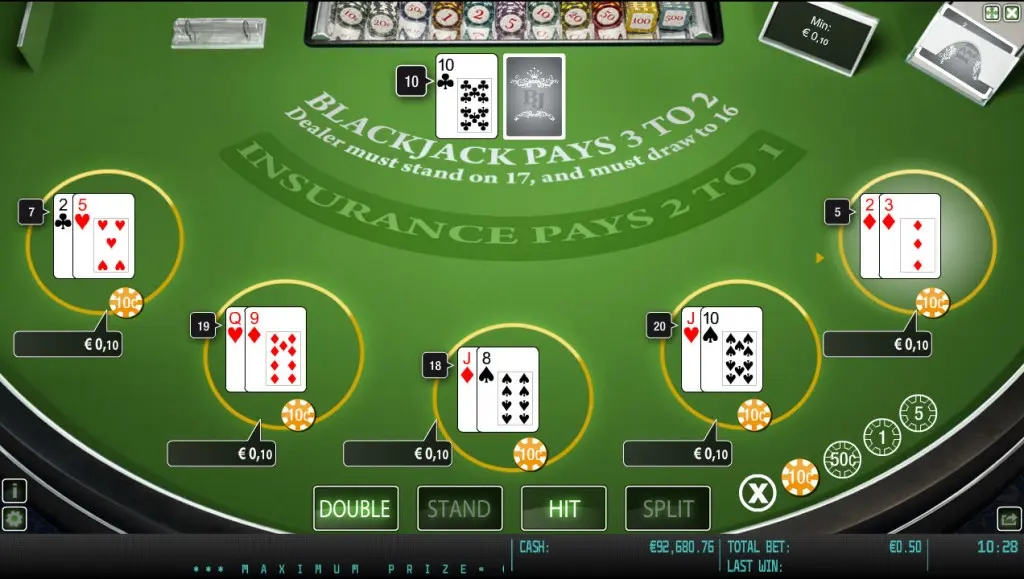
If you want a straightforward RNG blackjack table with a published return and a free demo you can open without depositing, this one qualifies. The listed RTP of 99.44% sits marginally above the 99.41% average across the blackjack tables we catalogue, which in practice means the difference is noise rather than an edge worth chasing.
What matters more is what Worldmatch does not publish alongside that figure: deck count, dealer soft 17 behaviour, blackjack payout, doubling and splitting rules, and whether side bets are attached. All of that lives in the game’s own rules screen, and you should read it before a single real-money hand.
BlackJack (Worldmatch) and the Worldmatch table range
Worldmatch runs a small catalogue — eight games in our records — and every blackjack table in it carries the same 99.44% published return. That uniformity tells you something useful: the provider is applying one house-edge target across the range rather than building distinct rule sets with distinct maths. It also means the RTP number alone will not help you choose between them.
If you want to compare the family directly, BlackJack Pro is the obvious sibling to open in a second tab, and Black Jack Single carries a name that points at a single-deck rule set. A single-deck game would normally shave a little off the house edge on the base game, though single-deck tables very often claw it back with a reduced blackjack payout — so that title is a prompt to check the paytable, not a confirmed advantage.
Popularity-wise this table sits at rank 119 in our list, in the bottom quarter by traffic. That is not a quality signal. Smaller providers get less shelf space at most casinos, and a table with sound maths can go unplayed simply because nobody links to it.
The 99.44% figure, and the assumption behind it
RTP and house edge are the same statement from opposite ends: 100% minus 99.44% gives a house edge of 0.56%. Over a long run of hands, the table expects to keep 56 cents per 100 units wagered.
The assumption buried inside that number is the one most players miss. A published blackjack RTP is calculated on the premise that you play perfect basic strategy on every hand — every hit, stand, double and split matching the mathematically correct decision for your total against the dealer’s up card. Deviate and the figure no longer applies to you. A player who stands on 16 against a 10 because it feels safer, takes insurance out of habit, or refuses to split 8s against a 9 is not playing a 0.56% game. Casual play commonly runs an effective edge several times higher, which turns a near-break-even table into a meaningfully expensive one.
Worldmatch publishes the same 99.44% across its range, so treat it as the provider’s design target under optimal play rather than a prediction of your own results.
Rules to confirm before you bet real money
Because the specifics are not published here, the rules screen does the work. These are the levers that move the edge, described as general rules of thumb:
- Blackjack payout — 3:2 is standard. A 6:5 payout costs the player roughly 1.4%, by far the most damaging single rule change you can encounter. If a table pays 6:5, no other favourable rule compensates.
- Dealer soft 17 — a dealer who stands on soft 17 is better for you by roughly two tenths of a percent than one who hits.
- Deck count — fewer decks generally favour the player, though the effect is measured in hundredths of a percent between six and eight decks.
- Double after split and re-splitting aces — both shift the edge slightly your way when permitted.
- Late surrender — a small gain, and only if you actually use it correctly.
- Dealer peek versus European no-hole-card — no-hole-card costs you a little when you double or split into a dealer blackjack.
The FACTS available for this table do not state which of these apply. Worldmatch does not publish the deck count or the soft 17 rule, and together those swing the edge by a few tenths of a percent, so read the in-game rules before you size a bet.
Strategy: the chart, not a system
Basic strategy is not a system and not a theory. It is a solved chart — every possible player total against every dealer up card, with the decision that produces the best expected outcome already worked out. Learning it is memorisation, not judgement, and it is the only thing that makes the published RTP relevant to your own play. It minimises the house edge; it never removes it.
Card counting does not work here. This is an RNG table, and the virtual shoe reshuffles before every hand, so no information carries forward from the cards you have already seen. Counting depends on depletion, and there is no depletion.
Betting progressions do not help either. Doubling after a loss, D’Alembert, or any similar staking pattern changes the shape of your variance — bigger swings, different distribution of session outcomes — while leaving expected value untouched. No hand is ever due, because each deal is independent of the last.
If side bets appear on this table, treat them separately from the base game: Perfect Pairs, 21+3 and similar wagers carry house edges many times higher than 0.56%. Insurance is a losing bet at standard 2:1 odds and basic strategy declines it.
Variance at the blackjack table
A 0.56% edge sounds nearly harmless, and over a long horizon it behaves that way. Session to session it does not. Doubles and splits mean individual hands can resolve at two, four or more times your base unit, so a run of aggressive-but-correct decisions going against you produces a drawdown much larger than flat-betting maths would suggest.
Practical sizing: pick a unit small enough that thirty or forty consecutive losing units would not end your session or your comfort. Correct play still loses hands, frequently, and the chart is judged over thousands of decisions rather than one evening.
Worth noting that Multihand Blackjack at 99.5% lets you play several boxes at once, which compresses more decisions into less time — that speeds the house edge’s arrival, it does not soften variance.
Free play first
A free demo is available for this table, and it is the sensible place to start. Use it to read the rules screen, confirm the payout and soft 17 behaviour, and drill your basic strategy chart until the awkward hands — soft 18 against a 9, 12 against a 2 — stop requiring thought. Demo results tell you nothing about real-money outcomes; the RNG is identical, but the sample you play in an hour is far too small to mean anything.
Blackjack is for players aged 18 or over. Set a budget before you open the table, treat it as entertainment spending rather than income, and stop at the number you decided on rather than the number the session suggests.
Who this table is for
| Detail | Value |
|---|---|
| Provider | Worldmatch |
| Published RTP | 99.44% |
| House edge (perfect basic strategy) | 0.56% |
| Category | Blackjack, Cards |
| Provider average RTP | 99.44% |
| Blackjack corpus average RTP | 99.41% |
| Free demo | Available |
This suits a player who already knows basic strategy and wants a plain RNG table with a competitive published return and no side-bet clutter forced on them. The 99.44% is fine, the demo is open, and the maths is standard.
It suits you less if you want documented rules before you click. Providers that publish deck count and soft 17 up front let you calculate your edge in advance; here you cannot until the game loads. If that matters, American Blackjack at 99.5% is worth a look as a comparison point.
Frequently Asked Questions
Can I play BlackJack (Worldmatch) for free?
Yes, a free demo is available, so you can open the table without depositing. Use the demo to read the in-game rules screen — Worldmatch does not publish the deck count or dealer soft 17 rule externally — and to practise basic strategy. Demo sessions carry no real-money prediction value whatsoever.
What is the BlackJack (Worldmatch) RTP?
Worldmatch publishes 99.44%, marginally above the 99.41% average across the blackjack tables we list. That figure assumes perfect basic strategy on every hand, without exception. Play by instinct instead and your effective return drops well below it, often by several percentage points across a session.
What is the house edge and which rules change it?
100% minus 99.44% gives a 0.56% house edge under optimal play. The biggest swing factor is the blackjack payout: 6:5 instead of 3:2 costs roughly 1.4%. Dealer soft 17 behaviour, deck count, double-after-split and late surrender each move it by smaller amounts.
Does card counting work on this table?
No. This is an RNG table that reshuffles the virtual shoe before every hand, so no card information carries between deals. Counting relies on tracking depletion in a shoe, and there is none here. Betting progressions do not help either — they reshape variance while leaving the 0.56% edge unchanged.
Who makes this game and what else do they offer?
Worldmatch, a studio with eight titles in our records, all its blackjack tables sharing the same 99.44% published return. Black Jackpot is another in the range worth comparing, and the shared RTP means you should pick between them on rules and interface rather than on the headline percentage.




