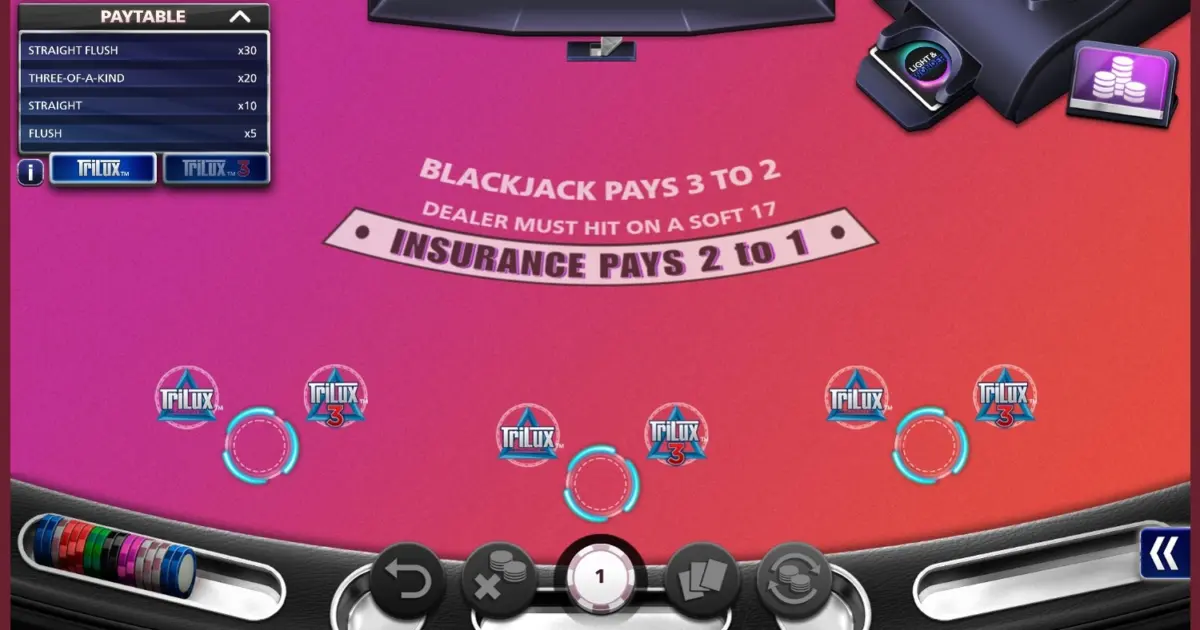
Blackjack Trilux sits at 99.44% RTP when you play flawless basic strategy on every hand, which places it fractionally above the corpus average of 99.41% for the blackjack category. That 0.56% house edge is competitive, but remember that the published figure assumes zero mistakes. A casual player who deviates from the chart will realise a materially lower return, often surrendering an extra percentage point or more to the house.
Pixiu Gaming lists this as their only blackjack table in the current catalogue, so you cannot cross-reference house rules or compare multiple variants from the same studio. The “Trilux” name suggests a side-bet feature, commonly a three-card poker-style wager, but Pixiu Gaming has not published the deck count, whether the dealer hits soft 17, the blackjack payout ratio, or the exact double and split rules. Check the in-game paytable before you play for money, because those variables shift the edge by tenths of a percent.
Is Blackjack Trilux a fair table?
The 99.44% RTP is fair and sits in the middle of the pack. For context, American Blackjack posts 99.5%, while Classic Blackjack comes in at 99.28%. The critical caveat: that 99.44% applies only if you follow perfect basic strategy on every hand. Basic strategy is the solved chart that tells you when to hit, stand, double or split based on your two cards and the dealer’s up-card. It minimises the house edge but never eliminates it.
Any departure from the chart costs you. Hitting 16 against a dealer 7 when you should stand, or standing on soft 18 against a 9 when you should hit, each adds a fraction to the house edge. Over a session those fractions compound. A player who guesses or uses intuition instead of the chart will see a realized return closer to 97% or 96%, turning a competitive table into a poor one.
| Metric | Value |
|---|---|
| RTP (perfect play) | 99.44% |
| House edge | 0.56% |
| Provider | Pixiu Gaming |
| Free demo | Yes |
| Popularity percentile | 72.2 |
Pixiu Gaming and this table
Pixiu Gaming publishes exactly one blackjack table, and this is it. That means no sister variants to compare, no established house-rule pattern you can assume carries over, and no track record in the category. The provider’s average RTP across their blackjack catalogue is 99.44% because the catalogue contains only this game. You are evaluating a single data point, not a studio philosophy.
The lack of a second table is not disqualifying, but it does mean you must verify every rule inside the game client. Other providers with deep blackjack catalogues tend to hold deck count and soft-17 rules constant across variants, giving you a baseline. Here you have no baseline. Treat nothing as assumed.
Rule set: what the title implies
The “Trilux” name almost certainly refers to a three-card side bet, typically paying on poker-style hands formed by your first two cards and the dealer’s up-card. This is a common bolt-on feature in modern blackjack variants. The name alone does not tell you the deck count, the dealer’s soft-17 rule, whether you can double after split, or whether surrender is offered. Those details shift the base-game house edge by measurable amounts.
For example, a single-deck game with a 3:2 blackjack payout and dealer standing on soft 17 can deliver a house edge below 0.2% under perfect play. An eight-deck shoe with a 6:5 blackjack payout and dealer hitting soft 17 pushes the edge above 2%. The difference is an order of magnitude, and Pixiu Gaming has not published which end of that spectrum this table occupies. Check the rules screen in the demo before you deposit.
The maths of a blackjack hand
Blackjack’s house edge comes from one asymmetry: you act first, and if you bust, the dealer wins immediately even if the dealer later busts too. Basic strategy is the mathematically optimal response to that asymmetry, calculated by running every possible hand against every dealer up-card through millions of simulations. It is not a system or a hunch; it is a solved problem.
Specific rules move the edge in predictable directions. A 6:5 blackjack payout instead of 3:2 costs you roughly 1.4 percentage points, the single most damaging rule change in the game. Dealer hitting soft 17 instead of standing costs about 0.2%. Each additional deck in the shoe adds roughly 0.03% to 0.05%. Double-after-split and late surrender each give back about 0.1% to 0.15% when used correctly. These are rules of thumb, useful for comparing tables at a glance, but the exact impact depends on the full rule set in combination.
Card counting does not work here. RNG-based blackjack reshuffles the virtual deck after every hand, so no count ever accumulates. The composition of the shoe on hand two is independent of hand one. Counting relies on depletion—knowing that a deck rich in tens and aces favors the player—and that information does not exist when the deck resets constantly.
Common mistakes that cost you the edge
Insurance is the most frequent leak. When the dealer shows an ace, you are offered insurance at 2:1 odds. The bet wins if the dealer has a ten in the hole, which happens 4 times out of 13 in a full deck, or roughly 30.8% of the time. You need the bet to win 33.3% of the time to break even at 2:1, so the house edge on insurance is about 7.5% at a standard six-deck table. It is a side bet dressed up as protection, and it costs you money over time.
Deviating from basic strategy on “gut feel” is the second leak. Standing on 12 against a dealer 2 because you are scared of busting feels safe, but it is the wrong play. The dealer busts often enough with a 2 up that you should hit. Playing scared—standing too early, never doubling 11 against a dealer 10—raises the house edge by a full percentage point or more over a session.
Side bets carry a far higher house edge than the base game. Perfect Pairs, 21+3, and similar wagers typically run between 3% and 8% house edge, sometimes higher. If Blackjack Trilux includes the Trilux side bet, it will be profitable for the house at a rate several times the 0.56% edge on the main game. Treat side bets as entertainment with a steep price, not as part of a winning strategy.
Trying it free first
The free demo is available, and you should use it to confirm every rule before you play for money. Check the blackjack payout ratio, the number of decks, whether the dealer hits or stands on soft 17, which doubles and splits are allowed, and whether surrender is offered. Run through a basic-strategy chart in the demo to verify that the game behaves as expected. Demo play does not predict real-money results—variance is variance—but it does let you audit the rule set without risk.
If you do play for money, set a budget in advance and treat it as the cost of entertainment, not a route to income. Blackjack offers one of the lowest house edges in the casino, but the edge never reverses. You are paying for the session, not building an income stream. Play only at licensed sites, keep to your limit, and remember that this is entertainment for adults 18 and over.
Final take on Blackjack Trilux
Blackjack Trilux delivers a competitive 99.44% RTP under perfect play, but Pixiu Gaming’s lack of published rule detail is a transparency gap. The RTP itself is fair—fractionally above the category average—and the free demo gives you a risk-free audit window. Use it. Confirm the deck count, the blackjack payout, and the soft-17 rule before you commit real money, because those variables determine whether the published RTP is achievable at your skill level.
For comparison, Blackjack (Mascot Gaming) also posts 99.5% and comes from a provider with a broader catalogue. If Pixiu Gaming’s rule transparency does not satisfy you, that is a reasonable alternative. If the in-game rules screen in Blackjack Trilux confirms a 3:2 payout, dealer standing on soft 17, and a reasonable deck count, then the table is worth your time. If any of those details are missing or unfavorable, walk away. The maths does not forgive bad rules.
Frequently Asked Questions
Is there a free demo for Blackjack Trilux?
Yes, a free demo is available. Use it to verify the deck count, blackjack payout ratio, and whether the dealer hits soft 17 before playing for real money. Demo play lets you audit the rule set without risking your bankroll, and those details determine whether the published 99.44% RTP is achievable.
What RTP does Blackjack Trilux offer?
Blackjack Trilux offers 99.44% RTP under perfect basic strategy, which sits fractionally above the 99.41% category average. That figure assumes you make the mathematically optimal play on every hand. A casual player who deviates from the chart will realize a lower return, often giving up an additional percentage point or more to the house edge.
Can I use card counting on Blackjack Trilux?
No. RNG-based blackjack reshuffles the virtual deck after every hand, so no count accumulates. Card counting relies on knowing the remaining composition of the shoe, and that information does not exist when the deck resets constantly. The house edge remains fixed at 0.56% under perfect basic strategy regardless of prior hands.
What does the Trilux name mean for the rules?
The Trilux name strongly suggests a three-card side bet, likely paying on poker-style hands formed by your two cards and the dealer's up-card. The name does not confirm the deck count, blackjack payout, or soft-17 rule, which shift the base-game house edge by measurable amounts. Check the in-game paytable to confirm these details before you play.
How does Blackjack Trilux compare to American Blackjack?
American Blackjack posts a 99.5% RTP, six basis points higher than Blackjack Trilux's 99.44%. Both are competitive tables, but American Blackjack comes from a provider with a documented rule set and a deeper catalogue. If Pixiu Gaming does not publish full rule transparency for Trilux, American Blackjack is the safer choice for a player who wants to verify the house edge in advance.




