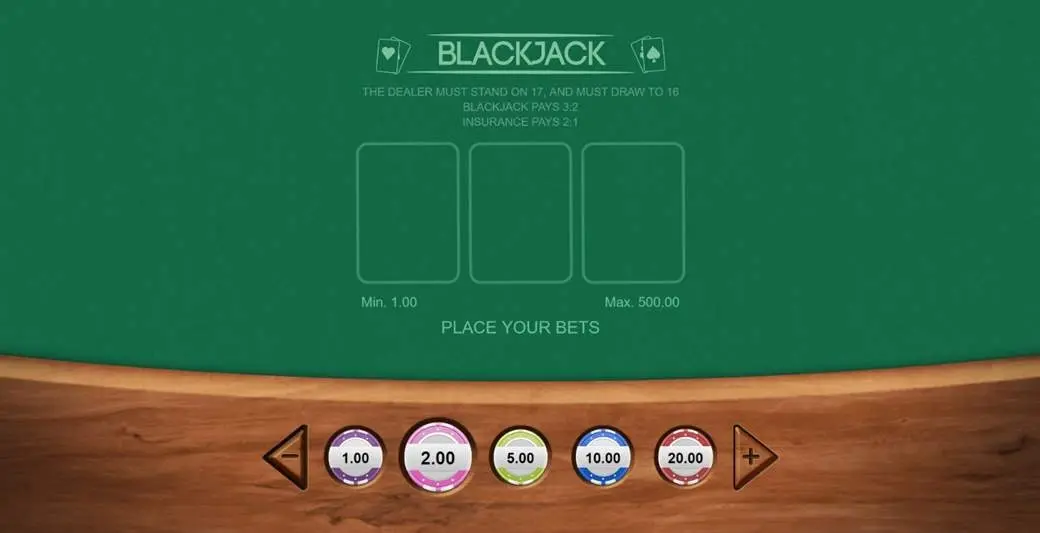
Blackjack (Spearhead) is a single-table RNG blackjack release from Spearhead Studios that posts a published RTP of 99.59%, putting it comfortably above the corpus average for online blackjack. If you are looking for a clean, no-frills blackjack table where the house edge is thin enough to make basic strategy genuinely worthwhile, this one deserves a spot on your shortlist — provided you confirm the exact rule set in-game before committing real money.
Blackjack (Spearhead) in one minute
Spearhead Studios is a relatively small provider in the iGaming space, and Blackjack (Spearhead) is its sole blackjack title. That matters because there is no broader portfolio of variants to compare against within the same studio — what you see is what you get. The game is classified under the “Black Jack” subcategory and does not carry a themed wrapper or side-bet suite, keeping the focus on the core decision points: hit, stand, double, and split.
The published RTP of 99.59% assumes perfect basic strategy on every single hand. That is the number you are working with, and it is the only number that matters when evaluating this table. No side bets, no progressive jackpot, no bonus mechanics dilute or enhance that figure — it is pure blackjack maths. The popularity percentile sits at 26.3%, which tells you this is not a chart-topping title in terms of player volume, but that is common for provider-exclusive tables that have not been widely distributed across operator networks.
Because Spearhead Studios only publishes one blackjack game, the provider average RTP matches the game RTP exactly at 99.59%. There is no intra-provider spread to worry about. What you do want to check is which specific rule set this title uses — deck count, whether the dealer hits or stands on soft 17, doubling restrictions, and splitting rules — because the same RTP headline can hide slightly different edge structures depending on the operator’s configuration.
| Provider | Spearhead Studios |
|---|---|
| RTP | 99.59% |
| Free demo | Yes |
House edge versus RTP: the numbers explained
RTP and house edge are two sides of the same coin. If the published RTP is 99.59%, the house edge is 0.41%. That means for every $100 wagered over an infinite number of hands, the mathematical expectation is a return of $99.59 and a loss of $0.41. In practice, short-session variance dwarfs that edge — you can win or lose far more in a single sitting — but over millions of hands the numbers converge.
The critical caveat is that 99.59% is a ceiling, not a floor. It assumes you play perfect basic strategy on every hand, with zero deviations, zero insurance bets, and zero doubling mistakes. The moment you deviate — hitting a 12 against a dealer 2 because it “feels” right, or taking insurance on a 2-to-1 side bet with a true count you are not tracking — the effective RTP drops. For a casual player making occasional errors, a realistic RTP closer to 98–99% is more honest.
Several rule changes move the house edge by meaningful amounts. A blackjack payout of 6:5 instead of 3:2 adds roughly 1.4% to the house edge — the single most damaging rule change in any blackjack variant. Whether the dealer hits or stands on soft 17 shifts the edge by a few tenths of a percent in either direction. Number of decks, double-after-split permissions, re-splitting aces, and late surrender each contribute smaller adjustments. The exact configuration for Blackjack (Spearhead) is not published in the facts available, so open the in-game paytable and count the rules before you play for real stakes.
How this table compares to other online blackjack
The corpus average RTP across all reviewed online blackjack tables is 99.41%. Blackjack (Spearhead) sits 0.18 percentage points above that average, which is a modest but real advantage. To put that in perspective, it means this table returns slightly more per 10,000 hands than the average online blackjack game — not enough to notice in a single session, but meaningful if you play regularly and track your results over time.
Compared to the most popular blackjack titles, the picture is instructive. American Blackjack posts an RTP of 99.50%, which is 0.09% lower than this Spearhead title. Classic Blackjack sits at 99.28%, a full 0.31% below — a noticeable gap for players who care about optimising expected return. Blackjack (Mascot Gaming) also comes in at 99.50%. None of these comparisons tells you which table to choose in isolation, because RTP is only one factor alongside rule set, table limits, interface quality, and mobile performance.
What the comparison does confirm is that Blackjack (Spearhead) is competitive at the top end of the RTP spectrum. It is not an outlier — there are tables with higher published returns — but it is firmly in the tier where basic strategy players get genuine value. If you are comparing tables from different providers, always check the rule set alongside the headline RTP. A game with 99.60% RTP but no late surrender and restricted doubling may actually be worse for you than this table at 99.59% with a more generous rule set.
Basic strategy in basic practice
Basic strategy is a solved, mathematically derived decision chart that tells you the optimal play for every possible hand combination against every possible dealer up-card. It is not a “system” — it is a table of facts, and it is the minimum standard for any player who wants the published RTP to apply to their session. There is no ambiguity, no feel-based deviation, and no progressive adjustment. You look up your hand, you look up the dealer’s card, and you make the play the chart dictates.
For Blackjack (Spearhead), you need to confirm the specific basic-strategy chart that matches the table’s rules. Different deck counts, soft-17 rules, and doubling restrictions produce different charts. A six-deck, dealer-hits-soft-17 chart is not the same as a single-deck, dealer-stands-on-soft-17 chart. Download or bookmark the correct chart for the rules you find in the paytable, and refer to it until the patterns are automatic. Most players can learn the core decisions in a few hours of focused practice in demo mode.
The edge case hands — 12 versus dealer 2 or 3, soft 18 versus dealer 9 or 10, pairs split against strong dealer cards — are where money is won or lost at the margins. These are also the hands where intuition most often conflicts with maths. The chart says hit your 12 against a dealer 2. The chart says split 8s against a dealer 10. The chart says never take insurance. Trust the chart, because it is built on combinatorial analysis of billions of simulated hands, not on gut feeling.
Betting systems and why they do not change the odds
Martingale, D’Alembert, Fibonacci, Paroli — these are all betting progressions, and none of them alter the expected value of a single hand. What they do change is the shape of your variance. Martingale doubles your bet after every loss, which means you win small amounts frequently but risk catastrophic drawdowns when you hit a long losing streak. D’Alembert is gentler but carries the same fundamental flaw: the house edge applies to every unit wagered, and wagering more units does not reduce it.
The math is simple and non-negotiable. If the house edge is 0.41% on a $10 bet, it is also 0.41% on a $20 bet, a $100 bet, or a $1,000 bet. The percentage does not change with the stake. A progression system that increases your bet after a loss simply exposes more of your bankroll to the same immutable edge at higher stakes. That is not a strategy — it is a recipe for a steeper drawdown curve.
The only decision that genuinely affects your expected loss is how much you wager per hand relative to your bankroll. A common guideline is to keep individual bets between 1% and 2% of your session bankroll, which gives you enough runway to absorb normal variance without busting before the edge has time to express itself. Set a session budget, stick to flat betting, and walk away when the budget is spent. That is the closest thing to a “system” that the maths supports.
The free demo
Blackjack (Spearhead) has a free demo available, and it is the right place to start. Demo play lets you practise basic strategy without risking money, test the interface, and get a feel for the table’s pace and layout. It does not predict real-money results — the RNG does not care whether you are playing for fun or for stakes — but it does let you make mistakes at zero cost while you learn the correct plays.
Use the demo specifically to drill the hands you find hardest. Play 500 hands focusing on soft-total decisions. Then play another 500 focusing on splitting. Track your results if you want to, but understand that short-run results in the demo are not statistically meaningful — variance dominates small samples. The value of demo play is building automaticity with the correct strategy, not building confidence from a lucky run.
Responsible gambling: Set a budget before you play and treat it as the cost of entertainment, not an investment with a return. Blackjack is a game with a thin house edge, but it is still a house edge — the casino expects to win over time. Never chase losses, never bet money you cannot afford to lose, and stop playing when your session budget is gone. Players must be 18 or older. If gambling stops being fun, seek help from a responsible gambling service in your jurisdiction.
Verdict
Blackjack (Spearhead) is a clean, mathematically honest blackjack table from Spearhead Studios with a published RTP of 99.59% — above the corpus average of 99.41% and competitive with popular alternatives like American Blackjack and Blackjack (Mascot Gaming). The thin house edge of 0.41% makes it a solid choice for players who actually use basic strategy, which is the only way to approach the published return.
The weaknesses are those of disclosure, not of maths. Deck count, soft-17 rule, and doubling restrictions are not confirmed in the published facts, so you must check the in-game rules before playing for real money. The popularity percentile suggests limited operator adoption, which may mean fewer places to play it. And as with every RNG blackjack, card counting is completely futile — the deck is reshuffled every hand, so there is no count to track and no edge to gain.
If you want a straightforward blackjack table with a strong RTP and no side-bet distractions, Blackjack (Spearhead) is worth a spin in demo mode. Confirm the rules, learn the chart, and play with a fixed budget. That is the entire edge you will ever have.
Frequently Asked Questions
Can I play Blackjack (Spearhead) for free?
Yes, a free demo is available. It lets you practise basic strategy and learn the interface without risking real money. Use it to drill the correct plays before moving to real stakes.
What is the RTP of Blackjack (Spearhead)?
The published RTP is 99.59%, which assumes perfect basic strategy on every hand. A casual player who deviates from the correct chart will achieve a lower effective return.
How does the house edge work in Blackjack (Spearhead)?
At 99.59% RTP the house edge is 0.41%. Rule differences such as 3:2 versus 6:5 blackjack payouts, dealer soft-17 rules, and doubling restrictions all shift this edge, so check the in-game paytable.
Does card counting work on Blackjack (Spearhead)?
No. This is an RNG table that reshuffles after every hand, so there is no running count to track and card counting provides zero advantage over the house edge.
How does Blackjack (Spearhead) compare to American Blackjack?
Blackjack (Spearhead) posts a slightly higher RTP at 99.59% compared to American Blackjack at 99.50%. The difference is small, so your choice should also factor in rule sets, limits, and interface preference.




