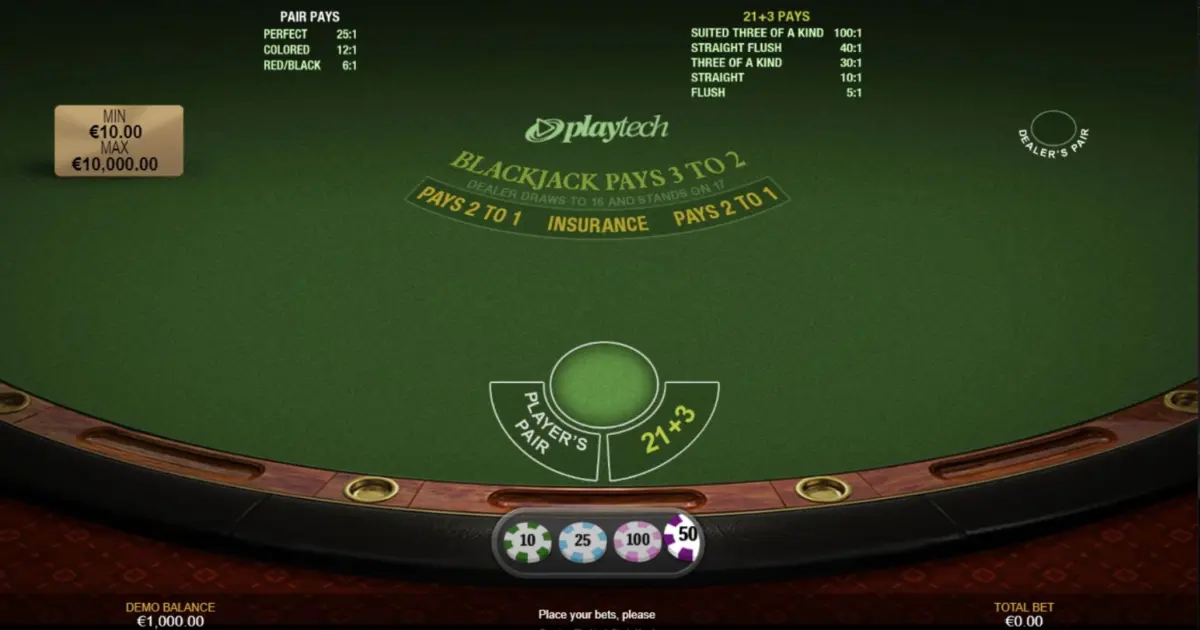
If you want a low-edge blackjack table to practise on, this one qualifies on paper. The published return of 99.58% sits a little above the 99.41% average across the blackjack games listed on this site, and a free demo is available so you can work through decisions without staking anything. What the published figure does not tell you is the rule set, because Origins (Playtech) does not publish the deck count, the soft 17 rule, the blackjack payout or the side bet menu in the data available here.
Is Blackjack Single Hand a fair table?
The RTP is 99.58%, which is another way of saying the house edge is 0.42%. That is a competitive number for an RNG blackjack game and it means that across a very large sample of hands, a theoretically perfect player gives back roughly 42 pence per £100 wagered.
The caveat matters more than the number. That 99.58% assumes perfect basic strategy on every single hand — every hit, stand, double and split played exactly as the solved chart dictates for the specific rules in force. Deviate, and the return you actually realise drops. A casual player who stands on soft 17 out of instinct, refuses to split 8s against a 9, or takes insurance because the dealer is showing an ace will realise a materially lower return than the published one. The gap between 99.58% and what a hunch-driven player achieves can be a full percentage point or more, which dwarfs the differences between tables.
So the fair answer is: the table is fair by the standards of the category, and whether you get anywhere near its advertised return is largely down to you rather than to the software.
Origins (Playtech) and this table
Origins is Playtech’s development studio, and the data here shows nine blackjack titles from them, averaging 99.6% RTP across the range. That is a tight, consistent band — this table’s 99.58% sits essentially on the studio average rather than being an outlier in either direction. A studio that keeps its returns clustered that closely tends to be making rule-set variations rather than deliberately loosening or tightening the maths from title to title.
If you want to compare across the range, Quantum Blackjack Plus is the highest published return of the group at 99.68%, so it is worth a look if you are optimising purely on the headline figure. All Bets Blackjack publishes the identical 99.58%, which makes it a useful side-by-side if you want to see how two tables reach the same return through different rules. Cashback Blackjack sits marginally lower at 99.55%, a difference of three hundredths of a percent that will never be visible in a single session.
| Detail | Value |
|---|---|
| Game name | Blackjack Single Hand |
| Provider | Origins (Playtech) |
| RTP | 99.58% |
| House edge | 0.42% |
| Category | Blackjack |
| Provider blackjack titles | 9 |
| Provider average RTP | 99.6% |
| Site blackjack average RTP | 99.41% |
| Free demo | Yes |
Rule set: what the title implies
The name points to a single-hand layout — one player hand per round against one dealer hand. Treat that as a strong hint rather than a confirmed rule, and check the in-game paytable before you play for money. The variant note attached to this listing mentions a multi-hand format, in which several player hands are dealt against one dealer hand, and that discrepancy is exactly why the rules screen is the only reliable source. Multi-hand play does not change the edge per hand, but it multiplies the number of hands you play per minute, and therefore how much you turn over in an hour.
Everything else about the rules is unpublished here. There is no confirmed deck count, no confirmation of whether the dealer hits or stands on soft 17, no stated blackjack payout, no double-after-split or re-split-aces rule, no surrender information, no side bet list and no table limits. Each of those moves the edge, some of them substantially. Check the paytable and the rules screen before your first real-money hand — it takes thirty seconds and it is the only way to know which basic strategy chart applies.
The maths of a blackjack hand
House edge in blackjack is built almost entirely out of rules, and a handful of them dominate. The blackjack payout is the big one: dropping from 3:2 to 6:5 costs the player roughly 1.4%, which is the single most damaging rule change in the game and enough on its own to turn a 0.42% edge into something you should walk away from. Dealer standing on soft 17 favours you by around two-tenths of a percent compared with the dealer hitting. Fewer decks favour you, though the difference between six decks and eight is only a few hundredths. Double after split, re-splitting aces and late surrender each shave small amounts off the edge in your favour, typically between 0.05% and 0.15% apiece. A dealer peek for blackjack is better for you than a European no-hole-card rule, where you can lose a doubled or split stake to a dealer blackjack.
Basic strategy is the solved answer to all of this. It is not a system and it makes no predictions — it is a chart that tells you the highest-expectation play for every combination of your hand and the dealer’s upcard, given a specific rule set. Playing it correctly is how you reach the published RTP. It never turns the edge positive.
Card counting does not work here. This is an RNG table that reshuffles the deck before every hand, so no information carries from one round to the next and there is no depleted deck to track. Progressive staking plans, whether Martingale, D’Alembert or anything else, change the shape of your variance and nothing else. Doubling after a loss makes big losing streaks rarer but far more expensive when they arrive; the expected value of every hand stays exactly where the rules put it. No hand is ever due.
Common mistakes that cost you the edge
Insurance is the most expensive habit at the table. At standard 2:1 odds it is a losing bet against a random shoe, and because you cannot count down an RNG deck there is no circumstance here in which it becomes correct. Decline it every time, including when you hold a blackjack.
Second is drifting away from the chart. Standing on 16 against a 10 because it feels safer, splitting 10s against a 6, or refusing to double a soft 18 against a 3 all cost fractions of a percent each and they stack up quickly. If you cannot remember the chart, keep it open next to the table — nothing in the game penalises you for taking a moment.
Third, side bets. Perfect Pairs, 21+3 and their relatives typically carry house edges of several percent, an order of magnitude worse than the base game. This listing does not confirm which side bets, if any, are offered here, so check the paytable. If they are present, a small base-game edge tells you nothing about them, and mixing them in undoes the reason you chose a 99.58% table in the first place.
Trying it free first
A Blackjack Single Hand free demo is available, and it is the sensible place to start. Use it to read the actual rules screen, confirm the deck count and soft 17 rule, see whether the blackjack payout is 3:2, and drill the basic strategy chart until the borderline hands stop making you hesitate. Demo results tell you nothing about how a real-money session will go — the sample is too small and there is no money at risk to change how you play. What the demo does give you is the rule set and the muscle memory, and both are worth having before you stake anything.
Play only if you are 18 or over. Decide what you are willing to lose before you open the table, treat it as the price of entertainment rather than a source of income, and stop when you reach that number instead of when you feel a session turning around.
Final take on Blackjack Single Hand
A published 99.58% RTP puts this table in the better half of the RNG blackjack games on this site, seventeen hundredths above the 99.41% category average and effectively level with the Origins studio average of 99.6%. That is a genuinely low house edge of 0.42%, and there is a free demo to learn on.
The gap in the record is the rule set. Without a confirmed deck count, soft 17 rule or blackjack payout, you cannot verify the published figure or pick the right strategy chart, so the rules screen is a mandatory first stop. Do that, play the chart, skip insurance and the side bets, and this is a reasonable table. Skip that step and the headline number is decoration.
Frequently Asked Questions
Can I play Blackjack Single Hand for free?
Yes, a free demo is available for this Origins (Playtech) table, with no download needed. It runs on virtual chips, which makes it the right place to read the rules screen and drill basic strategy. Demo sessions do not predict real-money outcomes, though, since the sample is small and nothing is at stake.
What is the RTP of Blackjack Single Hand?
The published RTP is 99.58%, equivalent to a 0.42% house edge. That figure assumes perfect basic strategy on every hand, played against the specific rule set in force. Players who improvise or take insurance realise a noticeably lower return, often a full percentage point or more below the advertised number.
How many decks does Blackjack Single Hand use?
Origins (Playtech) does not publish the deck count for this table in the information available here. Deck count affects the edge by a few hundredths of a percent, so it is worth confirming on the in-game rules screen along with the soft 17 rule and the blackjack payout, which matter considerably more.
Does card counting work on this table?
No. This is an RNG blackjack game that reshuffles before every hand, so no card information carries from one round to the next and there is nothing to count. Betting progressions like Martingale do not help either — they reshape variance while leaving the expected value of each hand unchanged.
How does it compare to other Origins (Playtech) blackjack tables?
Origins lists nine blackjack titles averaging 99.6% RTP, so this table's 99.58% sits on the studio average. Quantum Blackjack Plus is the highest at 99.68%, All Bets Blackjack matches at 99.58%, and Cashback Blackjack trails slightly at 99.55% — a difference too small to notice in one session.




