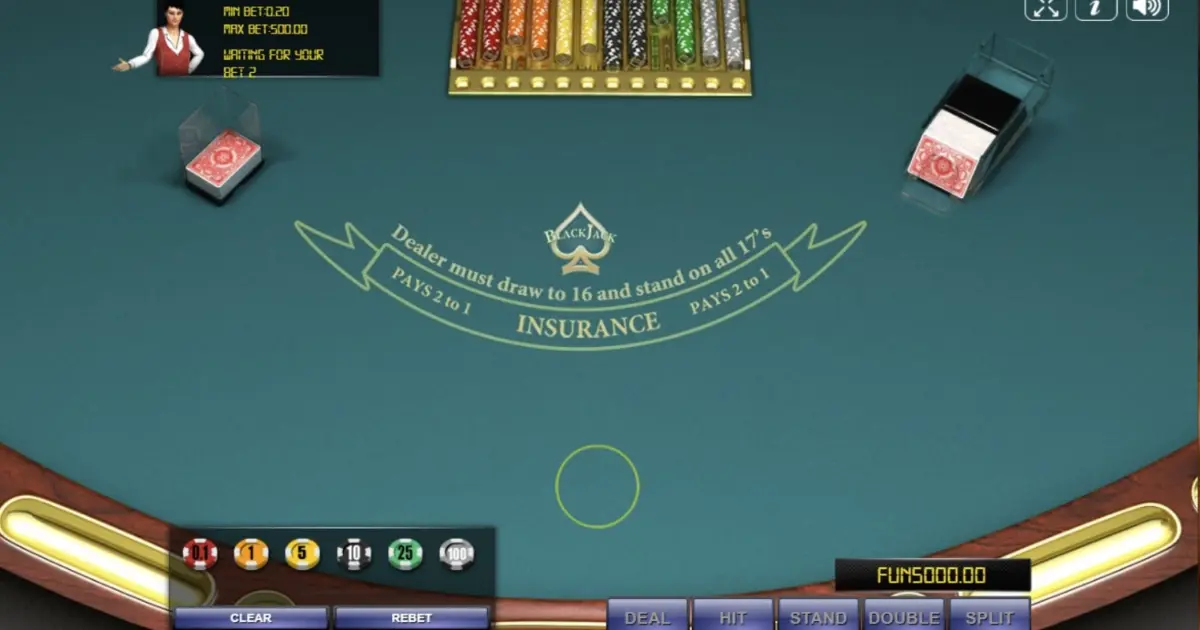
Blackjack Four Deck (Urgent Games) sits in the middle of the provider’s five-table range, all carrying the same 99.5% RTP figure and distinguished only by deck count. The four-deck configuration is a common industry standard, and the published return assumes you play flawless basic strategy on every decision. Urgent Games does not disclose whether the dealer hits or stands on soft 17, what the blackjack payout is, or which double and split rules apply, so you must check the in-game paytable before committing real money.
What kind of blackjack is Blackjack Four Deck (Urgent Games)?
The title tells you one fact: four decks. Beyond that, Urgent Games publishes no rule sheet. The 99.5% RTP corresponds to a house edge of 0.5%, which is achievable with moderately player-friendly rules—but only if you execute basic strategy without error. A casual player who stands on 16 against a dealer 10, takes insurance, or doubles at the wrong moments will see a materially lower return, often giving the house an edge above 2%. The game uses an RNG and reshuffles after every hand, so card counting delivers no advantage.
Return to player: 99.5%
The 99.5% RTP is the long-run statistical return under perfect play. It does not mean you will lose exactly 50 cents per hundred wagered in a single session; short-term variance swings both ways. The figure also assumes you never deviate from basic strategy, which is a solved chart of mathematically optimal decisions for every two-card hand versus every dealer upcard. One wrong split or a habit of taking insurance will erode that return by tenths or whole percentage points. Urgent Games’ entire blackjack suite shares this 99.5% figure, sitting fractionally above the corpus average of 99.41% for RNG blackjack tables, though the difference of 0.09% is statistically minor over any realistic session length.
| Attribute | Value |
|---|---|
| RTP | 99.5% |
| House edge (perfect strategy) | 0.5% |
| Deck count | Four |
| Provider | Urgent Games |
| Free demo | Yes |
Deck count, dealer rules and the payout that matters most
Four decks is a neutral middle ground. Moving from four decks to two improves the player’s edge by roughly 0.2%, while moving to eight decks costs about the same margin. The effect is real but small compared to the impact of other rules. What matters far more is the blackjack payout ratio. A 3:2 payout is the industry standard and the baseline for all published house-edge figures; a 6:5 payout adds approximately 1.4% to the house edge, turning a playable game into a poor one. Urgent Games does not state the payout for this table, and that omission is significant. Similarly, whether the dealer hits or stands on soft 17 moves the edge by around 0.2%, with the hit rule favouring the house. Check the in-game rules screen before you play for money.
The title implies a four-deck shoe, which normally means the cards are dealt from a virtual shoe and reshuffled after each hand in RNG mode. This eliminates any composition-dependent advantage; the deck is effectively reset to full every time.
Why the blackjack payout is the single most important rule
A natural blackjack at 3:2 pays £15 on a £10 bet. The same hand at 6:5 pays £12. That £3 difference, repeated over hundreds of hands, is worth more than any other rule change on the table. If you find a 6:5 table, walk away unless the other rules are extraordinarily generous, which they rarely are.
Playing your first ten hands
Load the game in demo mode and play ten hands while you locate the rules screen. Note the blackjack payout, the dealer soft-17 rule, and whether you can double after splitting. These three facts determine whether the published 99.5% RTP is achievable. During those hands, resist the urge to take insurance when the dealer shows an ace; insurance is a side bet that pays 2:1 but carries a house edge above 7% at standard four-deck composition, making it a losing proposition every time.
Use a basic strategy chart for your first session. The chart is not a betting system; it is a lookup table of the mathematically correct play for every combination of your hand and the dealer’s upcard. It does not promise profit, but it does minimise loss over time. Standing on 12 against a dealer 2 feels cautious, but the chart will tell you to hit; doubling on 11 against a dealer 10 feels risky, but it is the correct play. Follow the chart without interpretation.
Side bets: the maths behind the temptation
Urgent Games does not specify which, if any, side bets are available on Blackjack Four Deck. Common side bets on blackjack tables include Perfect Pairs, 21+3, and insurance. All carry a substantially higher house edge than the base game, often between 3% and 7%, and some exceed 10%. A side bet may pay 25:1 or 100:1 on a rare outcome, but the frequency of that outcome is calibrated so the house edge remains steep. If you play side bets for entertainment, treat the stake as the cost of that entertainment and expect to lose it. They are not a route to long-term return.
Insurance, offered when the dealer shows an ace, is technically a side bet rather than a form of protection. At 2:1 odds, it pays off only when the dealer has a ten-value card in the hole. In a four-deck shoe, the probability of that ten is less than the 2:1 payout compensates for, giving insurance a house edge around 7.5%. Decline it every time.
Session limits and bankroll
Set a session budget in advance and divide it into units that let you play at least thirty hands, preferably more. If you have £100 and the table minimum is £5, you can afford twenty bets before you must stop. That is too few to ride out normal variance. A better approach is a £2 or £1 unit if the table allows it, or a larger bankroll. Blackjack variance is narrower than slots but still real; you will see runs of five or six losses despite correct play. A fifty-unit bankroll gives you room to survive those runs without reloading emotionally.
No progression system—Martingale, Fibonacci, D’Alembert, or any scheme that raises the bet after a loss—changes the house edge or the long-run expectation. Progressions reshape the variance, creating more frequent small wins and occasional large losses, but the average outcome remains the same. A Martingale player who doubles after every loss will either recover one unit or hit the table limit and suffer a large loss. Over time, the house edge grinds the same percentage whether you flat-bet or progress.
Play for entertainment, not income. Set your budget before you start, treat blackjack as a cost rather than an investment, and stop when the budget is gone. If you feel you are chasing losses or playing beyond your means, seek support at BeGambleAware or similar services. 18+ only.
Verdict on Blackjack Four Deck (Urgent Games)
Blackjack Four Deck offers a fair RTP by RNG standards, but Urgent Games withholds the rule detail that separates a good table from a poor one. The 99.5% return is only meaningful if the blackjack payout is 3:2 and the other rules are reasonable, and you will not know that until you open the game. The four-deck count is standard, and the availability of a free demo is useful for checking the rules before committing real money. If the in-game paytable confirms 3:2 blackjack and sensible split and double rules, this is a playable table. If it shows 6:5 blackjack, walk away. For players who want transparency before they click, Blackjack Double Deck (Urgent Games) offers the same RTP with fewer decks, though it shares the same documentation gap. Blackjack Six Deck (Urgent Games) and Blackjack Eight Deck (Urgent Games) complete the provider’s range, all at 99.5%, so your choice comes down to deck preference and confirmed rules.
Frequently Asked Questions
Is there a free demo of Blackjack Four Deck (Urgent Games)?
Yes, the game is available in free demo mode. Use it to locate the in-game rules screen and confirm the blackjack payout ratio, dealer soft-17 rule, and double-after-split options before playing for real money, since Urgent Games does not publish these details externally.
What is the RTP of Blackjack Four Deck and does it assume perfect play?
The RTP is 99.5%, which assumes you play perfect basic strategy on every hand. A casual player who deviates from the strategy chart—standing on soft 17, taking insurance, or doubling at the wrong moments—will see a materially lower return, often giving the house an edge above 2%.
Can I count cards on Blackjack Four Deck (Urgent Games)?
No. The game uses an RNG and reshuffles after every hand, resetting the deck to full composition each time. Card counting requires a depleting shoe, so it offers no advantage here. The only way to minimise the house edge is to follow basic strategy.
Who makes Blackjack Four Deck and how does it compare to the provider's other tables?
Urgent Games developed the table as part of a five-game blackjack suite. All five tables share the same 99.5% RTP and differ only in deck count, ranging from two to eight decks. The four-deck version sits in the middle of that range, with a deck-count effect on the house edge of around 0.2% compared to the two-deck variant.
Does Blackjack Four Deck have side bets and are they worth playing?
Urgent Games does not specify which side bets, if any, are available. In general, blackjack side bets such as Perfect Pairs and 21+3 carry a house edge between 3% and 10%, far higher than the 0.5% edge of the base game. Insurance, offered when the dealer shows an ace, has a house edge around 7.5% at four-deck composition and is a losing bet every time.




