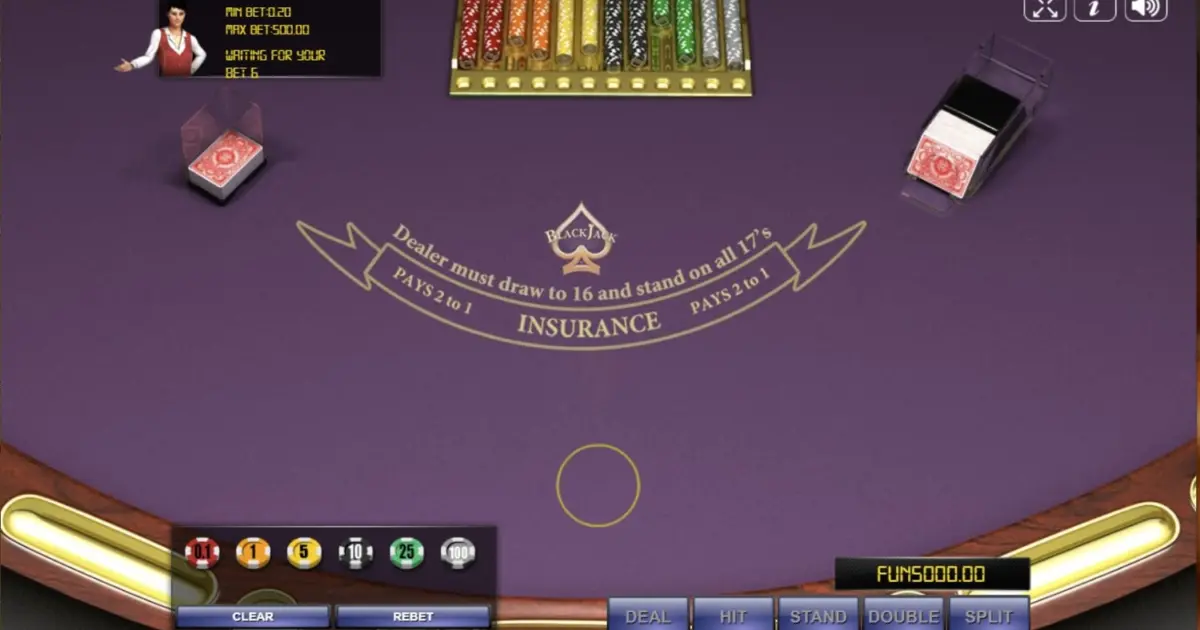
Blackjack Double Deck (Urgent Games) offers a 99.5% return to player when you execute perfect basic strategy on every hand, with a two-deck shoe that sits in the sweet spot between single-deck tables and the six- and eight-deck shoes most common in online blackjack. The deck count is explicit in the title and matters: two decks deliver a narrower edge than a shoe but don’t quite match the theoretical advantage of a single deck, assuming all other rules stay equal. Urgent Games does not publish the full rule set—blackjack payout ratio, soft-17 dealer behavior,DoubleAfterSplit, surrender availability—so you will need to check the in-game paytable before committing money.
| Attribute | Value |
|---|---|
| Provider | Urgent Games |
| RTP | 99.5% |
| Deck count | Two |
| Free demo | Yes |
| Popularity percentile | 87.2 |
Blackjack Double Deck (Urgent Games) at a glance
Urgent Games runs a compact stable of five blackjack variants, all carrying the same 99.5% RTP figure, differentiated by deck count. This table uses two decks, reshuffled every hand by the RNG. The 99.5% return sits nine-hundredths of a percent above the corpus average for online blackjack, which clusters tightly around 99.41%. That difference is real but small—roughly one additional unit returned for every thousand wagered—and it evaporates instantly if you deviate from basic strategy or take insurance at standard odds.
The title suggests a double-deck rule set, which traditionally means slightly better player odds than a six- or eight-deck shoe because fewer cards dilute the composition effect that makes basic-strategy decisions profitable. The provider does not confirm whether the dealer hits or stands on soft seventeen, what the natural blackjack pays, or whether you can double after splitting, re-split aces, or surrender late. Each of those rules shifts the house edge by a few hundredths to a few tenths of a percent, so the in-game rules screen is your only reliable source before you play for money.
The table ranks in the 87th percentile for popularity among tracked blackjack games, which indicates solid player traffic without the top-tier volumes commanded by Evolution or Playtech live-dealer suites. Urgent Games’ entire portfolio holds a 99.5% average RTP, so switching between Blackjack Six Deck (Urgent Games) or Blackjack Four Deck (Urgent Games) keeps the published return constant while the deck count alone nudges the theoretical edge by a few hundredths.
What a 99.5% RTP means at a blackjack table
A 99.5% return to player is equivalent to a 0.5% house edge, and that figure rests on one non-negotiable assumption: you play perfect basic strategy on every single hand. Basic strategy is a solved chart that tells you the mathematically optimal decision—hit, stand, double, split—for every combination of your cards and the dealer’s up-card. It does not rely on intuition, and it does not change with the flow of the shoe. Any deviation from the chart increases the house edge, and casual players routinely give back one to two percent by standing on soft seventeen against a dealer ten, failing to split eights against a dealer nine, or doubling soft hands at the wrong count.
The 0.5% edge also assumes you avoid insurance and side bets, which carry their own higher margins. If the real rule set for this table includes a 6:5 payout on natural blackjack instead of the standard 3:2, the house edge jumps by roughly 1.4 percentage points, erasing the published RTP advantage entirely and pushing the effective return below 98%. That single rule change is the most damaging you will encounter, and it is common enough in online RNG blackjack that you must verify the payout ratio before your first hand.
Even at 99.5%, the house retains a mathematical edge on every round. Over a thousand hands of perfect play wagering one unit each, you will lose five units on average. Variance will produce winning and losing streaks far larger than that figure, but the long-run expectation is a slow, predictable grind downward. Blackjack offers one of the narrowest edges in the casino, but it does not offer a fair game.
The rules that move the house edge
The name indicates a double-deck game, which normally means two fifty-two-card decks shuffled together. Deck count matters because it affects composition: in a single-deck game, removing one ace from play changes the probability of drawing another ace materially, which makes basic-strategy doubles and splits more profitable when the remaining deck is rich in tens and aces. As you add decks, that composition effect dilutes, and the house edge rises by a few hundredths of a percent per deck. A double-deck game sits between the tightest single-deck edges and the more common six- or eight-deck shoes, assuming all other rules stay constant.
Urgent Games does not publish whether the dealer hits or stands on soft seventeen. Hitting soft seventeen costs the player roughly 0.2%, because it gives the dealer another chance to improve a hand that would otherwise stand. The blackjack payout ratio—3:2 versus 6:5—is not confirmed, and as noted above, 6:5 adds 1.4% to the house edge, turning an attractive game into a poor one. Whether you can double after splitting, re-split aces, or surrender late is also unspecified; each of those rules moves the edge by 0.1% to 0.15% in the player’s favor when present.
The in-game rules screen is your only reliable confirmation. If the screen shows 6:5 blackjack or lists “dealer hits soft seventeen” without offsetting player-favorable rules like surrender or double-after-split, the effective edge will run higher than the 0.5% implied by the 99.5% RTP. Check before you deposit, because the difference between a 0.4% edge and a 1.8% edge is the difference between a slow grind and a fast one.
Basic strategy, and what it can and cannot do
Basic strategy is a chart, not a system. It maps every possible player hand against every dealer up-card and tells you the play—hit, stand, double, split—that loses the least money over the long run. It is solved mathematics, derived by simulating billions of hands, and it does not depend on gut feel, table history, or the cards that fell in the prior round. When the strategy chart says to split eights against a dealer ten, you split eights against a dealer ten, even though it feels like throwing good money after bad. The chart is correct, and your intuition is not.
Basic strategy minimizes the house edge; it does not eliminate it. At a double-deck table with favorable rules, perfect strategy might push the house edge down to 0.3%. At a table with 6:5 blackjack and dealer hits soft seventeen, the edge might sit at 1.8% even with perfect play. Either way, the house retains a mathematical advantage on every hand. Over a few dozen hands, variance dominates and you can finish ahead. Over a few thousand, the edge grinds you down to the expected loss.
Card counting does not work at this table. Blackjack Double Deck (Urgent Games) uses an RNG and reshuffles every hand, so there is no shoe penetration and no count to track. The composition of the deck resets after every round, which means the ten-rich and ace-rich situations that a card counter exploits never occur. If you are counting at an RNG table, you are wasting cognitive effort on information that has zero predictive value. Basic strategy is the only tool that applies here, and it applies equally on every hand.
Side bets and insurance
Urgent Games does not specify whether this table offers side bets such as Perfect Pairs or 21+3. Side bets are common in online blackjack and carry house edges far higher than the base game—typically five to ten percent, sometimes more. Perfect Pairs pays when your first two cards form a pair; 21+3 pays when your two cards and the dealer’s up-card make a poker hand. Both bets resolve independently of the main hand, and both lose money faster than the blackjack game itself. If the published 99.5% RTP applies only to the base game, and it almost certainly does, then side-bet RTP will run ten or fifteen points lower.
Insurance is a standard bet offered when the dealer shows an ace. You wager half your original stake, and the bet pays 2:1 if the dealer has a natural blackjack. At standard odds, insurance carries a house edge around seven percent at a double-deck table, far worse than the base game. The math is straightforward: in a two-deck shoe, thirty-two cards are tens and seventy-two are not. If you see an ace up and neither of your cards is a ten, roughly thirty-two cards complete the dealer’s blackjack and seventy remain in the deck. The 2:1 payout does not compensate for those odds, so insurance is a losing bet every single time you take it, even when you hold a natural yourself.
The only scenario in which insurance becomes profitable is if you are counting cards at a live-dealer or land-based table with deep shoe penetration and the true count indicates the remaining deck is sufficiently ten-rich. That scenario does not exist at an RNG table that reshuffles every hand. Decline insurance here, always.
Playing the Blackjack Double Deck (Urgent Games) demo
A free demo is available, and it is the correct place to confirm the rule set before you risk money. Open the demo, find the paytable or rules screen, and verify the blackjack payout ratio, the dealer’s soft-seventeen behavior, and whether double-after-split and surrender are allowed. If the demo shows 6:5 blackjack, walk away. If it shows 3:2 and dealer stands on soft seventeen, you are looking at a legitimate low-edge game, and the 99.5% RTP is credible.
The demo also lets you test whether the interface is responsive and whether the basic-strategy chart you are using matches the rule set. Some players print a strategy chart and keep it beside the screen; others use a second monitor or a phone. Either approach is legal and smart, because blackjack played without a chart is blackjack played at a higher house edge. The demo does not award real money and its shuffles are not predictive of real-money outcomes, but it costs nothing and exposes no flaws in your strategy execution before they cost you units.
If you move to real-money play, set a session budget in advance and treat it as the cost of entertainment, not a route to income. The house edge is small but cumulative, and no betting progression or pattern changes the mathematical expectation. Play only with money you can afford to lose, and walk away when the budget is gone. This is entertainment. You must be eighteen or older, and if you feel your play is becoming compulsive, seek support before it escalates.
Verdict: who should sit at this table
Blackjack Double Deck (Urgent Games) is a reasonable choice for a player who already knows basic strategy, wants a low-edge RNG table, and prefers a two-deck game to the more common six- or eight-deck shoes. The 99.5% RTP is legitimate if the underlying rules support it—3:2 blackjack, favorable double and split options—but you will not know whether they do until you check the in-game paytable. If the rules turn out to include 6:5 blackjack or dealer hits soft seventeen without offsetting player-favorable options, the effective edge will be higher than the headline RTP suggests, and you should compare it against Blackjack Eight Deck (Urgent Games) or another provider’s offering before committing.
The two-deck format offers a middle ground: tighter than a shoe, but without the composition swings of a single-deck game. It does not support card counting because the RNG reshuffles every hand, so this table suits a basic-strategy player who values a low edge and consistent play over the variability of live-dealer penetration. The provider’s stable is small, but the RTP consistency across all five variants means you can switch deck counts without hunting for a different paytable.
If you are still learning basic strategy or you routinely take insurance, this table will cost you more than the published RTP suggests. Master the chart first, confirm the rules in the demo, and then decide whether a 0.5% edge on a two-deck RNG game fits your session goals. For a disciplined player, it does.
Frequently Asked Questions
Is there a free demo for Blackjack Double Deck (Urgent Games)?
Yes, a free demo is available. Use it to confirm the blackjack payout ratio, whether the dealer hits or stands on soft seventeen, and which double and split options are allowed before you play for money. The demo reveals the full rule set that determines whether the published 99.5% RTP is credible.
What does the 99.5% RTP mean, and will I achieve it?
The 99.5% return to player assumes you play perfect basic strategy on every hand and avoid insurance and side bets. Any deviation from the strategy chart—standing when you should hit, failing to split eights, taking insurance—raises the house edge and lowers your realized return. Casual players routinely give back one to two percent by playing intuitively instead of following the chart.
Does card counting work at this table?
No. Blackjack Double Deck (Urgent Games) uses an RNG that reshuffles the deck after every hand, so there is no shoe penetration and no count to track. Card counting exploits the changing composition of a depleting shoe; when the deck resets every round, that information has zero value. Basic strategy is the only tool that applies here.
How does a two-deck game compare to six- or eight-deck blackjack?
Two decks sit between single-deck games and multi-deck shoes on house edge, assuming all other rules stay equal. Fewer decks mean composition effects—the impact of removing specific cards—are stronger, which makes certain basic-strategy doubles and splits slightly more profitable. The difference is a few hundredths of a percent, and it disappears if the rule set includes 6:5 blackjack or other player-unfavorable conditions.
Should I take insurance when the dealer shows an ace?
No. Insurance pays 2:1 when the dealer has a ten in the hole, but at a two-deck table roughly thirty-two cards out of a remaining seventy or so complete the blackjack, and the payout does not compensate for those odds. Insurance carries a house edge around seven percent, far worse than the base game, so decline it every time unless you are counting cards at a live table with deep penetration—a scenario that does not exist here.




