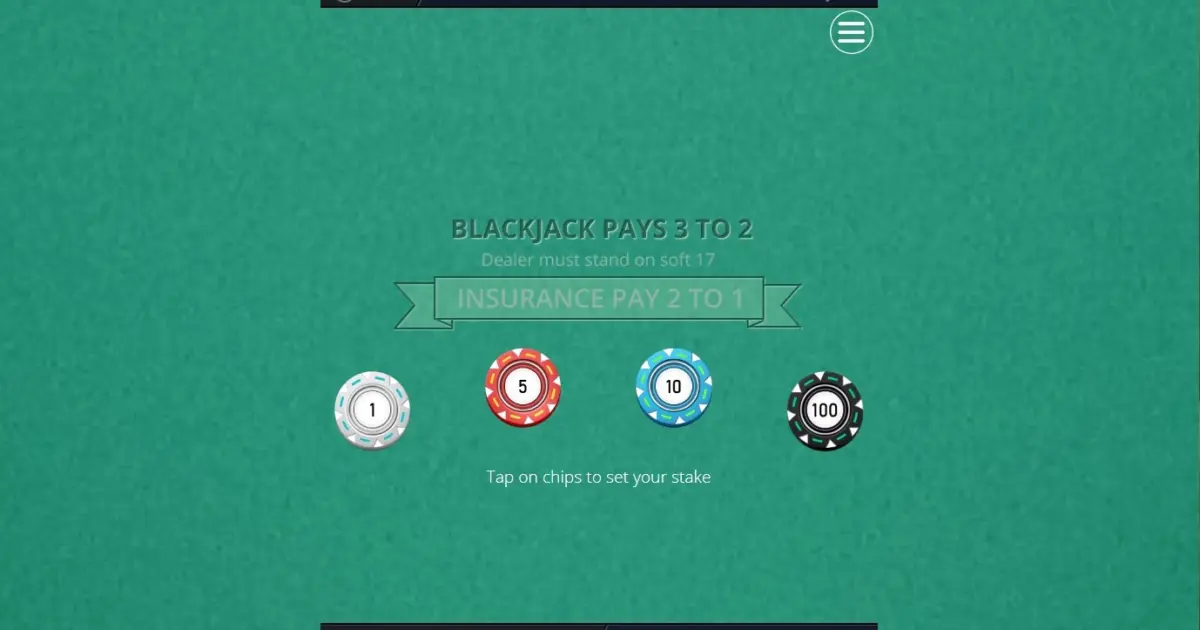
Blackjack (Esa Gaming) advertises a 99% return to player, placing it below the 99.41% average you will find across the tables reviewed on this site. That gap is meaningful in blackjack because the game already runs at razor-thin margins. Whether a 0.41% shortfall comes from a 6:5 payout, a hit-soft-17 rule, or an unfavourable deck count is impossible to determine from published data alone. You need to check the in-game rules screen before committing real money.
Is Blackjack (Esa Gaming) a fair table?
The 99% RTP assumes you play perfect basic strategy on every single hand. Any deviation—hitting when you should stand, splitting a pair that should stay together, taking insurance—pushes your realised return lower. For a casual player who makes a handful of errors per shoe, a material difference between a 99% theoretical return and what you actually get back over a session is the norm.
At the corpus average of 99.41%, a player holding $100 in chips expects to see roughly $99.41 returned over thousands of hands. At 99%, that same bankroll expects $99 back. The absolute difference per hand is small, but in a game with a house edge already compressed under 1%, losing even a few hundredths of a percent compounds noticeably over a long session. The practical takeaway: if you cannot confirm this table’s rules match a favourable configuration, treat the 99% figure as an optimistic ceiling rather than a floor.
| Provider | Esa Gaming |
|---|---|
| RTP | 99.0% |
| Free demo | Yes |
Esa Gaming and this table
Esa Gaming lists this as its only blackjack product, with a provider-wide average RTP of 99.0%. A single-game catalogue is unusual among established providers. Mascot Gaming, for comparison, publishes Blackjack (Mascot Gaming) at 99.5% RTP, a figure that implies a more player-friendly rule configuration.
With only one title to its name, Esa Gaming has no track record for consistency across multiple variants. When a provider maintains several blackjack tables, you can cross-check rule disclosures between them and spot outliers. Here, that cross-reference is unavailable. You are working with a single data point, which raises the importance of verifying every rule personally rather than assuming industry norms apply. Esa Gaming does not publish a company history or licence number alongside this table in the data available to us, so checking the operator hosting the game for licensing confirmation is a reasonable step before playing for money.
Rule set: what the title implies
The game carries no rule-family identifier in its name—no “European,” “Atlantic City,” “Single Deck,” or “Switch” qualifier. That absence is itself information. When a variant uses a specific ruleset that deviates from standard, providers almost always label it in the title so players can sort tables by configuration. A bare “Blackjack” label typically implies a common multi-deck shoe with dealer standing on soft 17, though this is a convention, not a guarantee.
None of the following are confirmed in available data: deck count, soft-17 treatment, whether doubling is permitted after splitting, whether aces can be resplit, whether late surrender is offered, hole-card peeking procedure, and side-bet availability. Each of these changes the edge by measurable fractions of a percent. The 99% RTP figure, taken in isolation, does not encode enough information to reverse-engineer the exact rule configuration. Open the game’s own rules screen and read it line by line before you sit down.
The maths of a blackjack hand
House edge in blackjack is the sum of every rule’s contribution. A 3:2 payout on natural blackjack keeps the base cost to the player around 0.5% under favourable conditions. Switching to 6:5 costs roughly 1.4%—far more than most other single changes combined. Dealer hitting soft 17 adds approximately 0.2%. Each additional deck adds a small fraction, though the jump from one to two decks is larger than from six to eight. Late surrender removes about 0.08% from the house edge. Double after split saves around 0.14%.
When you see a 99% RTP figure, you can back out that the implied house edge is 1.0%. That is above what a standard multi-deck shoe with dealer stand-on-soft-17 and 3:2 blackjack typically delivers. The gap suggests either a slightly unfavourable rule is present, or the figure includes the cost of an optional feature. Without confirmed rules, you cannot know which, and that uncertainty is the core problem with this table.
Common mistakes that cost you the edge
Insurance is a losing proposition at standard blackjack odds whenever the true probability of a dealer ten-value card is below 33.3%, and it almost always is. Taking insurance converts a hand you would have played at a small disadvantage into a side wager with a house edge in the 5–7% range, depending on deck composition.
Deviating from basic strategy on even a few hands per hour erodes returns noticeably. The chart is a solved product of millions of simulations—it does not require a system or a “feeling.” If you find yourself second-guessing the chart because a previous hand felt unlucky, you are introducing emotion into a problem that has a fixed optimal answer.
Chasing side bets to recover losses from the base game is the fastest way to double your exposure. Perfect Pairs and 21+3 carry edges of 2–11% depending on the specific paytable. If this table offers them, they are designed to pay the house more than the base game does.
Trying it free first
A free demo is available for this table. Use it to read the rules screen, confirm the payout on blackjack, and check whether any side bets are visible in the interface. Demo play will not tell you the deck count if the game does not state it, but it will reveal what the provider has chosen to display.
Remember that results in demo mode carry zero information about future real-money outcomes. The RNG does not maintain a memory of your demo session. Before playing for money, set a fixed entertainment budget and treat the entire session as a purchase of experience, not income. Gambling should remain a leisure activity for those 18 and older who can afford to lose the amount they set aside.
Final take on Blackjack (Esa Gaming)
A 99% RTP with no published rule details is a difficult table to recommend confidently when alternatives exist. American Blackjack at 99.5% and Classic Blackjack at 99.28% both offer more transparency and higher published returns. If Esa Gaming’s single blackjack product is the only table available at your operator, it remains playable provided you confirm the rules in-game and stick to basic strategy without deviation.
The honest summary: the mathematics here is sound in principle, but the information gap around specific rules makes it impossible to endorse over better-documented options. Your time is best spent verifying that table’s configuration, and if the payout is 6:5 or the dealer hits soft 17, walk away.
Frequently Asked Questions
Can I play Blackjack (Esa Gaming) for free?
Yes, a free demo is available for this table. Use it to inspect the rules screen and confirm payout values before playing with real money. Demo outcomes do not predict real-money results.
What is the RTP of Blackjack (Esa Gaming)?
The published RTP is 99.0%, which implies a 1% house edge under perfect basic strategy play. Casual players who make strategy errors will realise a noticeably lower return over a session.
How does Esa Gaming's blackjack compare to other tables?
At 99.0% RTP, it falls 0.41% below the 99.41% corpus average. Games like American Blackjack (99.5%) and Classic Blackjack (99.28%) both publish higher returns, making the gap meaningful in a game with thin margins.
Does card counting work at Blackjack (Esa Gaming)?
No. This is an RNG-based online table that reshuffles the virtual shoe every hand, removing the informational advantage card counting requires. Counting has no application here regardless of which rules this specific variant uses.
What rules should I check before playing Blackjack (Esa Gaming) for money?
Confirm the blackjack payout (3:2 versus 6:5), whether the dealer hits or stands on soft 17, the number of decks, and whether doubling after split is permitted. These are not published in available data, so open the in-game rules screen before your first real-money session.




