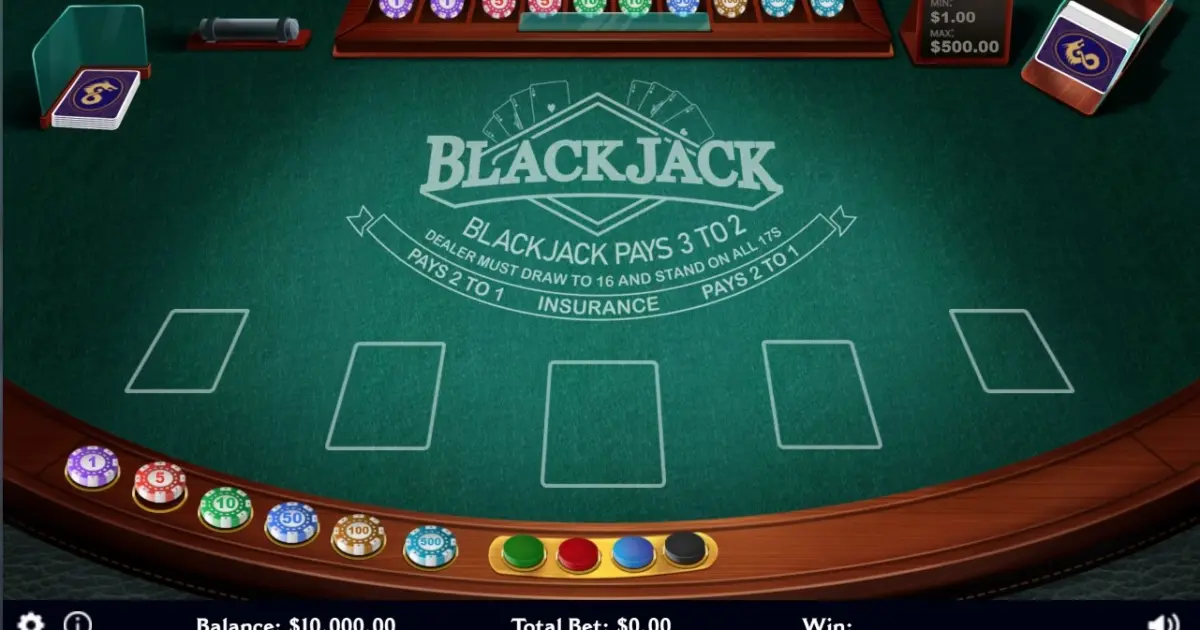
If you want a straightforward RNG blackjack table with a strong published return, this one qualifies: Dragon Gaming lists a 99.5% RTP, slightly above the 99.41% average across the blackjack titles we catalogue. A free demo is available, which is the sensible place to start.
The catch is that Dragon Gaming publishes very little else about the table. Deck count, dealer soft 17 behaviour, the blackjack payout and the side bet menu are not in the public data, so you will need the in-game rules screen to fill those gaps before you commit real money.
What kind of blackjack is Blackjack (Dragon Gaming)?
This is an RNG table game, not a live dealer stream. A random number generator deals every hand and the shoe is reshuffled between hands, which has one important consequence: card counting cannot work here. Counting depends on cards being removed from a shoe and not returned, so that the remaining composition drifts in your favour. A per-hand reshuffle resets that composition every time. Any counting system, any tracking of what has already appeared, is dead weight at this table.
The name is simply “Blackjack”, with no variant qualifier such as European, Atlantic City or Single Deck attached. That means there is no naming hint pointing to a particular rule family, which is genuinely useful information in its own right: you cannot infer the deck count or the dealer rules from the title, so you have to read them. Dragon Gaming is a small studio in this category with two blackjack tables in our index, the other being Blackjack Deluxe (Dragon Gaming), which carries the same 99.5% published figure if you want to compare the two rule sets side by side.
| Provider | Dragon Gaming |
|---|---|
| RTP | 99.5% |
| Free demo | Yes |
Return to player: 99.5%
RTP is the mirror image of the house edge. A 99.5% return means a house edge of 0.5%, or an expected cost of about 50p per £100 staked over a very large number of hands. That is a good number for blackjack and comfortably better than almost any slot.
The caveat matters more than the figure. 99.5% assumes perfect basic strategy on every hand, without exception. The number is calculated by simulating a player who always makes the mathematically optimal decision. Deviate, and the return you actually realise drops. Standing on a soft 17, refusing to split eights against a nine, hitting a hard 17 out of impatience: each of these costs a fraction of a percent, and they compound. A casual player who plays by feel is realistically looking at something in the 97% to 98.5% range rather than 99.5%.
For context, Classic Blackjack publishes 99.28%, so Dragon Gaming’s table is marginally more generous on paper. A 0.22% gap is small, though, and would be wiped out several times over by a single strategy error made repeatedly.
Deck count, dealer rules and the payout that matters most
Dragon Gaming does not publish the deck count, the dealer’s soft 17 rule, the blackjack payout, double and split permissions, or whether late surrender is offered. All of those move the edge, and the published 99.5% already accounts for whatever the real rules are. What follows is the general rule-of-thumb maths so you know what to look for on the rules screen.
The payout on a natural blackjack is the single most important line. A 3:2 payout is standard. A 6:5 payout on the same hand costs the player roughly 1.4%, which is nearly three times the entire house edge of a 0.5% game. No other single rule change comes close. If the paytable says 6:5, the table is not worth playing regardless of what the headline RTP claims.
The rest are smaller adjustments. A dealer who stands on soft 17 is better for you than one who hits it, by roughly 0.2%. Fewer decks favour the player, with single deck worth around 0.5% over an eight-deck shoe. Double after split, re-splitting aces and late surrender each hand back somewhere between 0.06% and 0.14%. Dealer peek versus European no-hole-card is worth around 0.1%. Read the rules screen once, and you will know what game you are actually sitting at.
Playing your first ten hands
Open the free demo, set the minimum stake and play deliberately. Basic strategy is not a system or a trick; it is a solved chart. For every combination of your hand and the dealer’s upcard there is one decision with the highest expected value, and it has been calculated exhaustively. Keep the chart open beside you until the common decisions are automatic.
The decisions that cost inexperienced players the most: always split eights and aces, never split tens, double on eleven against anything but an ace, stand on hard 17 or better, hit hard 12 through 16 against a dealer seven or higher, and stand against a dealer two through six with those same hands. Decline insurance every time. At the standard 2:1 offer, insurance is a losing bet with a house edge in the region of 6% to 8%, and it does not become correct because your hand looks fragile.
Ten hands is enough to notice that the chart sometimes tells you to do something uncomfortable, like hitting 16 against a ten. That decision is still the least bad option available; it loses less often than standing. And no hand is ever “due”. Each deal is independent, so a run of dealer twenty-ones tells you nothing whatsoever about the next one.
Side bets: the maths behind the temptation
Dragon Gaming does not publish which side bets, if any, this table offers, so check before you assume Perfect Pairs or 21+3 is available. The general point holds wherever they appear.
Side bets are priced on a completely different scale from the base game. A blackjack table running at a 0.5% house edge is one of the best bets in a casino. Perfect Pairs typically runs somewhere between 2% and 11% depending on deck count, and 21+3 commonly sits in the 3% to 8% range. That is between four and twenty times the cost per unit staked. They are separate wagers with their own paytables, not an extension of the hand.
They pay well when they land, which is exactly why they exist. If you enjoy them, treat the side bet stake as an entertainment cost separate from your blackjack bankroll, and understand that every unit you move from the main bet to the side bet raises the average cost of your session. There is no strategy adjustment that improves a side bet on an RNG table, because there is no shoe composition to exploit.
Session limits and bankroll
Blackjack has a low edge but real variance. Even with perfect play you will have losing sessions, and a bad run of twenty hands is entirely ordinary. Size your unit so that a normal downswing does not end your session: a common approach is a base bet of around 1% of the money you have set aside, which leaves room for splits and doubles without forcing you to chase.
Betting progressions do not fix this. Martingale, D’Alembert and “double after a loss” all change the shape of your variance, not your expected value. They convert many small losses into occasional very large ones, and the house edge on every individual hand is unchanged. Flat betting with correct strategy is the cheapest way to play.
Play only if you are 18 or over. Decide your budget before you open the table, treat it as the price of entertainment rather than a source of income, and stop when you reach it. If gambling stops feeling like a game, use the deposit limits and self-exclusion tools your operator provides.
Demo play is a strategy trainer, nothing more. Results in the free version do not predict real-money outcomes.
Verdict on Blackjack (Dragon Gaming)
The published 99.5% is a genuinely competitive figure, matching American Blackjack and beating the category average by a small margin. Combined with a free demo, that makes this a reasonable table to learn basic strategy on without spending anything.
What holds it back is the thin rule disclosure. Until you have read the in-game paytable and confirmed the blackjack payout and dealer soft 17 rule, you are trusting a headline number without knowing what produces it. Do that check first. If the payout is 3:2 and the dealer stands on soft 17, the 99.5% figure is credible and the table earns its place. If the payout is 6:5, walk away.
Frequently Asked Questions
Can I play Blackjack (Dragon Gaming) free with no download?
Yes. A free demo is available for this table and runs in the browser, so there is nothing to install. The demo uses play-money chips with the same rules and the same RNG as the real-money version, which makes it a useful place to drill basic strategy decisions before you stake anything.
What is the RTP of Blackjack (Dragon Gaming)?
Dragon Gaming publishes 99.5%, marginally above the 99.41% average across the blackjack tables in our index. That figure assumes perfect basic strategy on every hand without exception. Play by instinct instead and your realised return will be materially lower, typically somewhere between 97% and 98.5% depending on how often you deviate.
What is the house edge, and which rules change it?
A 99.5% RTP implies a 0.5% house edge. Dragon Gaming does not publish the deck count, dealer soft 17 rule or blackjack payout, so check the rules screen. As rules of thumb: a 6:5 blackjack payout costs roughly 1.4%, a dealer standing on soft 17 saves about 0.2%, and fewer decks favour you.
Does card counting work on this table?
No. The RNG reshuffles the cards after every hand, so the deck composition resets before each deal. Counting only works when cards leave the shoe permanently and the remaining mix drifts in your favour. That never happens here, and no progression system compensates either; those change variance, not expected value.
How does it compare to Blackjack Deluxe (Dragon Gaming)?
Both Dragon Gaming tables publish the same 99.5% RTP, so the headline return is identical. The difference will be in the rule details, which the provider does not disclose publicly for either table. Open both demos, compare the paytables and dealer rules directly, and pick whichever offers the better blackjack payout.




