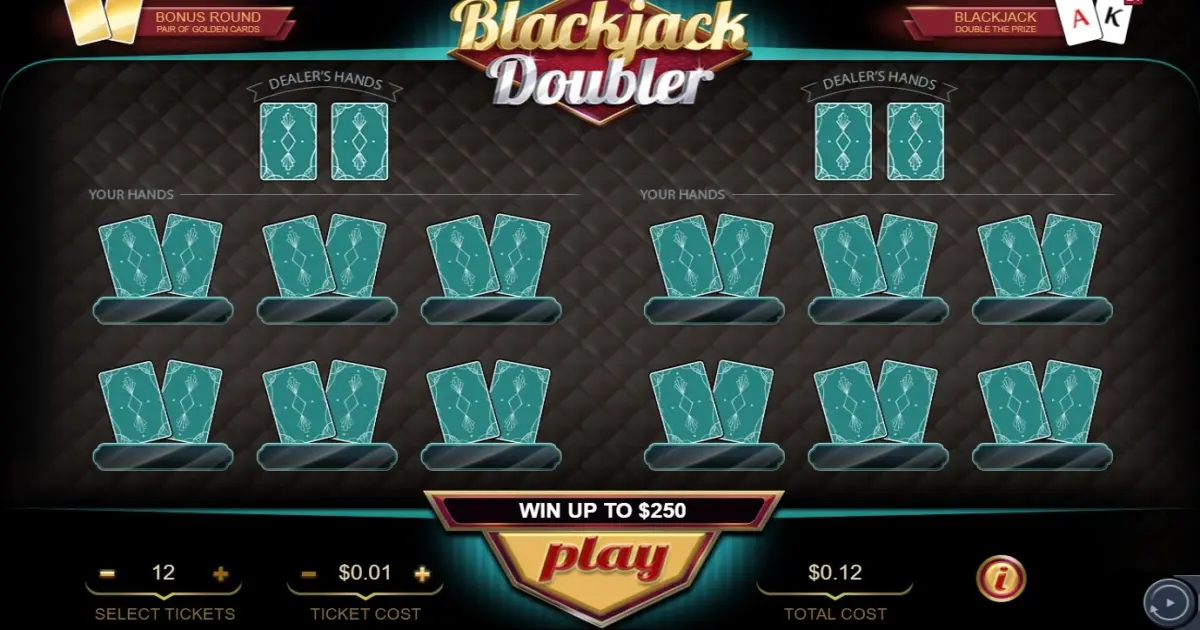
Blackjack Doubler is the only blackjack title NeoGames carries in this catalogue, and it lacks a published RTP. Whether that absence signals a hidden edge or simple provider silence is something you will need to resolve yourself in the game’s rules screen before depositing a single unit.
Blackjack Doubler and the NeoGames table range
NeoGames is primarily a sports-betting and virtual-sports provider, which explains why their blackjack library contains a single entry. That lone title sits at rank 59 in our theme ranking, in the 56th popularity percentile—middle of the pack, neither obscure nor widely sought.
Because there is no second NeoGames blackjack table to compare it against, your nearest reference points come from other providers. American Blackjack publishes a 99.5% RTP and follows a recognisable US ruleset; you can treat it as a benchmark for what a well-documented table should tell you before you sit down.
The practical implication of a single-game provider range is that you cannot triangulate NeoGames’ house-edge philosophy from their catalogue. Each rule variation—dealer soft-17 behaviour, double-after-split availability, surrender—remains locked inside this one table’s own documentation.
The RTP figure, and the assumption behind it
No RTP is published for this table. Our corpus average across blackjack titles in this catalogue is 99.41%, but that is a descriptive statistic about other games, not a substitute for a provider statement.
When a provider does publish a figure, remember the universal caveat: it assumes you play perfect basic strategy on every single hand. A player who makes one soft-18 miscalculation per round and doubles on a hard 11 against a dealer seven will realise a return measurably below whatever number the paytable prints. The gap between theoretical RTP and actual experience is not hypothetical; it is the arithmetic cost of imperfect decisions, and it compounds over hundreds of hands.
Without a published number for Blackjack Doubler, you cannot even begin to estimate that gap. Check the in-game paytable before playing for money.
Rules to confirm before you bet real money
The following variables each shift the house edge, and none is confirmed in the data available to us:
- Blackjack payout: 3:2 versus 6:5. The latter costs you roughly 1.4 percentage points of expected value and is the single most damaging rule change a casino can apply.
- Dealer soft-17 action: standing saves you approximately 0.2%; hitting costs you the same amount.
- Number of decks: fewer decks marginally favour the player under most rule sets, though the effect interacts with blackjack payout.
- Double-after-split: unavailable DAS typically adds 0.1–0.2% to the edge.
- Re-splitting aces: another small but measurable swing.
- Late surrender: if offered, it reduces the edge by roughly 0.07%.
If the game title contains “Doubler,” you should specifically check whether that word refers to a double-down mechanic, a multiplier side bet, or a branding term with no mechanical effect. The name alone does not resolve this.
Strategy: the chart, not a system
Basic strategy is a solved mathematical problem: for every player hand against every dealer up-card, there is exactly one decision—hit, stand, double, split, or surrender—that maximises your expected value under a specific ruleset. It is not a system in the sense of a betting progression or a pattern you follow after losses. It is a fixed chart you memorise or reference.
Which chart is correct depends on the exact rules of the table you are playing. A chart built for S17 with DAS will give you wrong answers on an H17 table without re-splitting aces. This is another reason the missing rule data matters: you cannot pick the right chart until you know the rules.
Playing with perfect strategy minimises the house edge. It never eliminates it. No sequence of decisions, however disciplined, converts a negative-expectation game into a positive one over the long run.
Variance at the blackjack table
Blackjack variance is moderate compared to slots but significant compared to, say, baccarat banker bets. A single-session result dominated by your blackjack frequency, dealer busts on stiff hands, and how often you successfully double into a ten is entirely normal. The expected value is a long-run figure measured over thousands of hands; a 200-hand session tells you almost nothing about whether your decisions were correct.
Unit sizing should reflect your bankroll and the session length you want. A player treating a 20-unit bankroll at 1% per hand will encounter less ruin risk than one betting 5% per hand, but neither approach changes the underlying expectation. Progressions like Martingale redistribute variance into a distribution with more frequent small wins and rarer catastrophic losses; the expected value remains negative.
Free play first
Classic Blackjack at 99.28% RTP gives you a documented baseline; use the Blackjack Doubler demo alongside it to see whether the interface or rules feel comparable. A free demo is available here, which is the right way to begin.
Use the demo to locate and screenshot the in-game rules screen. Confirm the payout on natural blackjack, whether the dealer hits soft 17, and which doubling and splitting options exist. Compare what you find against the chart you are using.
Playing responsibly means setting a loss limit before you open the game and treating any money staked as the cost of entertainment, not an investment or income source. You must be 18 or older to play for real money. If gambling stops feeling like entertainment, self-exclude and seek support from a licensed helpline in your jurisdiction.
Who this table is for
Blackjack Doubler suits a player who enjoys trying mid-popularity titles and is willing to invest two minutes reading the rules screen before staking money. The demo is free, so there is no cost to that investigation.
It is less suitable for a player who needs to compare published RTP figures before choosing a table, because the number is simply absent here. If you are a basic-strategy purist who refuses to sit at a table where the rules are unclear until you have confirmed them, that discipline applies here more than most: the missing data is the risk, not the game itself.
For a directly comparable experience with a documented edge, Blackjack (Mascot Gaming) at 99.5% RTP is a reasonable alternative to evaluate side by side.
| Attribute | Value |
|---|---|
| Game | Blackjack Doubler |
| Provider | NeoGames |
| RTP | Not published |
| Rank | 59 |
| Popularity percentile | 56.4 |
| Free demo | Yes |
| Provider blackjack count | 1 |
Frequently Asked Questions
Can I play Blackjack Doubler for free?
Yes. The demo version is available without registration or deposit. Free play lets you explore the interface and, importantly, locate the in-game rules screen where you can confirm the payout on a natural blackjack, the soft-17 rule, and which doubling and splitting options are available. Demo play does not predict real-money results, but it costs nothing to check.
What is the RTP of Blackjack Doubler?
NeoGames has not published an RTP figure for this table. Our catalogue records a corpus average of 99.41% across blackjack titles, but that is not this game's number. Any RTP claim you see elsewhere should come with the standard caveat: published figures assume perfect basic strategy on every hand, and most players deviate.
Does the house edge change with different rules?
Yes, significantly. A 6:5 blackjack payout instead of 3:2 adds roughly 1.4 percentage points. A dealer hitting soft 17 rather than standing adds about 0.2%. Double-after-split unavailability and restrictions on re-splitting aces each add small amounts. Because none of these rules is confirmed for Blackjack Doubler in available data, you must check the game's own paytable.
Can card counting beat Blackjack Doubler?
No. Like nearly all online blackjack tables, this is an RNG game that reshuffles after every hand, so no true count can develop. Card counting requires penetration through a shoe without reshuffling. The only mathematically sound advantage available here is playing correct basic strategy for the specific rules of this table, which reduces but never eliminates the edge.
How does Blackjack Doubler compare to other blackjack games?
The most obvious difference is transparency. American Blackjack publishes 99.5% RTP with a documented US ruleset. Blackjack Doubler by NeoGames has no published RTP and no confirmed rule details. If you value knowing your exact expected return before sitting down, the missing documentation here is a meaningful disadvantage relative to providers who disclose their figures.




