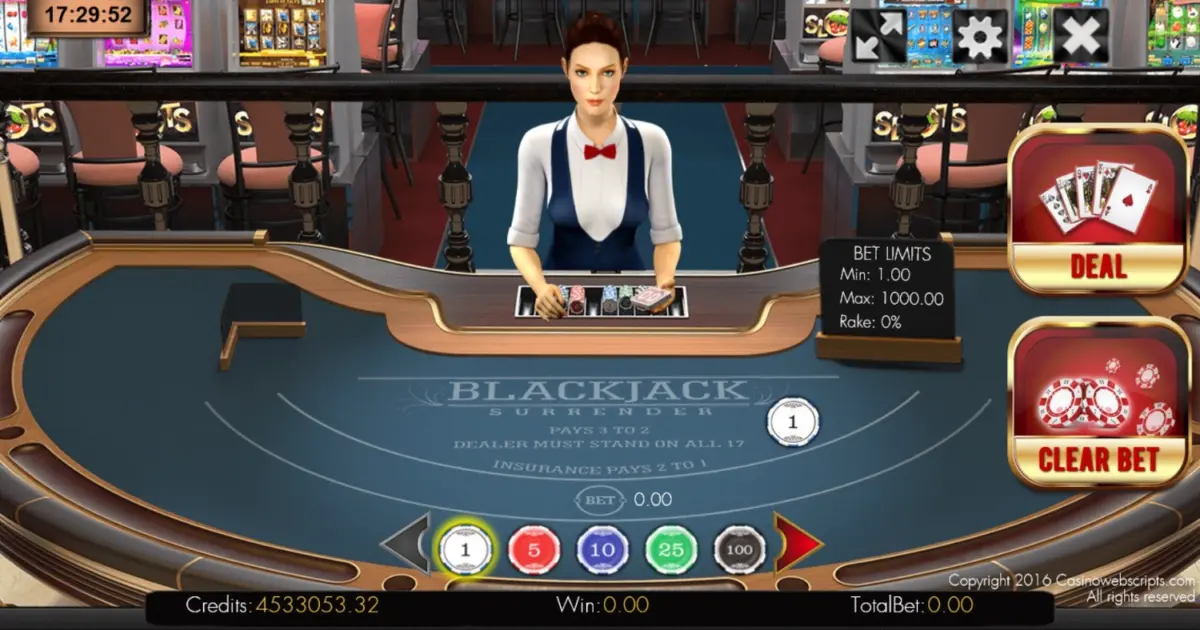
Blackjack 21 Surrender 3D Dealer is an RNG blackjack table from Casino Web Scripts that advertises a 99.64% return-to-player figure. The name signals a late-surrender option, which is the single most player-friendly rule addition in the game, but the published number assumes flawless basic strategy on every decision. If you want to try this table without risking a cent, the Blackjack 21 Surrender 3D Dealer free demo is available here, and reading through the rules below will tell you whether this particular game is worth your study time.
Blackjack 21 Surrender 3D Dealer and the Casino Web Scripts table range
Casino Web Scripts publishes eight blackjack titles in this catalog, sitting at an average RTP of 98.86%. Blackjack 21 Surrender 3D Dealer at 99.64% sits well above that provider average and also above the corpus-wide blackjack average of 99.41%. The spread within the provider range is wide: BlackJack 21 FaceUp 3D Dealer returns 99.61%, essentially matching this table, while BlackJack Ultimate 3D Dealer drops to 96.54% — a 3.1% gap that would devastate any bankroll over thousands of hands. That range matters because it shows Casino Web Scripts blackjacks do not share a single house-edge model; each table’s rules package determines its number. BlackJack 21 Classic also sits at 99.64%, identical to this surrender variant, which tells you the surrender rule is not being offset by a worse payout or an extra deck elsewhere on the table. The RTP figure alone does not distinguish these tables, so you need to compare their rule sets before choosing where to spend your time.
The 99.64% figure, and the assumption behind it
The 99.64% RTP means a theoretical house edge of 0.36%. That number is the floor achievable only under perfect basic strategy — the solved mathematical chart that tells you the optimal decision for every possible player-dealer card combination. Any deviation from the chart pushes your real return downward. A player who hits a hard 16 against a dealer 10, or who doubles a soft 18 against a 9, is adding cost to every such hand. Realistically, casual players who have not memorised the surrender-specific chart will realise something closer to 97.5–98% return, which is materially different from the headline figure. The published number is also computed over infinite hands. In a session of 60 hands, your actual return will scatter wildly around that mean — variance at this edge level means you will see stretches of 110% and stretches of 85% return, and neither outcome changes what happens on hand 61.
Rules to confirm before you bet real money
The FACTS block for this table provides the RTP and the surrender variant hint, but Casino Web Scripts does not publish several rule parameters that directly affect your edge. You must check the in-game rules screen for each of these before depositing:
| Rule | Status for this table |
|---|---|
| Blackjack payout | Not published — confirm 3:2 or 6:5 in-game |
| Number of decks | Not published |
| Dealer soft 17 action | Not published |
| Double after split | Not published |
| Re-split aces | Not published |
| Surrender type | Late (implied by title, confirm in paytable) |
| Hole card peek | Not published |
A 6:5 blackjack payout instead of 3:2 costs roughly 1.4% — more than the entire house edge on this table. If the dealer hits soft 17 rather than standing, that adds approximately 0.2%. If double-after-split is not allowed, that costs another 0.14%. Each of these could silently consume the surrender benefit. Compare against a fully documented table like Classic Blackjack (99.28% RTP) to see how a transparent rule set lets you verify the math before you commit.
Strategy: the chart, not a system
Basic strategy is a solved problem. For each combination of your two cards and the dealer up-card, one action has the highest expected value, and the chart encodes that answer. With surrender available, the chart gains additional entries: you now surrender hard 15 against a dealer 10, hard 16 against dealer 9 through Ace, and certain other compositions. Each of those surrender decisions recovers roughly 0.1% of edge compared to playing the hand out, which is why the option matters. What basic strategy is not: a system, a progression, or a guarantee. It minimises the house edge to the theoretical floor and nothing more. No arrangement of bets turns a negative-expectation game positive. If you want to see how surrender interacts with multi-hand play, Multihand Blackjack at 99.5% presents a different decision tree where you are simultaneously managing several charts’ worth of inputs, which tends to increase the rate of deviation from optimal play.
Variance at the blackjack table
Variance in blackjack comes from three sources: the randomness of the deal, the frequency of blackjacks and double-down results, and your own decision timing. With a 0.36% house edge, the standard deviation per unit bet is roughly 1.1 units. Over 60 hands in an hour, the expected loss is 0.216 units, while the standard deviation of total results is about 8.5 units. That means a single session is almost entirely noise — your bankroll will swing far more from random hand distribution than from the house edge itself. Card counting is irrelevant here: this is an RNG table that reshuffles after every hand, so the deck composition carries no forward information. Any betting progression — doubling after losses, flat-betting, or any other pattern — changes only the shape of your results distribution, never the expected value. The house edge is baked into each individual hand; no arrangement of those hands removes it. Your unit size relative to your session budget is the only lever you control over how long you stay in play.
Free play first
The free demo lets you confirm the surrender mechanics, check the in-game paytable for the rules listed above, and practice the chart until it becomes reflex without any money at risk. Use it to verify the blackjack payout ratio and deck count before you ever play a real-money session at this table. Remember that demo results carry zero predictive value for real-money outcomes; the math is identical, but your attention and decision quality differ when money is on the line. This is entertainment, not income. Set a session budget before you deposit, stop when it is spent, and never chase losses. If gambling stops being fun, that is the signal to walk away. Available to players 18 and over only.
Who this table is for
Blackjack 21 Surrender 3D Dealer makes sense for players who already know basic strategy and want to extend it to the surrender chart, because that addition is the entire reason to prefer this table over a standard variant. The 0.36% edge is competitive, and it exceeds the corpus average. However, the missing rule details mean you cannot verify that edge from published data alone — the number is only trustworthy if the in-game rules turn out to be player-friendly. If you find the paytable confirms a 3:2 payout, single or double-deck shoe, and stand-on-soft-17, this is one of the strongest online blackjack returns available from this provider. If it shows 6:5 or hit-soft-17, walk away and try one of the tables with transparent documentation instead. Players at the 38th percentile of popularity will find this is a niche table for those who value the surrender option over more common features like multi-hand play or side-bet menus.
Frequently Asked Questions
Can I play Blackjack 21 Surrender 3D Dealer for free?
Yes, the free demo version is available on this site with no registration or deposit required. You can practice surrender decisions and check the in-game paytable for deck count, blackjack payout, and dealer soft-17 rules before committing real money to any session.
What does the 99.64% RTP on this table actually assume?
The 99.64% RTP assumes perfect basic strategy execution on every single hand, including optimal surrender decisions. A casual player deviating from the chart even a few times per hour will realise a return closer to 97.5–98%, making the headline figure optimistic for most real sessions.
How does the surrender rule affect the house edge in this game?
Late surrender is worth approximately 0.07% to 0.1% back to the player compared to no-surrender rules, depending on the deck count. Combined with the published 0.36% house edge, this means the table would have roughly a 0.43–0.46% edge without the option, assuming all other rules stay the same.
Does card counting work at Blackjack 21 Surrender 3D Dealer?
No. This is an RNG table from Casino Web Scripts that reshuffles after every hand, so the deck composition at the start of each round is always fresh. No counting system, progression, or pattern can alter the house edge of 0.36% here.
How does this table compare to BlackJack 21 FaceUp 3D Dealer from the same provider?
Both sit within 0.03% of each other in published RTP — 99.64% versus 99.61%. The difference comes down to rule sets: the FaceUp variant shows both dealer cards, which changes the strategy chart entirely and removes some information advantage from the player. Which is better for you depends on whether you prefer surrender decisions or full information before acting.




