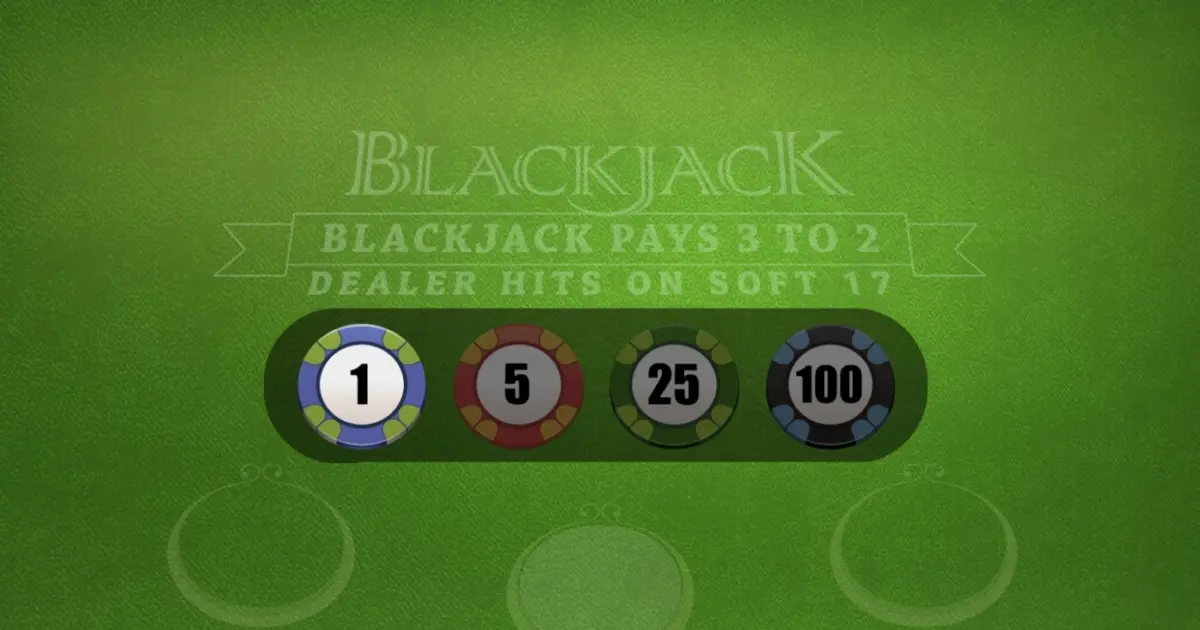
If you want a low-edge blackjack table to practise on, this one qualifies on paper: 3 hand blackjack (multislots) publishes an RTP of 99.51%, which is a touch better than the average across the blackjack tables listed here. The caveat matters more than the number, though, because that return only appears if you play every hand correctly. Playing three hands at once triples the number of decisions you can get wrong per round, and it triples how much money crosses the table per minute.
Is 3 Hand Blackjack (Multislots) a fair table?
A published RTP of 99.51% means a house edge of roughly 0.49% — under half a percent of every amount staked, in theory. That is a genuinely competitive figure for blackjack and far better than almost anything you will find on a slot.
The word “theory” is doing heavy lifting. RTP figures for blackjack are calculated on the assumption of perfect basic strategy on every single hand: every hit, stand, double and split played exactly as the solved chart dictates, with no exceptions for hunches or fatigue. A casual player who stands on 16 against a dealer ten because it feels safer, or who never doubles on soft 18, realises a materially lower return than 99.51%. Depending on how far you drift from the chart, the effective edge against you can be several times the published one.
The other thing to understand is that RTP is a long-run average, measured over an enormous number of hands. It tells you nothing about your next session. A few hundred rounds is statistically tiny, and swings in either direction at that sample size are entirely normal.
| Provider | MultiSlot |
|---|---|
| RTP | 99.51% |
| Free demo | Yes |
MultiSlot and this table
MultiSlot has exactly one blackjack table in our catalogue, and this is it. That is worth knowing for two reasons. First, there is no sibling table from the same studio to compare rule sets against, so you cannot infer this one’s conventions from a MultiSlot house style. Second, a single-title provider is unlikely to publish the kind of detailed rules documentation that larger studios put out, which puts the burden on you to read the in-game rules screen.
Since there is no provider stablemate, the useful comparisons come from other tables at similar return levels. American Blackjack sits at 99.5%, effectively identical on paper, and its name signals a dealer-peek rule set that is easier to reason about. Classic Blackjack is lower at 99.28%, which is about 0.23% more edge against you — small, but it compounds over volume. If you want a third reference point at the same level, Blackjack (Mascot Gaming) also lists 99.5%.
Comparing published RTPs across tables is only meaningful if the underlying rule sets are similar. A table with a high headline figure and a 6:5 blackjack payout would be a worse deal than a lower-RTP table paying 3:2.
Rule set: what the title implies
The title tells you one thing clearly: this is a multi-hand table, dealt as three player hands against a single dealer hand per round. That is a format, not a rule, and it does not change the house edge on any individual hand. What it changes is exposure. Three hands at the same unit size means three times the money at risk per round, and three times the hourly turnover. If you normally bet one unit per hand, a three-hand round is a three-unit round — budget accordingly rather than treating it as one bet.
Everything else about the rules is unpublished. MultiSlot does not disclose the deck count, whether the dealer stands or hits on soft 17, the blackjack payout, doubling and splitting permissions, whether late surrender is available, or which side bets if any are offered. Those omissions are not trivial: the blackjack payout alone is the single biggest lever, with 6:5 instead of 3:2 costing a player around 1.4% — enough to wipe out this table’s advantage several times over. Dealer standing on soft 17 versus hitting is worth roughly 0.2%, deck count a few hundredths of a percent per deck removed.
Open the in-game rules or paytable screen before you stake real money and confirm each of those. The demo is the cheapest place to do it.
The maths of a blackjack hand
Blackjack’s edge comes from sequence: you act first, so you can bust before the dealer ever plays. Everything basic strategy does is reduce the cost of acting first. It is not a system or a betting pattern — it is a solved chart, computed from the rule set, giving the single highest-expectation action for every combination of your total and the dealer’s upcard. There is no judgement in it and nothing to tune.
Basic strategy minimises the house edge; it never removes it. Playing perfectly on a 99.51% table means you face a 0.49% edge, not a zero edge.
Card counting does not apply here. This is an RNG table, and an RNG deck is reshuffled before every hand, so no information carries from one round to the next. Counting works by tracking depletion in a shoe that keeps dealing — remove the persistence and the count is always neutral. The same logic voids every betting progression. Martingale, D’Alembert and “double after a loss” reshape your variance, making swings larger and rarer, but they cannot alter expected value, because each hand’s edge is fixed regardless of what came before it. No hand is ever “due”.
Common mistakes that cost you the edge
Insurance is the clearest one. Offered when the dealer shows an ace, it pays 2:1 on a bet that the hole card is a ten-value card. At standard odds the true probability sits below the break-even point that bet requires, so insurance is a losing proposition and basic strategy declines it every time. Taking it on all three hands multiplies a bad bet by three.
Second is drifting off the chart. The common leaks are standing on 16 against a high upcard because busting feels worse than losing, refusing to split eights against a strong dealer card, and skipping doubles when the bankroll feels thin. Each deviation costs a fraction of a percent, and a handful of them together can turn a 0.49% edge into something several times larger.
Third is side bets. If this table offers Perfect Pairs, 21+3 or similar, they are priced entirely separately from the base game and typically carry house edges in the range of several percent — an order of magnitude worse than the hands you are playing. They are the fastest way to undo a good base-game RTP.
Fourth, specific to this format: raising your unit size because you are “only” playing one round. Three hands is three bets.
Trying it free first
A 3 Hand Blackjack (Multislots) free demo is available, and given how much of this table’s rule set is undisclosed, the demo has a concrete job to do. Use it to read the paytable, confirm the blackjack payout and the dealer’s soft 17 behaviour, check what doubling and splitting are permitted, and see whether side bets appear. Then use it to rehearse the chart across three hands at once, which is a different rhythm from single-hand play and where most decision errors creep in.
What the demo cannot do is forecast your real-money results. Play money removes the pressure that causes mistakes, and short-run outcomes in demo mode carry no predictive information about a real session.
Blackjack is entertainment, not income. Play only if you are 18 or over, set a budget before you start and treat it as spent, and stop when you reach it rather than when you feel a session should turn around. If gambling has stopped feeling optional, seek support from a recognised service in your country.
Final take on 3 Hand Blackjack (Multislots)
The headline is good: 99.51% is above the average of the tables listed here, and a sub-0.5% theoretical edge is about as player-friendly as blackjack gets. What holds it back is the information gap. With the deck count, soft 17 rule, blackjack payout and side bet menu all unpublished, you cannot verify that the figure reflects a rule set you would actually want to play, and the paytable is the only place to settle it.
Treat the three-hand format as a stake multiplier rather than a feature, learn the chart before you increase your unit size, decline insurance every time, and remember that no progression or counting approach touches the edge on an RNG table. Do that and you are playing this one about as well as it can be played — which still means a small, permanent edge against you.
Frequently Asked Questions
Can you play 3 Hand Blackjack (Multislots) for free?
Yes, a free demo of the table is available, so you can play 3 Hand Blackjack (Multislots) free without staking money. That is the sensible place to start, because MultiSlot leaves most of the rule set undisclosed — use the demo to read the paytable and confirm the blackjack payout, soft 17 rule and any side bets before betting real money.
What is the RTP of 3 Hand Blackjack (Multislots)?
The published RTP is 99.51%, which is marginally above the 99.41% average across the blackjack tables listed here. That figure assumes perfect basic strategy on every hand, without exception. Play by instinct instead of the chart and your effective return drops well below 99.51%, potentially by several times the stated house edge.
What house edge does this table have, and what would change it?
Roughly 0.49%, the complement of the 99.51% RTP. Rule details move that figure significantly: a 6:5 blackjack payout instead of 3:2 costs a player around 1.4%, dealer hitting soft 17 about 0.2%, and deck count a few hundredths of a percent each. None of those rules are published for this table.
Does card counting or a betting system work on this table?
No. This is an RNG table, so the deck is reshuffled before every hand and no information carries between rounds, which leaves any count permanently neutral. Betting progressions like Martingale fare no better — they change the shape of your variance, making swings bigger and less frequent, but they cannot alter expected value.
How does it compare with American Blackjack?
American Blackjack lists 99.5%, statistically indistinguishable from this table's 99.51%. The practical difference is transparency: its name signals a dealer-peek rule family, while MultiSlot publishes almost nothing about this one. Classic Blackjack is lower at 99.28%, or roughly 0.23% more edge against you per hand played.




