Sapphire Fever Bingo sits a notch above the pack for players shopping for value in the online bingo lobby. The room is built on the familiar 90-ball format and carries a published 95.81% return-to-player figure, which is 1.4 percentage points above the market average across comparable bingo titles. Whether that edge translates into a better session depends on how many tickets sell each round and how the operator structures the prize tiers — but on paper, the maths are favourable relative to what you will find in most competing rooms.
Is Sapphire Fever worth your time?
If you judge a bingo room purely by its RTP relative to the competition, Sapphire Fever earns a look. At 95.81%, the house edge sits at roughly 4.19%, meaning the room returns more per pound wagered than the average bingo title tracked across this site (94.41%). That gap is modest — less than one and a half pence per pound — but over a multi-round session it is real money, not rounding noise.
Beyond the percentage, Sapphire Fever is a 90-ball game, which means every ticket carries the standard nine-column grid with numbers 1 through 90. Three prize tiers are on the line each round: one line, two lines, and full house. The specific prize breakdowns are not published in the facts available here, so check the room’s own paytable before you buy in — in bingo the prize pool depends on ticket sales for that round, not on a fixed pay table the way a slot works.
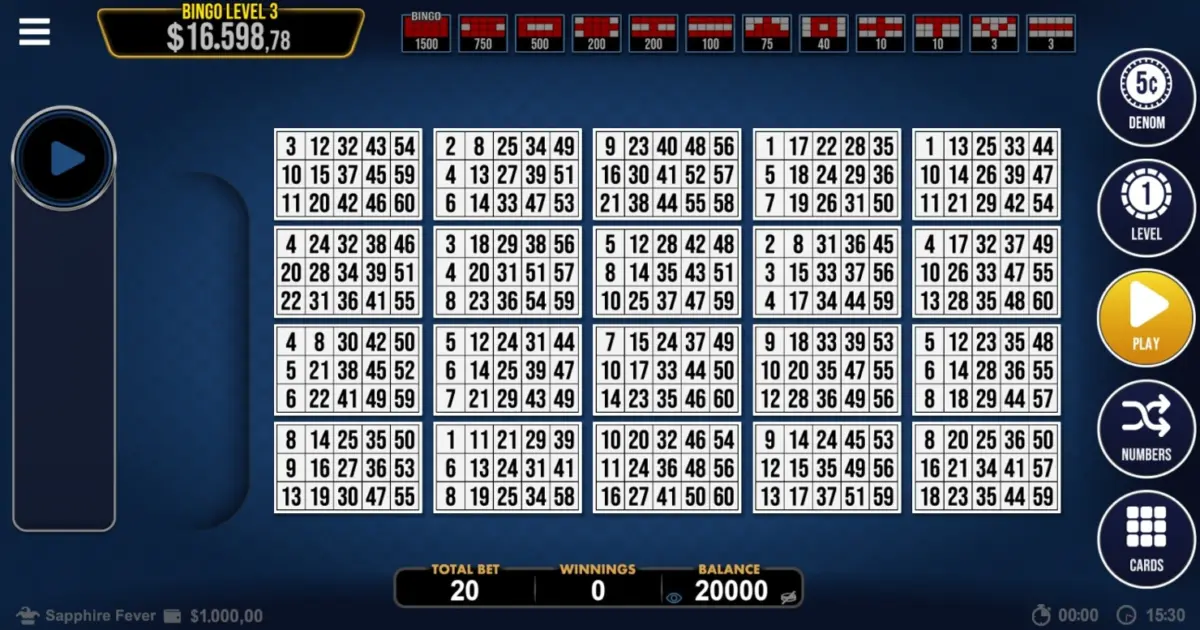
The game is available as a free demo with no download required, which lets you explore the interface, ticket layout, and auto-daub speed before committing any bankroll. Free play does not predict real-money results, but it does answer practical questions: how fast do numbers get called, how many tickets can you comfortably manage, and does the room’s pacing match your preference? For a bingo product ranked in the top tier by popularity and offered by a provider with a focused library of 17 titles, Sapphire Fever is at minimum worth a few free rounds to form your own impression.
| Provider | FBM Digital Systems. |
|---|---|
| RTP | 95.81% |
| Free demo | Yes |
| Site-wide average RTP | 94.41% |
Where the payout percentage actually comes from
In bingo the RTP is not set by spinning reels or weighted card decks — it is set by how the operator divides ticket revenue into the prize pool. Every number called in a round is shared across every ticket in the room, so the outcome is a collective draw, not a private spin. The published 95.81% RTP for Sapphire Fever therefore represents the share of all stakes that, on average, return to players as prizes over time.
This structure matters because the percentage is an average across an enormous number of rounds. In any single game the actual return depends on how many tickets sold and how many players are chasing the same prize tiers. A full-house win in a lightly attended round pays less than the same line in a packed room, because the same pool is split fewer ways — or more, depending on whether the jackpot is fixed or progressive. The RTP is the long-run expectation, not a promise for your next session.
Compared with the broader bingo market tracked on this site, Sapphire Fever’s return sits above the 94.41% corpus average. That 1.4-point premium suggests the room is configured with a slightly leaner operator margin. It does not mean you will win more often, but it does mean the prize pool keeps a larger share of stakes. Over hundreds of rounds the difference adds up, which is why comparing RTP across bingo rooms is a useful first filter even though no single session will mirror the long-run number exactly.
What the name tells you about the format
The “Fever” in Sapphire Fever signals that this is a 90-ball bingo room. FBM Digital Systems has used the Fever label across several of its bingo titles to denote the 90-ball format with three prize tiers per round, and the FACTS here confirm the subcategory as Bingo without contradicting that convention. The “Sapphire” prefix is the thematic skin — a gem-tone visual layer — not an additional mechanic.
Understanding the format matters for setting expectations. A 90-ball game runs three calls to decision: one-line, two-line, and full house. If you have played 75-ball pattern bingo, the pace and structure feel different. In 90-ball, there is no pattern to spot on a five-by-five grid; instead, each ticket has three rows and nine columns, and you are waiting for numbers from 1 to 90 to complete lines left to right, then two lines, then the entire card.
The room does not advertise speed or turbo variants, so expect a standard calling pace. FBM Digital Systems offers 17 bingo-related products, and the Fever brand sits alongside Multi Mega and Champion Bingo in its portfolio. If you want a related 90-ball room from the same provider, Champion Bingo II is worth comparing for its own prize structure and pacing, while Multi Mega – Classic offers a different FBM flavour for players who want to branch out.
Auto-daub, card choice and what you can and cannot control
In Sapphire Fever, as in all standard online 90-ball bingo, auto-daub marks your numbers for you. Every ticket in the room is checked against the same sequence of randomly called numbers, so the system is simply ensuring that no human reaction-time error costs you a win. This is the normal setup for online play — it is not a crutch, it is the mechanism that makes remote bingo work at scale.
What you can control is how many tickets you buy per round. Buying more tickets means a larger share of the possible number combinations are in your hand, which increases the probability that you are the one to complete a line or full house first. That is a genuine advantage in each round. However, more tickets also mean more money risked. The expected value per pound staked does not improve simply because you hold more cards — it stays locked to the room’s house edge. More tickets give you a better chance of winning, not a better return on each pound wagered.
Card selection in 90-ball online bingo is typically random: the system assigns ticket numbers from the pool of possible distributions. You cannot pick “lucky” cards or influence which numbers appear. The only strategic decisions are how many tickets to buy per round and whether you stop after a set number of rounds. Those choices affect your variance and session length, not the underlying edge. If you are considering whether to scale up your ticket count, think in terms of session entertainment time rather than as a way to tilt the maths in your favour.
How Sapphire Fever compares to other online bingo
Sapphire Fever’s 95.81% RTP places it above the market average of 94.41% across comparable bingo products tracked on this site. That gap is small but consistent — roughly 1.4 cents per pound wagered more returned as prizes over the long run. For players who compare rooms before depositing, this is a meaningful point in Sapphire Fever’s favour, even though the difference will not be visible in any single round.
The game sits in a provider ecosystem where FBM Digital Systems averages a 95.81% RTP across its tracked bingo catalogue, meaning Sapphire Fever is precisely on the provider’s house standard rather than an outlier. If you have played other FBM rooms, the underlying math model is likely similar, with the visual theme being the primary differentiator. Rooms like Multi Mega Full HD share the same provider pedigree, making them a reasonable comparison point if you want to contrast presentation while keeping the maths profile close.
Against the wider bingo landscape, the decision often comes down to format and pace. Sapphire Fever is 90-ball, which gives you three chances to win per round. Players who prefer the pattern-hunting mechanics of 75-ball or the ultra-fast rounds of 30-ball speed bingo will find a different rhythm elsewhere. But for anyone who values a slightly above-average return in the 90-ball format, Sapphire Fever holds its position. Its popularity — ranked in the top tier by percentile — suggests many players have reached the same conclusion. Pairing it with a free demo round before committing real stakes is the practical way to confirm the room suits your session goals.
Bankroll and session limits
Set a session budget before you buy your first tickets and stick to it regardless of how the round plays out. Bingo’s shared-draw structure means hot streaks and cold streaks will come and go, but the house edge is constant over enough rounds. Treat ticket purchases as the price of entertainment — not as an investment, and never as a way to recover losses.
If you play Sapphire Fever’s free demo first, use it to establish a comfortable number of tickets per round and a pacing that fits your bankroll. A player buying four tickets per round at a standard stake will burn through a session fund at a different rate than someone buying two — both are valid, but only if you have chosen the right level in advance. Setting a time limit alongside a money limit is a sensible habit: it prevents the session from drifting beyond what you planned to spend. Remember that you must be 18 or older to play, and if gambling stops being fun, step away. Support is available from responsible-gambling services in your region.
Verdict
Sapphire Fever Bingo is a solid pick within the 90-ball category, combining a 95.81% RTP with the familiar three-tier prize structure and auto-daub mechanics that make online bingo low-effort and accessible. The room is not flashy — it does not reinvent the format or add side-game mechanics — but it delivers a slightly above-average return on stakes, which is the single most concrete advantage a bingo room can offer over its competitors.
The free demo with no download removes the barrier to entry, letting you test the interface, call speed, and ticket management before spending anything. If you value a lean house edge in a straightforward 90-ball room and you are comfortable with FBM Digital Systems as a provider, Sapphire Fever earns its place on a shortlist. For a different angle on the same provider, Champion Bingo II is worth a look — but as a self-contained room, Sapphire Fever does what it sets out to do without unnecessary complexity.
Frequently Asked Questions
Can I play Sapphire Fever for free before betting real money?
Yes — Sapphire Fever Bingo offers a free demo that requires no download. Use it to test the ticket layout, auto-daub speed, and calling pace before committing real funds. Free play does not predict real-money outcomes, but it answers practical questions about how the room works.
What is the RTP of Sapphire Fever and how should I interpret it?
Sapphire Fever Bingo carries a published RTP of 95.81%. In bingo this means that, over a large number of rounds, 95.81% of all stakes are returned to players as prizes on average — the remaining 4.19% is the operator's margin. The figure reflects the prize-pool structure, not a per-card or per-spin guarantee.
Does buying more cards improve my odds in Sapphire Fever?
Buying more tickets per round increases the chance that your hand completes a line or full house first, because you hold more of the possible number distributions. However, it does not change the expected return per pound wagered — more cards mean more exposure to the same house edge, not better value per unit staked.
Who makes Sapphire Fever and what format is it?
Sapphire Fever Bingo is developed by FBM Digital Systems, a provider with a focused library of 17 bingo products. It uses the 90-ball format with three prize tiers per round — one line, two lines, and full house — which is the most common bingo variant in online lobbies.
How does Sapphire Fever compare to other bingo rooms on this site?
Sapphire Fever's 95.81% RTP sits 1.4 percentage points above the tracked bingo market average of 94.41%, giving it a modest but real long-run edge. Rooms from the same provider, such as Multi Mega Full HD, share a similar maths profile, while Champion Bingo II offers a different FBM theme to explore.