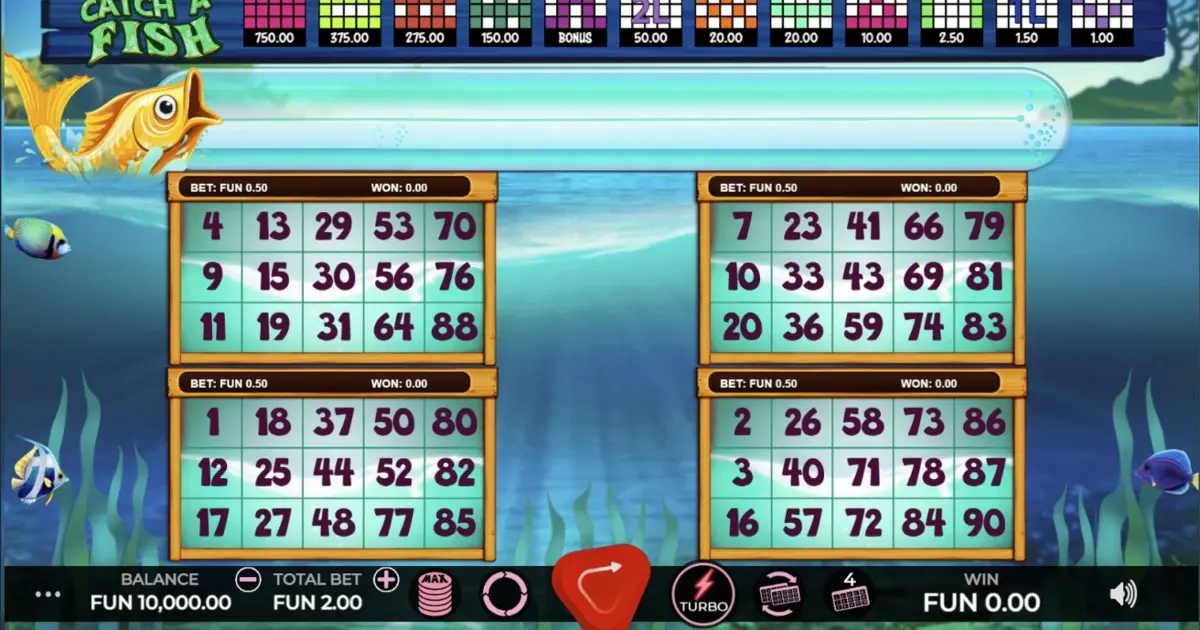
If you enjoy themed rooms where a fishing motif wraps around a standard shared-draw format, catch a fish bingo offers a published return of 94.25% — the highest among the three Caleta Gaming bingo titles we list alongside it. That said, the operator does not publish its ball format or exact prize-tier breakdown on the game page, so you will need to confirm those details inside the room before committing real money.
Catch a Fish Bingo at a glance
| Detail | Value |
|---|---|
| Provider | Caleta Gaming |
| RTP | 94.25% |
| Format | Bingo (ball format unspecified in available data) |
| Free demo | Yes |
| Provider game count | 30 titles |
| Provider average RTP | 93.37% |
| Corpus average RTP | 94.41% |
The 94.25% figure places this room roughly one percentage point above Caleta Gaming’s own portfolio average and within a fraction of the broader corpus benchmark. For a bingo product, that spread matters less than it does in slots, because actual return depends heavily on how many players buy in and how the operator allocates the pool each round.
How the numbers are called and marked
Like every online bingo room, Catch a Fish runs on a shared draw. A random number generator selects balls in sequence, and every ticket held by every player in the room is marked against that same call order. Your role during the game is minimal: in auto-daub rooms (the standard for online bingo), the software ticks your numbers for you, so no clicking or timing affects whether you complete a pattern first.
The ball format is not specified in the data we have. Caleta Gaming operates rooms across different bingo subcategories, so you may find this title running a 90-ball card with three winning stages, a 75-ball pattern grid, or a compressed speed format. Check the room rules before you play, because the format determines how many calls you need to win and how long each round lasts.
What a 94.25% figure means in bingo
In a slot, a published RTP describes the theoretical return per spin across millions of outcomes weighted by symbol frequency. Bingo works differently. The 94.25% here represents the share of total ticket revenue that the operator returns to players as prizes over a sustained period. The remaining 5.75% is the house margin.
This is not a per-card guarantee. If a round sells 200 tickets and the prize pool is fixed, the actual percentage returned to players depends on how many of those 200 tickets hold the winning numbers. A round with a single full-house winner returns differently from one where the line prize splits among several players. The published figure smooths these variations across many games.
Compared to the other Bingo Iglu room by the same studio at 92.86%, Catch a Fish gives players roughly 1.4 percentage points more back as prizes over time, all else being equal.
One card or many: how tickets affect your odds
Buying additional tickets for the same round increases your probability of holding the winning numbers first. If there are 100 tickets in play and you hold two, you have twice the chance of being the winner compared to holding one. What does not change is the expected value per pound staked.
Each ticket carries the same 5.75% house margin. Ten tickets do not dilute that edge; they multiply your exposure to it while also multiplying your chance of winning. Think of it as buying more lottery lines — you improve your shot at the prize but pay proportionally more for that shot, with no mathematical advantage per unit spent.
Some rooms cap the number of tickets a single player can buy, often between 50 and 90, to keep the competition between players fair. Catch a Fish’s ticket cap is not published in the data available to us. Look for it in the room lobby.
Prize tiers and what they actually pay
The specific prize structure for this room is not documented in the data we hold. In bingo generally, operators split the ticket revenue into tiered prizes. A 90-ball format typically divides into one line, two lines, and full house, with the full house taking the largest share. A 75-ball or speed format usually pays a single full-card prize, sometimes with a smaller side pot for the first pattern completed.
Caleta Gaming’s other titles illustrate how the studio varies structures: Bingolaço runs at 92.38% RTP and Bingo Pirata at 92.02%, both suggesting comparable prize-pool logic but with tighter margins. For Catch a Fish specifically, open the room’s paytable tab to confirm how many tiers exist and what percentage of the pool each tier claims before you decide whether the structure suits your stake size.
Playing the Catch a Fish demo
A free demo version of this game is available, letting you watch the call sequence, see how cards populate, and understand the pacing without staking money. This is useful for learning whether the round length and interface suit your attention span — bingo rounds can range from under a minute in speed formats to ten minutes in traditional 90-ball rooms.
Demo play cannot tell you anything about real outcomes. The prize pool in free mode is simulated; in real play, it depends on how many human players buy in that round. No demo predicts a live result.
Set a budget before you play for real money, treat ticket purchases as entertainment you are paying for, and remember this product is restricted to players aged 18 and over.
Verdict: who should play Catch a Fish
Among Caleta Gaming bingo games available for review, this title offers the strongest published return. If you already play in a network that carries this provider’s rooms, Catch a Fish is a reasonable choice over its siblings purely on the payout percentage.
If you are new to Caleta Gaming entirely, the fishing theme, the above-average RTP for this studio, and the accessible free demo make it a sensible starting point. Players who need a published ticket price, a confirmed ball format, and a detailed prize-tier breakdown will find those specifics absent from the game listing and should verify them inside the room interface before depositing.
Ranking at the 71st percentile for popularity across this review corpus, it draws a mid-range audience — enough activity to sustain competitive prize pools in busier time slots, without the saturation of a flagship room.
Frequently Asked Questions
Is Catch a Fish Bingo available to play for free?
Yes, a free demo version is available. You can watch calls, see how the card layout works, and get a feel for the round pacing without depositing money. The demo simulates prize pools and cannot predict what a real-money round will pay.
What does the 94.25% RTP mean for this bingo room specifically?
In bingo, the RTP figure represents the share of total ticket revenue returned to players as prizes over many rounds, rather than a per-spin return weighted by reel symbols. The remaining 5.75% is the operator's margin. Actual returns vary by round because the prize pool depends on ticket sales volume.
Does choosing your own card improve your odds in Catch a Fish?
The data available does not specify whether Catch a Fish lets players select cards or assigns them automatically. In rooms where you choose, the selection does not alter the mathematical house edge — every valid card carries the same probability of completing a pattern given a random call sequence.
How does Catch a Fish compare to other Caleta Gaming bingo titles?
Catch a Fish returns 94.25%, which is nearly 0.9 percentage points above the provider's portfolio average of 93.37% across 30 bingo games. By comparison, Bingo Iglu sits at 92.86% and Bingo Pirata at 92.02%, making Catch a Fish the strongest-payout option among these three.
Does buying more tickets give you better value per pound staked?
No. Additional tickets increase your probability of being the round winner but carry the same house margin per ticket. Buying ten tickets multiplies both your chance of winning and your total exposure to the edge, leaving expected value per pound unchanged.