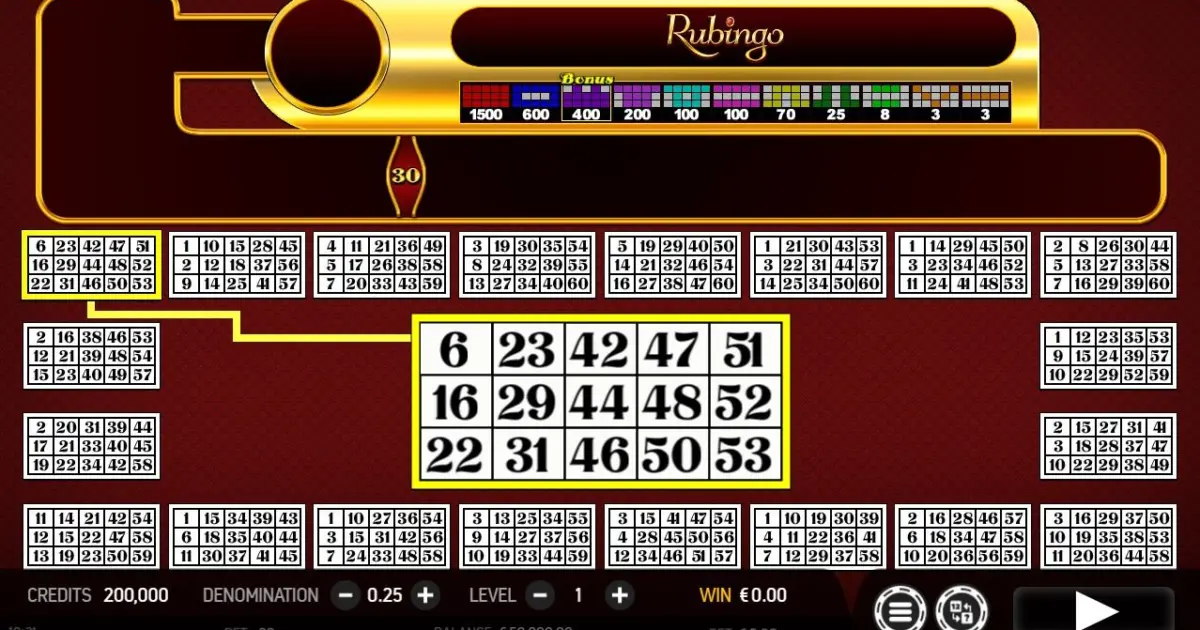
The single most decision-relevant thing about rubingo bingo is what is missing: FBM Digital Systems has not published a return-to-player or payout percentage for this room, and the facts available give no ticket price, card count or prize tier breakdown either. What you do get is a free demo, which is enough to see the format and pace before you decide.
That makes this a room you check rather than one you can assess from a spec sheet. If you want a number before you buy in, you will need to open the room’s own rules or paytable page.
How Rubingo plays
Online bingo works the same way whatever the studio: numbers are drawn at random and every ticket in the room is marked against that one shared sequence of calls. This is the structural difference between bingo and a slot. A slot spin is yours alone and resolves against a weighted reel set. A bingo round is one draw that the entire room shares, and the only thing separating you from the next player is which numbers your tickets happen to hold, all of them fixed before the first call.
Auto-daub does the marking for you in almost every modern online room, so there is nothing to press and nothing to miss. You buy tickets, the calls run, and the game announces whoever completes the required line or pattern first. If two players complete on the same call, the prize is normally shared.
What the available facts do not tell you about Rubingo specifically is the ticket price, how many cards you can hold in one round, how fast the calls run, or how the prize pool is split. Those are the four numbers that actually shape a session, so treat the demo as your fact-finding step rather than a warm-up.
| Provider | FBM Digital Systems. |
|---|---|
| Free demo | Yes |
| Site-wide average RTP | 94.41% |
FBM Digital Systems. and this room
FBM Digital Systems has 17 games listed in this catalogue, and the ones with published figures average 95.81% return against a site-wide average of 94.41%. That is a provider-level average, not a promise about Rubingo, and it draws on titles across their range rather than this room. Read it as a rough indication of how the studio tends to price its games, nothing firmer.
If you want a sense of the studio’s house style before committing, Champion Bingo II is the closest sibling in name and sits in the same catalogue. Multi Mega Full HD is the presentation-led option in the range, while Multi Mega – Classic strips the same idea back. None of the three has a published return figure here either, which is worth knowing: this is a studio whose numbers you generally have to find in the room itself rather than on a listing page.
Rubingo currently ranks 31st on this site and sits in the 81.5th popularity percentile, so it is played more than most bingo titles in the corpus. Popularity is not quality, but it does mean you are unlikely to be alone in the room.
Reading the RTP figure
There is no RTP figure to read. No return or payout percentage has been published for Rubingo, which is common in bingo because the prize pool depends on how many tickets sell in a given round rather than on a fixed mathematical model built into the game.
That difference matters. A slot’s RTP comes from symbol weighting on the reels and holds regardless of how many people are playing. A bingo payout percentage describes how much of the money taken in ticket sales goes back out as prizes. If a room takes in 100 and pays out 90, the payout percentage is 90%, and the shape of that number depends on the operator’s prize structure, not on any spin-by-spin engine.
So when you do find a bingo figure quoted, read it as share of stakes returned as prizes across the room, not as what any single ticket returns to you. And when none is quoted at all, as here, the honest position is that you cannot calculate your expected return before playing. Check the room’s rules page. If it is not there either, that absence is itself information you can factor into the decision.
90-ball, 75-ball or speed: what the format changes
The facts available do not specify which format Rubingo uses, and the name gives no clue, so this section is about what to look for when the demo loads rather than what to expect.
In 90-ball, one game carries three prize tiers: one line, two lines, then full house. Money is spread across the round, so more players see something back, but individual prizes are smaller. In 75-ball, you play patterns on a 5×5 grid, shapes rather than lines, and many 75-ball rooms let you pick your own cards. Speed and 30-ball variants compress everything into a single full-house win on a smaller card, which means faster rounds, faster spend and an all-or-nothing outcome each game.
These are genuinely different products wearing the same label. Ball count, prize tier count and call speed together decide how long your budget lasts and how often anything comes back. Find those three details in the demo before you decide whether the room suits how you like to play.
Does skill matter here? An honest answer
In standard auto-daub online bingo, your skill contribution is effectively zero. The software marks your numbers for you, so there is no reaction time to sharpen and no missed call to punish you. Every ticket in the room is scored against the identical sequence of draws. Whether you win comes down to which numbers your tickets carried, and those were set before the first ball.
The one input you sometimes get is card selection in pattern-based formats. It feels like a decision, but the draw is random, so no arrangement of numbers is better than another going in. Choosing cards changes which random outcome you are holding, not your odds of holding a winner.
Buying more tickets is the other lever, and it is widely misread. More tickets cover more of the possible outcomes, so your chance of being the player who completes first genuinely rises. Your expected value per pound staked does not move at all. Ten tickets is ten units exposed to the same house edge as one, so it buys a better shot at this round at proportionally higher cost. No number is ever due, hot or cold. The draw has no memory.
Free play before real money
A Rubingo free demo is available, which is the practical answer to most of the gaps above. Load it and you can confirm the ball count, the number of prize tiers, how fast calls run, how many cards a round allows and whether any side feature is bundled in. That is five real facts you cannot get from a listing page, and they cost nothing to collect.
What the demo cannot do is tell you anything about real-money results. Demo play does not predict cash outcomes, and in bingo it also runs without the thing that defines a real round, which is a live room of paying players competing for a prize pool funded by actual ticket sales. Treat it as a format tour, not a trial run.
Bingo is 18+ only. Set a budget before you open the room and treat it as money spent on entertainment, the same way you would a cinema ticket, not as income or a way to recover a previous loss. If the amount you are willing to lose is not clear to you before the first call, work that out first.
Final take on Rubingo
Rubingo is worth a look through the demo and a careful read of the room rules before anything else. FBM Digital Systems has a reasonable catalogue presence at 17 titles and a provider average above the site norm, and the game itself is popular enough to sit in the 81.5th percentile here. Those are mildly encouraging signals about the studio, not about this room.
The honest verdict is provisional, because the numbers that would let you judge it are not published. No return figure, no ticket price, no confirmed format, no prize tier breakdown. Play the free version, note the ball count and call speed, find the payout percentage in the room’s own rules if it exists, then decide. A room that hides its structure is not automatically a bad room, but it does put the work of checking on you.
Frequently Asked Questions
Can you play Rubingo free before betting real money?
Yes, a free demo of Rubingo is available, so you can see the room without staking anything. Use it to confirm the ball count, call speed, number of cards per round and how the prize tiers are split, since none of those details are published in the game's listing. Demo results do not predict real-money outcomes.
What is the RTP of Rubingo?
FBM Digital Systems has not published a return-to-player or payout figure for Rubingo. That is common in bingo, where the prize pool depends on ticket sales rather than a fixed reel model, so any bingo figure means share of stakes returned as prizes across the room. Check the room's own rules page before buying tickets.
Does choosing your cards improve your chances in Rubingo?
No. In standard auto-daub online bingo, numbers are drawn at random and every ticket in the room is marked against the same calls, so no arrangement of numbers is better than another. Card selection changes which random outcome you hold, not your odds. Skill input is effectively zero once the draw starts.
Who makes Rubingo?
FBM Digital Systems, which has 17 games listed in this catalogue. Across the titles with published figures, the studio averages 95.81% return versus a site-wide 94.41%, though that average says nothing definite about Rubingo itself. Their range here also includes Champion Bingo II and two Multi Mega titles.
How does Rubingo compare with Champion Bingo II?
Both come from FBM Digital Systems and neither has a published return figure here, so you cannot compare them on payout percentage. Rubingo ranks 31st on this site and sits in the 81.5th popularity percentile. The practical comparison is format and pace, which means opening both demos and checking ball count and call speed yourself.