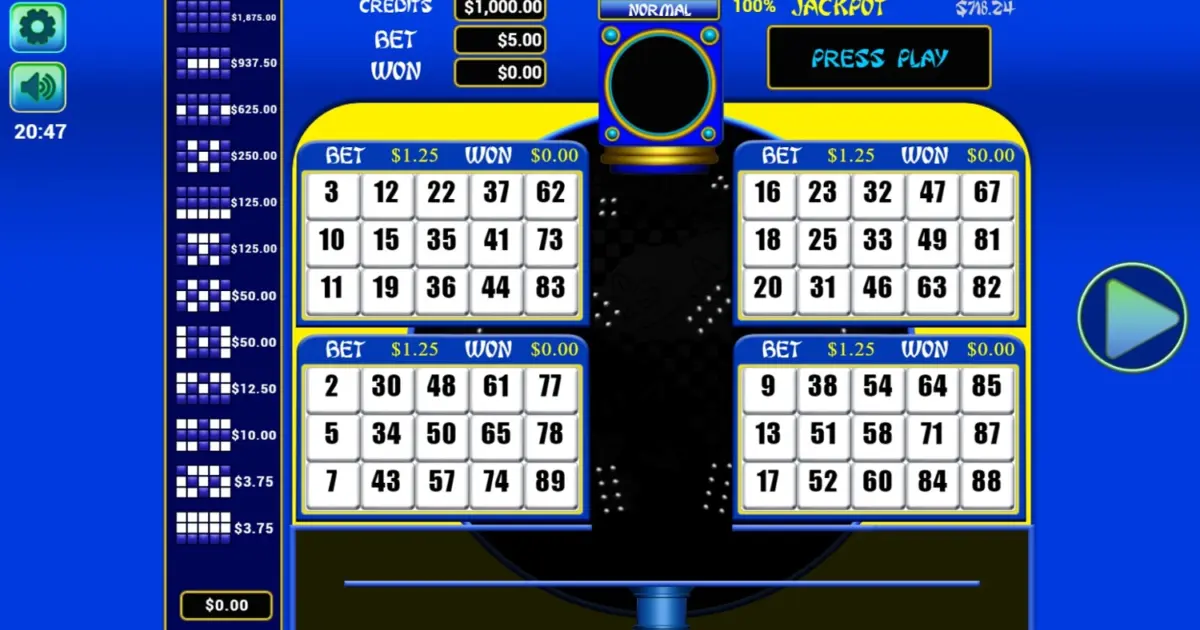
Pachinko 2 is a Japan-themed bingo room from Vibra Gaming with a published return of 95.6%, which is meaningfully above the 94.41% average across the games in this catalogue. It sits in the top 15% of rooms by popularity here, and a free demo is available, so you can watch a full draw play out before deciding whether to stake anything. If you want a themed room with a transparent payout figure, this is a reasonable candidate; if you want a jackpot headline or a novel format, keep looking.
What kind of bingo is Pachinko 2?
Pachinko 2 is listed as a bingo game under a Japan primary theme, with pachinko as the second theme tag. That is the extent of what the provider has published about the format: no ball count, no card layout and no prize-tier structure are stated anywhere in the room’s own data. So the honest answer is that the theme tells you what it looks like, and nothing about how a round resolves.
That matters more in bingo than in most genres. In a 90-ball room you are playing for three prizes inside one game — one line, two lines, then full house — so a single ticket can pay out at three separate moments and the game has a natural rhythm of near-misses. In 75-ball bingo the win condition is a pattern on a 5×5 grid rather than a completed line, cards are often chosen by the player, and the round ends on a single shape. Speed and 30-ball variants compress the whole thing into one full-house race on a smaller card, which cuts the round length hard. Those three formats feel completely different to sit through, and Pachinko 2’s name and theme do not tell you which one it is.
What is universal is the mechanism underneath all of them. Numbers are drawn at random and every ticket in the room is marked against the same sequence of calls. You are not running a private spin the way you would on a slot; you are one of many tickets riding the same draw. That single fact drives everything else in this review.
The maths of a shared draw
Because every ticket in the room is marked against the same called numbers, the only thing that separates your ticket from anyone else’s is which numbers it happened to hold before the first ball dropped. In standard online bingo with auto-daub, there is no decision to make mid-round and no timing to get right. The ticket is fixed, the calls are random, and the winner is the person whose pre-printed numbers happen to complete the required line or pattern first.
So “skill” in this format is close to zero, and it is worth being blunt about that. Card selection — where a room lets you pick your own cards, as 75-ball rooms often do — changes which numbers you hold, not the odds attached to holding them. Every card in a fair room is equally likely to be the winning one. Choosing your own cards is a preference, not an edge.
The other consequence is that buying more cards does not improve your value per pound. It increases the chance that you are the person who wins this particular round, because you hold more of the possible tickets, but it also multiplies your exposure to the same house edge. Ten cards means ten times the stake and roughly ten times the chance of being the winner, which leaves the expected return per pound exactly where it was. More cards is more variance, not better maths.
Where the 95.6% comes from
Vibra Gaming publishes a 95.6% return for Pachinko 2. In bingo that figure should be read as the share of stakes that comes back out as prizes across the room, not as a per-spin return the way a slot’s RTP works. A slot’s return is baked into symbol weighting on a reel; a bingo room’s return is set by how the operator structures the prize pool against ticket sales. The number is a statement about the paytable, not about any individual draw.
For context, Vibra Gaming’s average across its nine games in this catalogue is 95.69%, so Pachinko 2’s 95.6% is essentially level with its own provider’s norm — a fraction under, but close enough to call it typical for the studio. Against the wider catalogue average of 94.41%, it is 1.19 percentage points higher, which is a real gap in a genre where margins are thin and a couple of points is the difference between a room that feels reasonably priced and one that does not.
| Field | Value |
|---|---|
| Game name | Pachinko 2 |
| Provider | Vibra Gaming |
| Category | Bingo |
| Published return | 95.6% |
| Provider average return | 95.69% (9 games) |
| Catalogue average return | 94.41% |
| Primary theme | Japan |
| Secondary theme | Pachinko |
| Free demo | Available |
One caveat worth carrying with you: a published payout percentage is only as good as the room’s actual ticket pricing and prize split on the day you play. If the operator changes the number of tickets sold or the prize split, the realised return moves even though the headline figure did not. Treat 95.6% as the provider’s stated structure, not a guarantee about your session.
Reading the room’s rules before you buy in
Pachinko 2’s data does not include a ticket price, a card count, a prize-tier breakdown or a call speed. That is not unusual for bingo, and it is not a red flag on its own — it means the specifics live in the room itself rather than in the game’s marketing data. Before you stake anything, open the rules or paytable panel and check four things.
- Ticket price and what it buys. Whether one purchase is a single card or a strip of six, and whether the price changes as the room fills.
- The prize split. In a three-tier room, how much of the pool goes to one line, two lines and full house. A room can pay 95.6% overall while weighting almost everything to the full house, which makes the smaller prizes feel negligible.
- The format. Confirm whether you are playing 90-ball with three prizes, a 75-ball pattern game, or a compressed speed variant, because the round length and the number of chances to win differ enormously.
- Call speed and any auto-daub setting. This is the one thing that genuinely changes how the game feels to play, even though it changes nothing about the odds.
If none of that is published in the room either, that is your answer about how transparent the operator wants to be, and you can weigh it accordingly.
How Pachinko 2 compares to other rooms
The closest comparison is Pachinko 3, the other game carrying the Japan and pachinko theme tags in this catalogue. It publishes a 94.65% return, which is 0.95 percentage points below Pachinko 2 — a small but consistent edge to the sequel on the stated figure. If the theme is what draws you in, Pachinko 2 is the better-priced of the two on paper.
Within Vibra Gaming’s own output, Bingo 3 publishes 95.0%, marginally under Pachinko 2, and Show Ball 3 publishes 96.87%, which is the highest of the studio’s bingo games listed here and the strongest published figure among the rooms worth comparing. If you are format-agnostic and simply want the best stated return from this provider, Show Ball 3 is where the number points. If you specifically want the Japan theme, Pachinko 2 is the pick over Pachinko 3.
Ranked against the whole catalogue, Pachinko 2 sits at 23rd with an 86.4th percentile popularity score, so it is a well-played room rather than a curiosity. That cuts both ways: a busier room usually means a bigger prize pool funded by more ticket sales, but it also means more competing tickets against yours in any given draw.
Free demo and staying in control
A free demo is available for Pachinko 2, and it is genuinely useful here for one specific reason: it lets you see the format. Watch a full round and you will learn whether this is a three-prize 90-ball game, a pattern-based 75-ball game or a compressed speed variant, how fast the calls come, and how the prize tiers land. That is real information you cannot get from the theme label alone.
What the demo cannot tell you is anything about your real-money results. Demo play runs on the same structure but with no money at stake, and a good run in demo has no predictive relationship to what happens when you buy in. Bingo outcomes are decided by which numbers your ticket holds, and no amount of practice changes that.
Set a budget before you open the room, treat it as the price of an evening’s entertainment rather than as income, and stop when it is gone. Bingo is a paid leisure activity with a house edge built in — 18+, and if it stops feeling like entertainment, step away.
Final verdict
Pachinko 2 is a solid, unremarkable-in-a-good-way bingo room. A published 95.6% return that beats the catalogue average by 1.19 points, a provider with a consistent 95.69% across its nine games, a Japan and pachinko theme that stands out from the generic end of the genre, and a free demo that lets you check the format before committing. It is not the highest-returning Vibra Gaming bingo game in this catalogue — that is Show Ball 3 at 96.87% — and it does not publish the format, ticket price or prize structure you would ideally want up front.
So the decision comes down to what you are actually after. If you want the Japan theme and the best stated return within it, Pachinko 2 edges out Pachinko 3 and is the clear choice. If you want the strongest published figure from this provider and do not care about the theme, look at Show Ball 3 instead. Either way, read the room’s own rules before you buy in, and buy the number of cards you actually want to play rather than the number you think improves your odds — it does not.
Frequently Asked Questions
Can I play Pachinko 2 bingo for free?
Yes. A free demo is available for Pachinko 2, and it is worth using to see the format in action before you stake anything. The demo will show you the call speed and how the prizes land, but it tells you nothing about your real-money results — a good demo run has no predictive value.
What does the 95.6% RTP mean in a bingo game?
It means 95.6% of stakes taken in the room is returned as prizes, with the remainder as the operator's margin. In bingo this is set by the prize-pool structure against ticket sales, not by symbol weighting the way a slot's return is, so read it as a statement about the paytable rather than a per-game return.
Does choosing my own cards or playing more cards improve my odds in Pachinko 2?
Choosing your own cards does not change your odds — every card in a fair room is equally likely to win, so selection is a preference, not an edge. Buying more cards raises your chance of being the winner in a given round, but it multiplies your exposure to the same house edge, leaving the expected return per pound unchanged.
Who provides Pachinko 2 bingo?
Pachinko 2 is made by Vibra Gaming, which has nine games in this catalogue with an average published return of 95.69%. Pachinko 2's 95.6% is essentially level with that studio norm, and comfortably above the 94.41% average across the wider catalogue of games here.
Is Pachinko 2 better than Pachinko 3?
On the published figures, yes. Pachinko 2 returns 95.6% against Pachinko 3's 94.65%, a gap of 0.95 percentage points, and both share the Japan and pachinko theme tags. If you specifically want the best stated return from Vibra Gaming rather than the theme, Show Ball 3 publishes 96.87%.