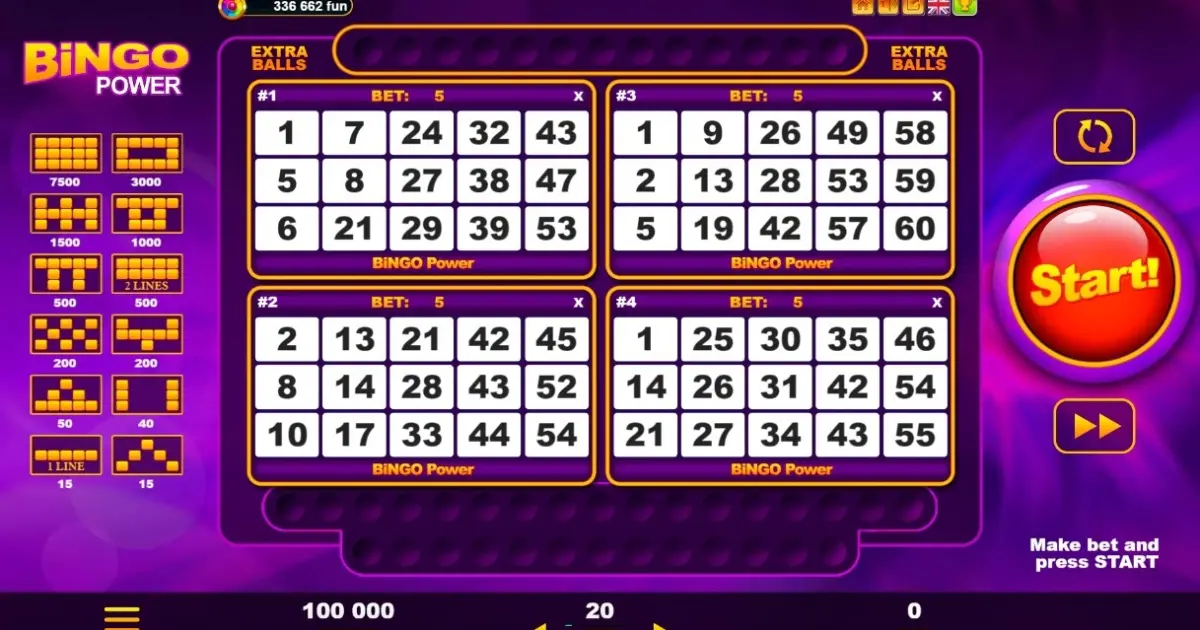
Bingo Power sits below the average return you will find across bingo rooms on this site, and that gap matters more in a shared-draw game than it does on a slot. At 92%, roughly eight pounds in every hundred you stake come back as prizes over the long run, while the operator keeps the rest. The question is whether the format, speed, and presentation of this particular room make up for the lower share of stakes.
Is Bingo Power worth your time?
You should think of this room as a mid-tier bingo product with a payout that trails the site average. Belatra Games built it as their sole bingo title, and that single-game portfolio means there is no family of related variants to benchmark it against internally. What you get is a straightforward draw-based game where every ticket in the room marks the same sequence of called numbers, and the prize pool is determined by how many players participate in a given round.
If you are comfortable with a 92% return-to-player figure and prefer playing a less saturated room where fewer competitors chase each prize tier, this could work for your sessions. If you are chasing the highest share of stakes back, the corpus average of 94.41% tells you there are better options available. A free demo lets you check whether the pacing and interface suit you before committing money, which is always the smarter first step regardless of what number the paytable shows.
| Provider | Belatra Games |
|---|---|
| RTP | 92.0% |
| Free demo | Yes |
| Site-wide average RTP | 94.41% |
Where the payout percentage actually comes from
In bingo, the published return figure — here, 92% — represents the share of total ticket revenue across all players in a game that the operator redistributes as prize money. It is not a per-ticket probability the way a slot’s RTP is calculated across millions of simulated spins. Instead, it reflects the prize pool structure the operator sets relative to the ticket price and the number of players expected in each round.
This distinction changes how you should read the number. A 92% payout means that across a large sample of games with varying ticket sales, the room returns 92 pence per pound to the collective prize fund, keeping eight pence as margin. Your individual result depends entirely on whether you hold the winning ticket for one of the prize tiers — line, two lines, or full house in a 90-ball format, or a specific pattern in a 75-ball variant — and whether you are the first to complete it before anyone else in the room calls the winning pattern.
The 92% figure also tells you nothing about variance per session. A room with a small player pool can swing wildly: one night you hit a full house worth a large sum, the next ten games you win nothing because someone else held the completing number. The published RTP is a long-run structural average, not a prediction of any individual session outcome.
What the name tells you about the format
The word “Power” in the title is a thematic label, not a mechanical descriptor. It does not confirm a specific ball count, prize structure, or speed setting. Belatra Games has not published a variant designation for this room in the available data, so you cannot determine from the name alone whether it runs 90-ball with three tiers, 75-ball with selectable patterns, or a compressed speed format.
What the name does suggest is positioning. “Power” in the iGaming naming convention typically signals either a progressive or pooled prize that grows across rounds, or simply a high-energy visual theme. Without a published rules page or in-room paytable visible before you buy in, treat the name as branding rather than specification. Check the game’s own information panel once loaded for the ball count, number of cards per player, and prize tier breakdown before committing funds.
This is a genuine gap in the available data. The absence of format confirmation means you should expect a standard draw-based structure from a provider with only one bingo title in their catalogue, but you cannot rule out a themed bonus element layered on top. Belatra is better known for slot mechanics, and their single bingo entry could carry a slot-style side feature that does not follow the traditional shared-draw model exclusively.
Auto-daub, card choice and what you can and cannot control
Online bingo rooms operate on auto-daub by default: the software marks your tickets as numbers are called, so you never miss a pattern. Your involvement in the outcome ends the moment you purchase cards. The sequence of calls is randomly generated and shared identically across every player in the room, meaning no decision you make during the draw affects whether your ticket completes a line or full house first.
What you can control is how many cards you hold. Buying additional tickets for the same round increases the number of possible outcomes you cover, which raises your chance of being the one to win. However, this does not improve your expected value per pound staked. Each additional ticket is exposure to the same 8% house margin, so you are scaling both your winning probability and your long-run cost proportionally. There is no strategic card selection in 90-ball rooms where the game assigns numbers; in 75-ball variants that allow you to pick your own patterns, you can at least choose a shape that is statistically slower to complete, but that choice only affects variance, not return.
Speed of play is another variable you cannot adjust in most rooms. The interval between calls is set by the operator, not the player. If you prefer slower rounds that give you time to track multiple tickets across simultaneous games, check whether this room allows multi-tab play before assuming it does.
How Bingo Power compares to other online bingo
Against the corpus average of 94.41%, this room trails by 2.41 percentage points. That gap compounds over sessions: per hundred pounds wagered, you return 92 versus 94.41 across the site’s bingo catalogue. For a low-stakes recreational player, the difference is marginal. For someone buying many cards across repeated sessions, it accumulates.
Thunder Bingo returns 96.27%, putting it more than four full points ahead of this room. If your priority is maximizing the share of stakes that cycle back to players, that is where you should look. Similarly, Bugs Party at 96% sits clearly above the site average, suggesting the providers behind those rooms operate on a more player-friendly prize-pool ratio.
Belatra Games has only one bingo title in this catalogue, so there is no internal family to compare against. The single-game portfolio means you cannot triangulate whether 92% is a deliberate low-margin choice or simply the one configuration this provider built. Other providers with multiple bingo entries tend to cluster within a narrow band around their average, which gives you a clearer sense of their structural pricing. With one data point, you take the published figure at face value and move on.
Bankroll and session limits
Bingo’s structure creates a specific bankroll problem that slots do not: because you can hold many cards simultaneously and rounds can complete in under sixty seconds, the effective cost per hour of play scales with how many tickets you buy and how many rooms you run at once. Set a fixed session budget before you enter any room and treat the entire amount as the cost of the evening’s entertainment, not an investment with an expected return. The 92% payout is not a guarantee you will get 92 pounds back from a hundred-pound session; it is a structural average visible only across thousands of games.
Decide your ticket budget per round before the draw starts. Once the numbers are being called, the temptation to buy extra cards on a round you feel is “going well” is one of the most common ways session budgets collapse. The draw is not going anywhere — it is a random sequence shared by everyone, and adding a card to a round already in progress just multiplies your exposure to the house edge without changing what numbers will be called. 18+, set a limit before you start, and walk away when you hit it regardless of what the last three rounds looked like.
Verdict
Bingo Power is a functional shared-draw room from a provider whose bingo catalogue contains exactly one title. At 92%, it returns less than the site average and significantly less than the top-performing rooms in this category. The free demo mode lets you evaluate the interface, pacing, and format without financial risk, which is the most useful step for any room where the variant details are not pre-published.
It suits a player who values room variety over return optimization, or who prefers a less competitive environment where fewer players chase each prize. It does not suit someone optimizing for maximum share-of-stakes returned as prizes. If the latter is your goal, the named comparisons in this review make the trade-off explicit and measurable. Play what fits your budget and your patience for variance, and treat the RTP gap as a real cost rather than a rounding error.
Frequently Asked Questions
Can I play Bingo Power free demo before betting real money?
Yes, a free demo is available for this room. It runs the same auto-daub and shared-draw mechanics without requiring a deposit, so you can check the interface, card layout, and pacing before buying in. Demo play does not predict real-money outcomes, and the prize pool structure is meaningless without real stakes behind it.
What does the 92% Bingo Power RTP actually mean for my sessions?
The 92% figure means that across all games and all players over a long period, 92 pence of every pound staked returns to the collective prize pool. It does not mean you personally get 92 pounds back from a hundred-pound night. Your individual result depends on whether you hold the winning ticket in a given round, and short-session variance in bingo can swing far from the published average in either direction.
Does choosing different cards in Bingo Power affect my odds of winning?
In standard auto-daub online bingo, card choice has no effect on your odds because the game assigns numbers randomly and the same call sequence applies to every ticket. You cannot pick a "better" card. Buying additional cards for the same round does increase your probability of holding the winning ticket, but each card adds exposure to the same 8% house margin without improving your return per pound.
Who is the provider behind Bingo Power and what else do they make in bingo?
Belatra Games developed this room, and it is their only bingo title in this catalogue. Belatra is primarily known for slot games, which means this single bingo entry has no sibling titles to compare internal payout structures against. The provider average RTP of 92% equals this game's RTP simply because there is nothing else to average it with.
How does Bingo Power compare to Thunder Bingo in terms of payout?
Thunder Bingo returns 96.27% compared to Bingo Power's 92%, a gap of over four percentage points in favour of Thunder Bingo. Per hundred pounds staked across many rounds, you would expect roughly 96.27 back from Thunder Bingo versus 92 from this room. That difference compounds over long sessions, making it meaningful for players who buy many cards across repeated visits.