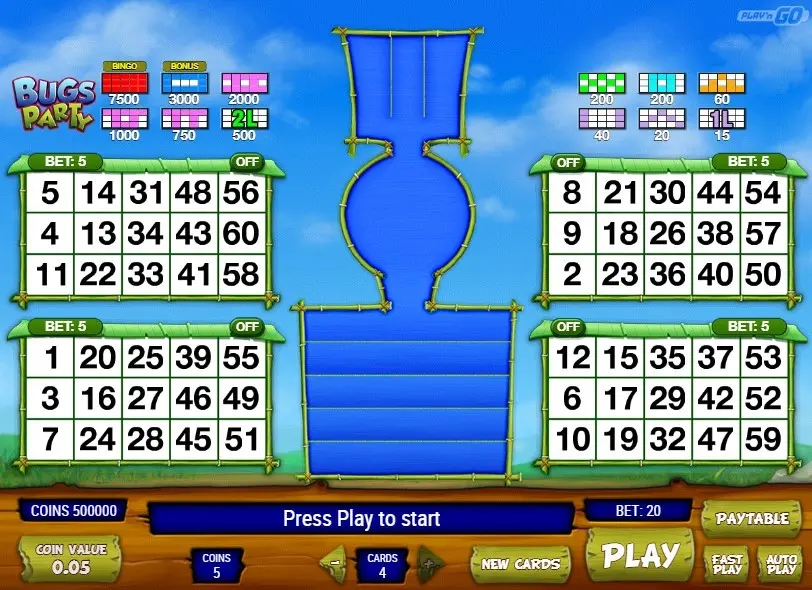
If you want a bingo room with a published return figure rather than a blank paytable, bugs party bingo is one of the more transparent options on this site. Play’n GO lists it at 96.0%, against a 94.41% average across the games covered here, and a free demo means you can see the room before you buy a ticket.
What follows is limited to what the operator actually publishes about this game, plus the maths that applies to every online bingo room. Where a detail has not been published, you will see that said plainly rather than guessed at.
| Detail | Value |
|---|---|
| Game name | Bugs Party Bingo |
| Provider | Play’n GO |
| Published RTP | 96.0% |
| Theme | Nature |
| Category | Bingo |
| Free demo | Available |
How Bugs Party plays
Online bingo is a shared draw, not a personal spin. Numbers are called at random from the room’s pool, and every ticket in play is marked against exactly that same sequence of calls. Your result depends on which numbers your ticket happens to hold before the draw begins, and on whether someone else’s ticket completes the winning pattern first.
That makes bingo structurally different from a slot. A slot pays you against a weighted reel set, and your spin is yours alone. In bingo the calls are public property, so the question is never “did my spin land” but “did my ticket cover more of this particular draw than the other tickets in the room”.
Play’n GO has not published the ticket price, the number of cards you can hold per round, the prize-tier breakdown or the call speed for this room in the data available here. Those are the levers that decide how a session actually feels, so open the game’s own rules and paytable screen before you buy in. On a nature theme like this one you can reasonably expect insect artwork and colour rather than a traditional hall look, but nothing beyond the theme label is confirmed.
Play’n GO and this room
Play’n GO has six bingo titles listed on this site, with an average published return of 96.31% across them, so this room sits fractionally below the studio’s own average and comfortably above the wider field. Six titles is a focused catalogue rather than a sprawling one, which usually means the interface and rules screens carry over between games.
The nearest comparison inside that catalogue is Rainforest Magic Bingo, which shares the nature theme but has no published RTP, so this room is the better-documented of the two. If you want another Play’n GO room with a confirmed figure to sit beside this one, Flying Pigs also lists 96.0%. Sweet Alchemy Bingo is the studio’s sweet-shop take on the same format if you would rather change the visuals than the numbers.
This title is also the most-played bingo game in the listings here, which tells you about traffic and room population rather than about your odds. A busier room means draws fill and resolve faster; it does not change what any single ticket is worth.
Reading the 96.0% figure
In bingo, a return figure means something narrower than it does on a slot. It describes the share of total ticket sales the operator pays back out as prizes across the room, over a very long run of games. It is not a per-round return and it is not a forecast for your session.
The practical read: on 96.0%, roughly four pence of every pound staked across the room stays with the house over time, with the remaining ninety-six pence redistributed to whoever’s tickets complete the patterns. Because prizes in bingo come out of a pool built from ticket sales, the amount on offer in any given round moves with how many tickets sold, not with how long the room has gone without a winner. No number, ticket or room is ever “due”.
Against the 94.41% average across the games listed here, 96.0% is a genuinely better headline than most. That is a comparison of published figures, not a promise about outcomes.
90-ball, 75-ball or speed: what the format changes
The format decides how many ways a round can pay and how long it lasts, and the data available for this game does not state which one applies. The room’s own rules screen will say, and it is the first thing worth checking.
As a guide to what you might find: 90-ball games run three prize tiers inside a single round, one line, two lines and full house, so a round has several resolution points. 75-ball games use patterns on a 5×5 grid and often let you pick your own cards, which changes the feel without changing the maths. Speed and 30-ball formats strip it back to a single full-house win on a smaller card, so rounds resolve quickly and stake turnover per hour climbs. That last point matters more than it sounds: a faster format applies the same house edge more times per hour.
Does skill matter here? An honest answer
No. In standard auto-daub online bingo your involvement ends when the ticket is bought. The software marks numbers for you, the calls are random, and the winner is whoever’s pre-purchased numbers happen to line up first. There is no decision available that improves your expected return.
Choosing your own cards, where a format allows it, does not help either. Every number in the pool is equally likely on every call, so one selection of numbers has the same expected value as another. It can make the round more engaging, which is a legitimate reason to do it, but it is not an edge.
Buying more tickets is the point people most often get wrong. More tickets cover more of the possible outcomes, so you are more likely to be the player who wins this particular round. Your expected value per pound staked does not move at all, because each extra ticket carries the same house edge as the first. More tickets is more exposure, not better value.
Free play before real money
A Bugs Party free demo is available, so you can watch the calls, the card layout, the prize tiers and the pace at no cost. That is the cheapest way to find the details the published data leaves out, and to decide whether the round length suits you before money is involved. Demo results are generated the same way as real ones but they predict nothing about a paid session.
Bingo is entertainment you pay for, not income. Set a budget before you open the room, treat it as spent the moment you buy in, and stop at that number whether the session went well or badly. Play only if you are 18 or over.
Final take on Bugs Party
The case for this room is the published 96.0% return and the fact that it is documented at all, which is not the norm in bingo. It is Play’n GO’s most-played bingo title here and it sits close to the studio’s 96.31% average.
The gaps are real, though. Ticket price, card limits, prize tiers, call speed and format are not published in the data available, so you cannot judge the cost per round or the session length before you look at the game itself. Load the demo, read the paytable, and you will know within a few rounds whether it fits. If you want the same theme in another room, Rainforest Magic Bingo is the alternative, though it publishes no return figure at all.
Frequently Asked Questions
Can I play Bugs Party Bingo for free?
Yes, a free demo is available for this Play'n GO room, so you can watch the draw, the card layout and the pace without staking anything. It is the practical way to find the details the published data omits, such as ticket price and format. Demo rounds do not predict real-money results.
What does the 96.0% RTP mean in a bingo game?
It means roughly 96 pence of every pound staked across the room is redistributed as prizes over a very long run, with about four pence retained by the house. In bingo that share comes from the prize-pool structure rather than weighted reels, so read it as a room-wide long-term figure, not a per-round return.
Does choosing my cards improve my odds in Bugs Party Bingo?
No. Every number in the pool is equally likely on each call, so one set of numbers has the same expected value as any other. In standard auto-daub online bingo the software marks for you and the outcome is fixed by the random draw, meaning skill has no effect on your return.
Who makes Bugs Party Bingo?
Play'n GO, which has six bingo titles listed on this site with an average published return of 96.31%. This nature-themed room lists 96.0%, slightly below the studio average but above the 94.41% average across all games covered here. It is also the most-played bingo title in these listings.
How does it compare to Rainforest Magic Bingo?
Both are Play'n GO rooms on a nature theme, but this one publishes a 96.0% return while Rainforest Magic Bingo has no published RTP figure available here. If a documented payout percentage matters to your decision, Bugs Party is the better-evidenced of the two nature bingo games.