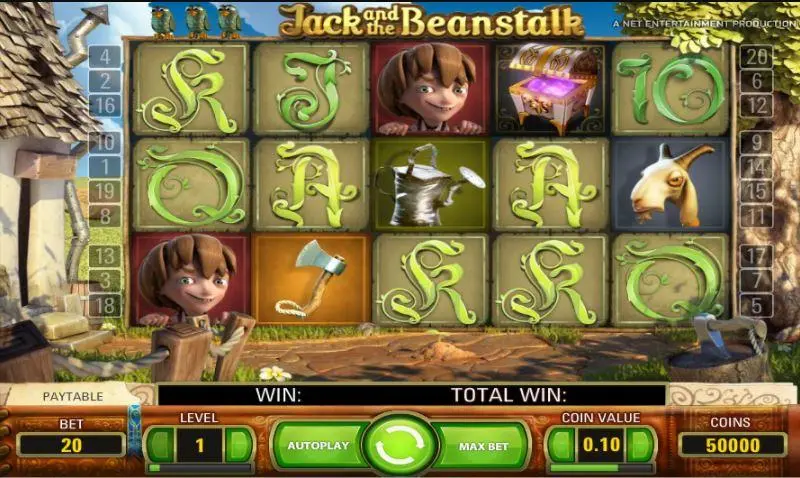
Jack And The Beanstalk comes from NetEnt with a 5-reel build and a Fairy tales tag, sitting at rank 2495 in a large catalogue where visibility is competitive. No RTP has been published for this specific title in the facts supplied, and no volatility, paylines or max-win figure is listed, which limits how precisely you can model session risk. That absence matters: you can still try the jack and the beanstalk slot in its free demo to see pace and structure without staking, but you should plan bankroll as if variance is unknown.
| Item | Detail |
|---|---|
| Game name | Jack And The Beanstalk |
| Provider | NetEnt |
| Reels | 5 |
| Themes | Fairy tales, 5-Reels |
| Provider titles in catalogue | 191 |
| Provider average RTP | 96.1% |
| Corpus average RTP | 95.71% |
| Catalogue rank | 2495 |
| Popularity percentile | 87.5% |
| Free demo available | Yes |
Who makes Jack And The Beanstalk
NetEnt is the provider credited for Jack And The Beanstalk, a studio with 191 titles in this catalogue and a long record in the 5-reel video slot space. That scale matters when you compare games, because a large footprint lets you check a provider’s house average against the wider market and against a specific title. Here the provider average is 96.1% across those 191 games, while the corpus average across all providers in the same catalogue is 95.71%.
A provider of this size typically covers many mechanics and themes, but the facts for this title do not list a paytable, symbol set, reel modifiers, or a bonus structure, so there is no verified feature detail to attribute to NetEnt for this game. The primary theme is Fairy tales, with a secondary tag of 5-Reels, which tells you the reel count and the broad narrative bucket without adding visual detail that is not in the data. In practice, that means you can anchor expectations to NetEnt’s overall RTP level and to the general idea of a 5-reel layout, then use the demo to see how this particular implementation behaves.
Catalogue context also helps. With 191 NetEnt entries to choose from, the studio’s output is not a handful of outliers but a distribution you can benchmark. If you want a like-for-like sense of what NetEnt tends to deliver on RTP, the provider average of 96.1% is the cleanest single number, and the comparison point of 95.71% for the whole corpus shows that average sits a little above the market centre in this dataset. Neither figure tells you how this one game pays, but together they frame the provider’s usual slot maths. For players who filter by studio first, that framing is often more useful than a vague claim about quality.
Where Jack And The Beanstalk sits in the NetEnt catalogue
At rank 2495 with a popularity percentile of 87.5%, Jack And The Beanstalk sits in the upper slice of a large catalogue where many titles compete for attention. Percentile here is a distribution marker: a game at 87.5% is more visible or more often surfaced than 87.5% of the corpus, which suggests steady interest rather than a niche placement. Rank alone does not explain why a title is popular, and the facts do not include hit frequency, volatility or bonus detail that might drive that rank, so treat the figure as a placement indicator, not a quality score.
To put the catalogue position in context, it helps to look sideways at other NetEnt titles in the same dataset. Starburst is listed with an RTP of 96.1% and sits as a long-standing reference point for the provider, matching the house average exactly. Framing Jack And The Beanstalk against that title shows what a published 96.1% looks like in practice and underlines what is missing here: Starburst gives you a number you can do maths with, while this game does not.
Another peer is Pirates Party at 96.17%, a touch above the NetEnt mean, and Gonzo’s Quest at 96.0%, a touch below it. The spread is narrow, which is typical of a mature provider where most titles cluster near the average, but you cannot assume Jack And The Beanstalk lands in that cluster without a published figure. The practical takeaway is simple: use rank and percentile to gauge visibility, use the provider average to understand the studio’s centre of gravity, and keep this game’s own RTP marked as unknown until NetEnt publishes it.
RTP: Not published against a 96.1% house average
The facts supplied do not include an RTP for Jack And The Beanstalk, so there is no verified percentage to quote, compare or plug into a loss-per-hour estimate for this title. That is not a small gap. RTP is the long-run statistical average returned to players across a very large number of spins, and every concrete statement about expected return depends on having that number. Without it, you cannot say this game returns £96 per £100 wagered or any other figure, because the calculation needs an anchor that is not provided.
What you can do is frame the gap. The provider average for NetEnt is 96.1% across 191 titles, and the corpus average is 95.71%. If a game were exactly at the provider mean, the maths would be straightforward: £100 wagered would average £96.10 returned over a very large sample, with the house edge at 3.9%. Over 1,000 spins at £1 a spin, that long-run average implies £1,000 staked and about £961 returned, a £39 theoretical loss, though actual sessions vary widely. Over 10,000 spins the same 96.1% still applies as the expected value, but short-run results swing around it, and each spin remains independent. Those illustrations stand as general RTP maths, not as claims about this game, because this game’s number is missing.
Missing data is itself information. Some market listings quote an RTP for Jack And The Beanstalk elsewhere, but the dataset used for this review does not verify one, so this page treats it as unpublished and avoids repeating an unverified figure. That protects you from planning a session around a number that may refer to a different configuration or jurisdiction. If NetEnt or a regulated info screen later shows a certified figure for the version you are playing, use that screen value for any precise budgeting. Until then, keep expectations tied to the known averages around the game, not to an assumed value for the game itself.
Volatility and who it suits
Volatility is not listed for Jack And The Beanstalk in the facts, so there is no low, medium or high label to apply here. In general terms, volatility describes how a slot distributes returns over time, not whether it returns more overall. Low volatility tends to mean more frequent but smaller results, longer stretches of play on the same bankroll, and smaller bankroll swings. High volatility tends to mean longer dry spells punctuated by larger swing sizes, which shortens typical sessions on a fixed budget and requires a larger bankroll for the same number of spins. Medium sits between the two on frequency and swing size.
Because the label is absent for this title, you cannot sort it into one of those buckets with confidence. A common error is to infer volatility from theme, rank, or provider alone, but those signals do not map cleanly to maths. Two games from the same studio with the same theme can sit at opposite ends of the volatility range, and popularity rank reflects visibility rather than variance. The only reliable source for a volatility rating is a regulator-approved info screen or a provider sheet that states it explicitly, and neither is included in the facts here.
For session planning without a stated volatility, the cautious approach is to assume variance could be meaningful and size stakes so you can absorb swings. Stake range is also not listed for this game, so you cannot calculate spins-per-budget from a verified minimum and maximum. In general, your number of spins on a fixed budget is budget divided by stake per spin, and your session length in minutes is that spin count divided by spins per minute, but the inputs for this title must come from the version you open, not from this review. Every spin is independent, so no pattern of bet sizes or timing changes the expected value; it only changes how quickly you reach your time or loss limit.
Playing Jack And The Beanstalk slot for free
The facts mark free demo as available, listed as free demo available: Yes, which means you can open the game and play Jack And The Beanstalk free without staking. For a title with unpublished RTP, volatility and stake range, that demo is more than a preview; it is the cleanest way to confirm the reel layout, the pace of play, the way wins are presented, and the minimum and maximum stakes shown on the controls of the version you will actually launch. Use the demo to check the info or help screen for any RTP or volatility statement that applies to that build, and to see how quickly your demo balance moves at the stake you would use in real play.
Demo play does not predict real-money results, and RTP, where published, describes a long-run average rather than what a short session will do. Treat any free session as a way to learn the interface and to decide whether the tempo suits you, not as evidence that real play will behave the same way over 50 or 100 spins. If you later play with real money, keep it bounded and deliberate.
Set a budget before you start, use deposit or time limits where available, and treat the spend as paid entertainment rather than a way to make money. You must be 18+ to play, and every spin is independent, so no system of stake changes makes a game more likely to pay. If you notice you are chasing losses or playing longer than planned, step away and use the responsible-gambling tools offered by your platform or a support organisation in your jurisdiction.
Similar picks
If you like the Fairy tales bucket but want a published number to anchor the maths, the related theme set gives you options that are easier to model. Rainbow Riches is listed at 95.0% RTP, which sits below both the NetEnt average of 96.1% and the corpus average of 95.71%. In long-run terms that is £95.00 returned per £100 wagered, a 5.0% house edge on average, again with wide short-run variance. It is a useful contrast to a game with no published figure, because it shows how a lower RTP shifts expected value while saying nothing about session feel on its own.
Two closer-to-average picks in the same theme group are Golden Goddess at 96.0% and Nuke World also at 96.0%. Both sit a tenth of a point below the NetEnt mean and a little above the corpus mean, which puts them in the middle of the distribution rather than at an extreme. Comparing a known 96.0% to Jack And The Beanstalk’s unpublished figure keeps you honest: you can discuss what 96.0% means mathematically without projecting it onto the Fairy tales title you are evaluating.
The broader lesson from the theme count is scope. With 183 games tagged Fairy tales in this catalogue, the category is large enough that you can filter by verified figures first. If a published RTP is important to your selection process, prioritise titles that show it on a regulated info screen and use the demo to confirm the version matches the figure. If you prefer to stay with NetEnt specifically, the provider peers noted earlier give you the same anchor on RTP while keeping the studio constant. Either route gives you numbers you can calculate with, while Jack And The Beanstalk remains in the try-before-you-commit bucket until its own maths is verified.
Verdict
Jack And The Beanstalk is a 5-reel Fairy tales slot from NetEnt that is visible in the catalogue, with an 87.5% popularity percentile and rank 2495, and with free demo available so you can inspect the version you would actually play. Those are the solid, verifiable points. The gaps are equally clear: no RTP is published in the facts for this title, no volatility is stated, no stake range is listed, and no feature or max-win detail is provided, so you cannot build a precise risk model from this page alone.
That profile suits a cautious approach. Open the demo, read the in-game help or info pages for the certified figures that apply to that build, and note the minimum and maximum stakes as they appear on the controls. If the demo tempo and presentation appeal to you and the info screen later confirms an RTP and volatility that fit your budget, you have a basis for a planned session. If those numbers remain absent or you want to calculate expected value now, choose a peer with a published figure and revisit this one once its maths is documented. With the current data, the fair summary is that this is a well-placed NetEnt fairy-tale reel set with verified demo access but with key maths still to be confirmed.
More from NetEnt
- Pirates Party — 96.17% RTP
- Berryburst — 96.56% RTP
- Twin Spin — 96.6% RTP
- Twin Spin Megaways — 96.04% RTP
Frequently Asked Questions
Can I play Jack And The Beanstalk for free without downloading it?
The dataset marks free demo as available, so you can try Jack And The Beanstalk free in your browser where the demo is offered. The demo loads the same 5-reel layout and controls, letting you check pace and the info screen. Demo credits have no cash value and results do not predict real-money outcomes, since every spin is independent.
What is the RTP of Jack And The Beanstalk and what does it mean?
No RTP is published for Jack And The Beanstalk in the facts used here, so this review does not quote a figure. In general, RTP is a long-run average, so a 96% game would average £96 returned per £100 wagered over a very large sample. For this title, check the regulated info screen in the version you open for any certified number.
What is the volatility of Jack And The Beanstalk and how does it affect risk?
Volatility is not listed for Jack And The Beanstalk, so this review does not assign low, medium or high. As a concept, high volatility tends to bring longer flat stretches and larger swings, while low volatility tends to bring more frequent, smaller results. Without a stated rating, size stakes to absorb variance and confirm details on the in-game help page.
Who makes Jack And The Beanstalk and what else does the provider offer?
Jack And The Beanstalk is by NetEnt, credited with 191 titles in this catalogue and a provider average RTP of 96.1%. Related NetEnt games in the data include Starburst at 96.1% and Gonzo's Quest at 96.0%, which show where that average sits. The studio's catalogue spans many themes, including the Fairy tales tag used here across 183 titles.
How does Jack And The Beanstalk compare to Rainbow Riches?
Jack And The Beanstalk has no published RTP in this dataset and sits in the Fairy tales theme group, while Rainbow Riches is listed at 95.0% RTP in the same theme set. That 95.0% is below the NetEnt average of 96.1% and below the corpus average of 95.71%, which affects long-run expected value. Use the demo to compare presentation, since rank and theme alone do not determine volatility.