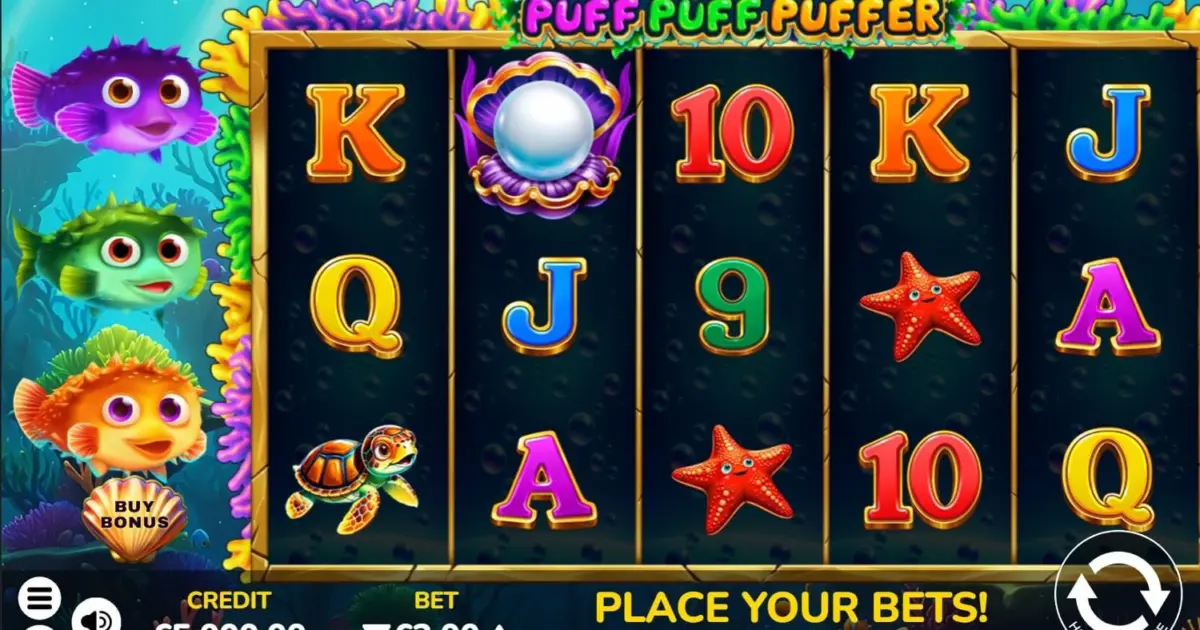
Puff Puff Puffer is an Ocean and sea slot from Atomic Slot Lab that strips the decision back to one number: a 95.98% RTP on a 5-reel layout. If you are comparing games before you commit bankroll, that figure and the fact you can try the puff puff puffer slot as a free demo tell you most of what matters for a first session. There is no published volatility or stake range to refine the maths further, so this review sticks to what the numbers actually imply for session length and variance.
First look at Puff Puff Puffer
Puff Puff Puffer comes from Atomic Slot Lab, a studio with 41 titles in the corpus used for this site. Its primary theme is Ocean and sea, tagged also with 5-Reels and Fishing, so it draws on ocean and sea imagery without the review needing to invent specific characters or animations. The reel count is confirmed at 5, and the sub-category is Slot Machine.
On popularity, it sits at rank 2455 with a popularity percentile of 87.7. That percentile means it is more searched and viewed than 87.7% of the catalogue, which is useful context: you will find it discussed often, but rank alone tells you nothing about how it pays.
For players skimming, the actionable facts are short. Atomic Slot Lab has published an RTP of 95.98% for this title. A free demo is available, which lets you see the reel layout and pacing without wagering. What has not been published is equally important: payline count, ways count, volatility rating, hit frequency, max win and stake limits are absent from FACTS, so any site quoting them for this specific game is filling gaps. The honest approach is to evaluate the game on the verified figures and treat missing data as a prompt to be more cautious with bankroll until you have observed variance yourself in demo play, remembering demo outcomes do not predict real-money results.
How a round plays out
With only the reel count verified, this section stays general about mechanics and flags what cannot be confirmed for Puff Puff Puffer. Five reels is the standard video-slot grid, and it typically spins left to right with wins assessed on defined paylines or on a ways system where matching symbols on consecutive reels count. FACTS lists neither a payline number nor a ways count for this title, so neither can be stated.
Many slots do include symbols such as wilds that substitute for other symbols and scatters that trigger features elsewhere on the grid. Some titles add free spins, pick bonuses, expanding symbols or buy-feature options. None of those features are listed in FACTS for Puff Puff Puffer, so they cannot be described as present or absent here. If a round does include a bonus, its design would affect hit frequency and volatility, but without published hit frequency you cannot calculate how often any win should appear.
What you can take from the confirmed 5-reel tag is pacing. Five reels usually means a familiar spin rhythm and a clear paytable structure once you open the in-game help screens. When you load the Puff Puff Puffer free demo, check the paytable for the actual line structure, symbol values and any feature rules. That in-game information, plus the 95.98% RTP, is the only reliable basis for judging how a round plays out. Every spin is independent, and previous results do not change the odds of the next spin.
Reading the 95.98% return figure: puff puff puffer slot
RTP is a long-run average, not a promise for a session. A 95.98% RTP means that for every £100 wagered in total across a very large number of spins, the game is designed to return £98 on average? No, £95.98 on average, with the remaining £4.02 representing the house edge over that huge sample. The calculation is total returned divided by total wagered, measured in millions of spins, not what you should expect in 50 or 500 spins.
To make the figure concrete: if you wagered £1 per spin for 1,000 spins, you will have staked £1,000. The theoretical return across that sample would be £959.80, for a theoretical loss of £40.20. In practice, any single block of 1,000 spins will land above or below that line because of variance. Short samples swing widely; long samples converge slowly toward the theoretical figure.
Context helps. The corpus average RTP on this site is 95.71%, so Puff Puff Puffer at 95.98% sits 0.27 percentage points above the site average. Against its own provider, Atomic Slot Lab averages 95.51% across 41 games, so this title is 0.47 points above the Atomic Slot Lab average. Those are small edges in mathematical terms, about £2.70 extra return per £1,000 staked versus the corpus average, and about £4.70 versus the provider average. It does not make the game low-risk; it simply means the long-run cost per spin is marginally lower than those averages, before variance is considered.
| Item | Figure |
|---|---|
| Provider | Atomic Slot Lab (41 games) |
| RTP | 95.98% |
| Reels | 5 |
| Primary theme | Ocean and sea |
| Other tags | 5-Reels, Fishing |
| Popularity rank / percentile | 2455 / 87.7th |
| Free demo available | Yes |
| Provider average RTP | 95.51% |
| Corpus average RTP | 95.71% |
Why volatility changes your bankroll maths
FACTS does not list a volatility rating for Puff Puff Puffer, so this section explains why that absence matters rather than assigning one. Volatility describes how returns are distributed. Low volatility generally means smaller, more frequent wins and longer sessions on a fixed bankroll. High volatility generally means longer dry spells punctuated by larger swings. Medium volatility sits between.
Without a published rating, you cannot estimate session length or required bankroll from a label. You also cannot infer hit frequency, because hit frequency and volatility are not published together here. The practical implication is to plan more conservatively until you have observed the game. If you try the demo, note how often any win lands and how far your balance drifts from the starting point over 200 to 300 spins, but remember that even 300 spins is a tiny sample and demo variance does not predict real-money variance.
Volatility also interacts with RTP. Two games can share a 95.98% RTP yet feel completely different: one may keep you close to the theoretical line with small deviations, another may swing £50 or £100 away from the line in the same number of £1 spins. Because that distribution is unknown here, the safest bankroll maths is to assume you could see a high-variance pattern and size your budget so that a run of non-winning spins does not force you to chase. No betting pattern, stake progression or timing changes the house edge; each spin remains independent.
Bet sizing from minimum stake upwards
No minimum stake, maximum stake or default coin range is published in FACTS for Puff Puff Puffer. That limits what can be said specifically, and it is better to state the gap than to guess. Stake range determines how many spins a fixed budget buys and therefore how much variance you can absorb.
In general terms, the maths is straightforward. Divide your session budget by your stake per spin to get spin count. A £50 budget at £0.20 per spin buys 250 spins; at £0.50 it buys 100 spins; at £1.00 it buys 50 spins. More spins smooths short-term variance a little and gives you more time to see how the game behaves, while fewer spins increases the chance that a normal dry spell ends the session early. This is true regardless of RTP, because RTP does not control the shape of individual sessions.
Until the published stake limits appear in the in-game help or from Atomic Slot Lab directly, treat any numbers quoted elsewhere with caution. When you open the free demo or the real-money lobby, confirm the actual minimum and maximum and check whether the game allows you to adjust bet size per spin or per line, if lines are used. Choose a stake that lets you complete the number of spins you planned for entertainment without needing to increase bets to recover losses.
Where Puff Puff Puffer sits among Ocean and sea slots
The Ocean and sea theme is crowded, with 527 titles in this corpus sharing the tag. That gives you plenty of direct comparisons on the one figure that is reliably published: RTP.
Puff Puff Puffer at 95.98% sits below several well-known peers in the same waters. Big Bass Bonanza is listed at 96.71% and fishes the same thematic pool with a 0.73 point higher long-run return, which is about £7.30 more per £1,000 staked in theory. Bigger Bass Bonanza matches that 96.71% figure, so the comparison holds for that sequel as well. Pearls of Aphrodite at 96.81% sits 0.83 points above Puff Puff Puffer, roughly £8.30 per £1,000 staked. These differences are small per spin but they compound over large samples, and they are the cleanest way to contrast Ocean and sea slots when volatility and max win are unpublished.
Within its own stable, Atomic Slot Lab averages 95.51%, so Puff Puff Puffer is the slightly higher-returning option among the provider’s catalogue. The provider-linked examples Almighty Pegasus at 95.49%, Divine Wine at 95.49% and 5 Amazon Jewels at 95.55% all sit 0.43 to 0.49 points below it. If you prefer to stay with the same studio while prioritising RTP, Puff Puff Puffer has the edge on paper among those names, though again variance will dominate any single session. For players browsing Ocean and sea slots as a group, use RTP as the first filter and then inspect each game’s paytable for the structure that suits your preference for session length.
The honest verdict
Puff Puff Puffer is worth a look if you want a 5-reel Ocean and sea game that is marginally ahead of both the site average and its provider average on RTP, and you value being able to trial it first through a free demo. The 95.98% figure is not an outlier, but it is a modest mathematical advantage over many alternatives in the same theme, equivalent to a few pounds per £1,000 staked in the long run.
The caveats are the missing specifics. No volatility rating, no published payline or ways count, no hit frequency and no max win figure means you cannot model session risk precisely from this page alone. You will need to open the game itself to confirm stake limits and paytable details, and you should expect normal slot variance where short sessions can deviate far from the theoretical return in either direction.
Play within a budget you set before you start and treat the session as paid entertainment, not a way to make money. Use deposit limits or session timers if they help you stay to that budget, take breaks, and stop if it stops being enjoyable. You must be 18+ to play. If you need support, consider a recognised responsible-gambling organisation in your jurisdiction. The demo is a useful way to see pacing without spending, provided you remember it cannot predict real-money outcomes.
Frequently Asked Questions
Can I play Puff Puff Puffer as a free demo without wagering real money?
Yes, free demo play is listed as available for Puff Puff Puffer, so you can load the game and spin with play credits. Demo mode shows the 5-reel pacing and paytable layout, but it does not pay real money and its results do not predict what would happen with real wagers.
What is the RTP of Puff Puff Puffer and what does 95.98% mean for my session?
The published RTP is 95.98%, meaning the game is designed to return £95.98 for every £100 wagered across millions of spins. For a 1,000-spin sample at £1 a spin, the theoretical return is £959.80. Any single session will vary widely around that average due to natural variance.
What volatility is Puff Puff Puffer and how does that affect risk?
No volatility rating is published in FACTS for Puff Puff Puffer, so it cannot be labelled low, medium or high here. Volatility affects how often wins land and how large the swings are. Without it, plan conservatively and confirm the in-game help, using demo play only to observe pacing.
Who makes Puff Puff Puffer and what else do they offer?
Atomic Slot Lab makes Puff Puff Puffer and has 41 games in this corpus, with an average provider RTP of 95.51%. Related titles from the same studio include Almighty Pegasus at 95.49%, Divine Wine at 95.49% and 5 Amazon Jewels at 95.55%, all slightly below this game's 95.98%.
How does Puff Puff Puffer compare to Big Bass Bonanza on return?
Puff Puff Puffer at 95.98% returns about 0.73 points less than Big Bass Bonanza at 96.71%, both Ocean and sea themed. Over £1,000 staked the theoretical difference is about £7.30. Big Bass Bonanza's higher RTP gives a slightly lower long-run cost per spin, though short-term variance dominates either game.