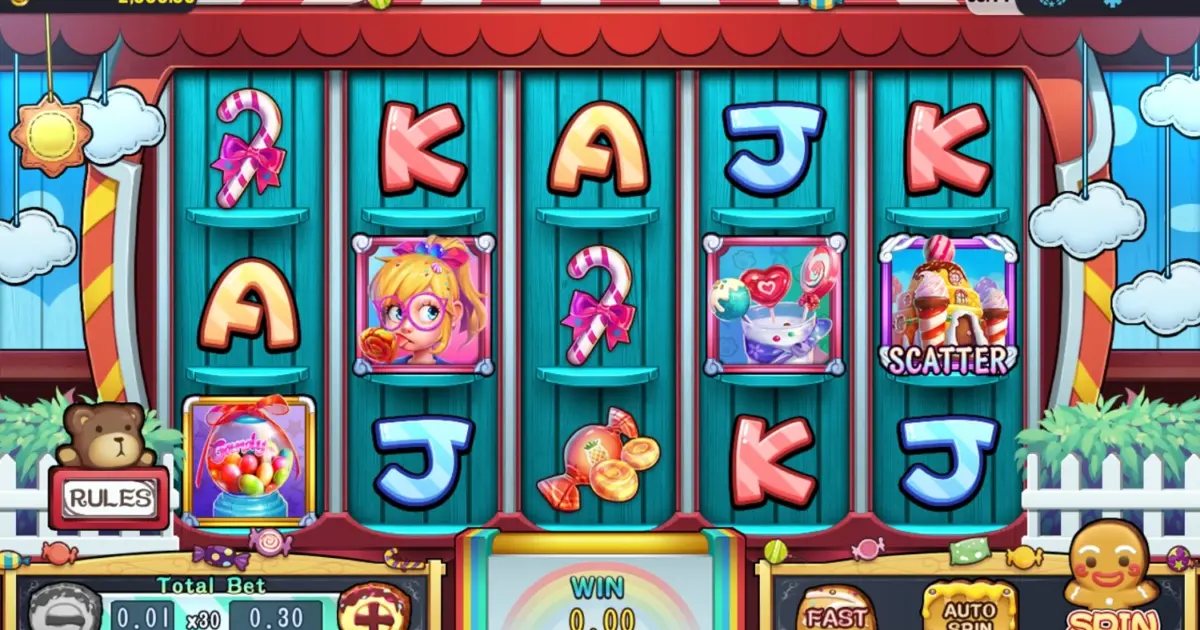
If you judge games by the number that actually matters over time, the candy house slot is worth a look: DreamTech has set its return to player at 96.86%, which sits 1.15 percentage points above the 95.71% average across the games catalogued here. It is a five-reel machine on a sweets theme, and it ranks 2,312nd by popularity, putting it in the top 11.6% of titles by traffic.
What DreamTech has not published is a volatility rating, a paytable breakdown, a hit frequency or a maximum win figure. That absence shapes how you should approach it, and it is the main reason the free demo matters here more than it would for a fully documented release.
Candy House versus the average slot
The clearest single comparison is rtp_vs_corpus: +1.15 percentage points against the corpus average of 95.71%. In plain money, a game returning 95.71% gives back £95.71 per £100 wagered across a very large sample, while 96.86% gives back £96.86. The gap is £1.15 per £100 staked.
That sounds small, and over one session it is invisible — short-run results are dominated by variance, not by the theoretical figure. Over volume it compounds. Wager £100 a week for a year and the expected cost difference between those two RTP levels is roughly £60. Nothing about that is a promise of profit: both numbers describe a house edge, 3.14% in this case. The edge is simply thinner than typical.
Compared with the broader 313-game sweets category and the 77 titles DreamTech has in the catalogue, that positioning is the strongest documented argument for this release. It is also, given how little else is published, close to the only one.
RTP breakdown: 96.86% in context
RTP is a long-run statistical average calculated across millions of simulated spins, not a per-session guarantee. At 96.86%, the theoretical return is £96.86 per £100 wagered — but that figure only asserts itself over sample sizes far larger than any human session. Across 1,000 spins at £1, expected total return is around £968.60, while the actual outcome could reasonably land hundreds of pounds either side of it.
Two things follow. First, every spin is independent: the result of one has no bearing on the next, and no sequence of losses makes a payout more likely. Second, no staking pattern, timing choice or bet progression changes the 3.14% edge. Betting bigger changes the size of the swings, not the percentage.
Here are the figures DreamTech and this catalogue do confirm:
| Field | Value |
|---|---|
| Game | Candy House |
| Provider | DreamTech |
| RTP | 96.86% |
| House edge | 3.14% |
| Reels | 5 |
| Theme | Sweets |
| Type | Slot machine |
| Popularity rank | 2,312 (88.4th percentile) |
| DreamTech average RTP | 96.9% |
| Catalogue average RTP | 95.71% |
| Free demo | Available |
Volatility profile
No volatility rating has been published for this game, so anyone quoting one is guessing. That matters, because volatility governs the shape of your session far more visibly than RTP does.
Low-volatility slots pay small amounts often. Balances drift rather than lurch, sessions last longer on a given budget, and the top prizes are modest. High-volatility slots do the reverse: long stretches with little back, punctuated by rarer and larger hits. Two games can share an identical 96.86% RTP and feel nothing alike — one steady, one brutal — because the return is distributed differently. Medium volatility sits between the two and is the most common design target.
With the figure unpublished, the practical substitute is observation. Play the demo for a few hundred spins at a fixed stake and watch the balance line: frequent small returns point towards the lower end, long dry runs broken by occasional spikes point towards the higher end. That is an impression, not a measurement, but it is better than assuming. If you need a documented risk profile before committing money, this is the field to treat as a gap.
DreamTech as a studio
DreamTech has 77 games in this catalogue, with an average RTP of 96.9% across them. That average is 1.19 points above the corpus figure, which suggests a studio that consistently configures returns above the market norm rather than one that happens to have a single generous release. This title’s 96.86% sits almost exactly on the studio’s own average — typical DreamTech, not an outlier.
Some of their other titles go higher. Crazy Alchemist is configured at 97.36%, half a percentage point above this game, which over volume is a real difference in expected cost. Ice and Fire sits at 97.28% and is the next step down from that. If pure return is your filter, both beat this release on paper.
What none of those numbers tell you is mechanics, pacing or how the sessions feel, because the studio has not published feature details for them either. RTP comparison is the reliable axis; everything else requires trying them.
Three Sweets alternatives worth comparing
The sweets category runs to 313 games, so there is no shortage of substitutes. Three are useful reference points.
- Sweet Bonanza returns 96.51%, a third of a point below this game. It is by far the best-known confectionery slot, which makes it the natural benchmark even though the RTP comparison slightly favours DreamTech’s title.
- Lollipop Drop MultiMax is set at 94.00% — 2.86 points below this game, or £2.86 more expected cost per £100 wagered. That is a meaningful gap, and worth knowing before you pick on theme alone.
- Sugar Land has no published RTP in this catalogue. An unlisted return is not automatically a bad one, but it means you cannot compare it on the only hard number available, so treat it as an unknown rather than an equal.
Ranked purely on documented return, this game beats two of those three and the third cannot be assessed. That is a solid, if narrow, result.
Getting the most out of the free demo
A Candy House free demo is available, which is the sensible starting point given how much is undocumented. Demo play runs on the same underlying maths, so it shows you the paytable, the symbol set, the feature triggers and the general rhythm of the game without costing anything. What it cannot do is predict real-money outcomes — results in one mode say nothing about results in another, and no number of demo spins shifts the odds of the next one.
Use it to answer specific questions. How often does something land? How deep do the quiet stretches run? Does the session length at your intended stake suit the budget you had in mind?
On that budget: this is 18+ entertainment, and the only stake that makes sense is one you have already decided you can lose. Set the figure before you start, treat it as the price of the evening, and stop at it. A 3.14% edge means the expected long-run direction is downward, however any single session goes.
Should you play the Candy House slot?
Play it if an above-average return is your priority and you are comfortable filling in the blanks yourself. 96.86% is a genuinely competitive figure, 1.15 points clear of the catalogue average and in line with DreamTech’s own 96.9% standard, and the 88.4th-percentile popularity ranking suggests enough players find it worth returning to.
Skip it, or at least demo it first, if you want to know your risk profile before staking. No volatility rating, no max win and no feature documentation means you are buying on one number and a theme label. For pure return, Crazy Alchemist at 97.36% is the stronger pick from the same studio; for a documented household name in the same theme, Sweet Bonanza at 96.51% costs slightly more per £100 but comes with far more published detail.
Verdict: a well-priced sweets slot with a thin evidence file. The maths holds up. Judge the rest in the demo.
Frequently Asked Questions
Can you play Candy House for free?
Free demo play is available for this title, running on the same mathematics as the paid version, including the 96.86% RTP. It lets you see the paytable, symbol set and general pacing at no cost. Demo results do not predict real-money outcomes, and demo play cannot pay out real money.
What is the RTP of Candy House and is it good?
The RTP is 96.86%, meaning a theoretical return of £96.86 per £100 wagered across a very large sample and a house edge of 3.14%. That is 1.15 percentage points above the 95.71% catalogue average, so it is competitive. Short sessions are governed by variance, not by that long-run figure.
Is Candy House high or low volatility?
DreamTech has not published a volatility rating for this game, so any figure quoted elsewhere is unverified. Volatility determines swing size and session length: low pays small and often, high pays rarely and larger. With no rating available, several hundred demo spins at a fixed stake is the practical way to gauge it.
Who is DreamTech and what other slots do they make?
DreamTech is the studio behind this release, with 77 games in this catalogue and an average RTP of 96.9% — well above the 95.71% corpus average. Higher-returning examples include Crazy Alchemist at 97.36% and Ice and Fire at 97.28%. Feature details for most of their library are not publicly documented.
How does Candy House compare to Sweet Bonanza?
On return, this game edges it: 96.86% against 96.51% for Sweet Bonanza, a gap of 0.35 percentage points or 35p per £100 wagered. Sweet Bonanza is the far better-known title with more published detail, while DreamTech's release offers the slightly thinner house edge and a largely undocumented feature set.